















How Woolly Mammoths Survived Arctic Cold

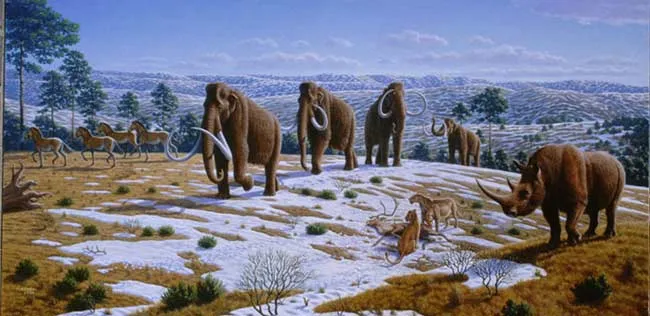
The lumbering, shaggy-haired woolly mammoth once thrived in the frigid Arctic plains despite having originally migrated from a more tropical climate. A new study has found tiny genetic mutations that changed the way oxygen was delivered by its blood could be responsible for its tolerance to the cold climate.
The woolly mammoth was an elephantid species and most closely related to today's Asian elephants. It went extinct around 10,000 years ago. But because the mammoth lived in the Arctic, many remains of the species have been found preserved in the permafrost.
Ancestors of both the mammoth and Asian elephant originated in Africa around 6.7 million to 7 million years ago and stayed for about 4 million years before moving up into Southern Europe and then farther up into what is now Siberia and the northern plains of Canada around a million years later.
At around the same time "a cataclysmic event occurred on Earth — the Ice Ages," said Kevin Campbell of the University of Manitoba in Winnipeg, Canada, who led the study into the ancient animal's blood, which is detailed in the May 2 online issue of the journal Nature Genetics.
Mammoths, like their elephant cousins of today, would have been adapted to the warm climate they evolved in. In these climates, an elephant's biggest problem is getting rid of heat -- they do this with their big ears, through which many heat-porting blood vessels circulate. They wave their ears around in the breeze to dissipate that heat.
That perennial elephant problem was reversed for the mammoths once the Ice Ages settled in and "a whole new environment was made" in the Arctic, which had also been warm up until that point in Earth’s history, Campbell said. Now mammoths had to hold in all the heat they could.
"We know that conserving heat became their number-one concern," Campbell told LiveScience.
Get the world’s most fascinating discoveries delivered straight to your inbox.
Mammoths adapted to their new, colder home partly by evolving a "thick, huge pelt," and down-sizing their ears compared with their warmer-dwelling relatives. "Their ears were tiny, like dinner plates," Campbell said, referring to the cold-adapted mammoths.
How other Arctic animals adapted
But Campbell suspected that the mammoths also could have had blood that was better adapted to work in the cold, like many Arctic mammals alive today do.
Other Arctic animals today, such as reindeer and musk-ox, have a "counter-current" blood system. Essentially the blood vessels taking the warm, oxygen-laden arterial blood down into the legs and feet pass very close to the veins carrying colder, venous blood back to be re-oxygenated. The close contact between the two types of vessels allows the arterial blood to pass its warmth on to the venous blood headed back to the heart and lungs. This evolutionary system keeps the warmth in the core of the animal's body and reduces heat loss due to the cold climate, while still allowing the arterial blood to take its oxygen to the extremities.
"It allows their feet and extremities to get really cold," Campbell said.
This is in contrast to humans, where blood flow simply shuts down in extreme cold to keep warmth in the core – that's why people get frostbite but reindeer don't.
But this counter-current system isn't enough by itself to keep Arctic animals functioning in the cold. The key involves hemoglobin, the blood protein that grabs oxygen in the lungs and delivers it to the other organs of the body. The blood protein essentially needs a certain amount of heat energy to power its release of the oxygen molecules it carries into the tissues and organs that need it.
When blood is cold "it's very unlikely that that threshold is going to be met," Campbell said.
To get around this problem, reindeer and many other Arctic mammals evolved a slightly tweaked form of hemoglobin that requires less energy input to deliver its oxygen.
Resurrecting an ancient molecule
Campbell wanted to see if mammoths were also able to evolve a specialized form of hemoglobin that would keep working at cold temperatures and allow them to conserve body heat.
There was just one problem: mammoths are extinct.
"We can't take a frozen blood sample," Campbell explained.
Instead, Campbell and his colleagues used genes extracted from mammoth remains to recreate and examine mammoth hemoglobin.
"We had to bring it back to life," Campbell said.
The team extracted DNA from a 43,000 year-old Siberian mammoth specimen and had the portion of it that holds the instructions for hemoglobin sequenced.
When Campbell saw the results he said could tell that "there were some changes that were very suggestive of physiological processes" that meant the mammoths did indeed evolve a specialized cold-adapted form of hemoglobin.
The changes amounted to just 1 percent of gene region that contained the instructions for hemoglobin, "but one of those changes is profound," Campbell said. That change "is going to make them adapted to cold."
To find out if these gene changes actually produced a different type of hemoglobin, the team used a method that has been used to make human hemoglobin. The method involves putting the specific genes into E. coli, which will read the human, or mammoth, DNA like its own DNA and produce the substance in question.
But mammoth DNA samples retrieved from frozen specimens are very damaged, so Campbell and his team first turned to the mammoth's closest living cousin. They got the DNA and RNA (the stuff that holds the instructions for proteins in cells) from a living Asian elephant and put them into E. coli.
And sure enough, "these E. coli made Asian elephant hemoglobin," Campbell said.
Once the Asian elephant hemoglobin checked out, the team could try mammoth hemoglobin. To do this, they used Asian elephant RNA and a process called site-directed mutagenesis, which involves changing all the individual points in the RNA code that are different between the Asian elephant and the mammoth, effectively turning Asian elephant RNA into mammoth RNA. The newly made mammoth RNA is put in the E. coli, which spits it out what is essentially mammoth hemoglobin.
Campbell said this hemoglobin would be exactly the same as if he had taken a time machine back 43,000 years and drawn blood straight from the animal. "I can study it as if I had a fresh blood sample from that animal," he said.
The team compared the Asian elephant and mammoth hemoglobin and "we found that they're radically different," Campbell said. Just as Campbell had suspected, the mammoth hemoglobin doesn't need as much energy to offload oxygen as the Asian elephant hemoglobin does.
Interestingly, the mammoth DNA had two separate mutations that are different from those seen in mammals today.
"They used a completely different" way to solve the hemoglobin problem to adapt to the cold, Campbell said.
Why not humans?
Campbell first thought of examining mammoth hemoglobin DNA in this way when he was studying hemoglobin during a postdoctoral posting in Denmark and also happened to see a Discovery Channel show on the mammoth, and "it was this little lightbulb moment," he said.
Campbell said that one question he has frequently been asked is why human populations that live in the Arctic regions, such as the Inuit, wouldn't have evolved a similar mechanism to adapt to the cold.
The answer is three-fold: For one, humans moved to the Arctic much more recently than many other Arctic mammals, so they wouldn't have had time to evolve such a trait; also, humans don't need to evolve cold-tolerant hemoglobin, because "we make boots; we make tents" – we have our brains to help us deal with the cold, Campbell said; finally some humans do have a mutation of their hemoglobin similar to this, but it is actually detrimental, because their hemoglobin falls apart and they end up anemic.
"Humans could never even evolve this because if they did they would all be anemic," Campbell said.
Campbell said that he would like to expand on this work by trying to investigate other extinct beasts that lived in the ancient Arctic, such as mastodons, cave bears, woolly rhinoceroses and giant sloths.
- Images: The World's Biggest Beasts
- 10 Amazing Things You Didn’t Know About Animals
- 10 Species You Can Kiss Goodbye

Andrea Thompson is an associate editor at Scientific American, where she covers sustainability, energy and the environment. Prior to that, she was a senior writer covering climate science at Climate Central and a reporter and editor at Live Science, where she primarily covered Earth science and the environment. She holds a graduate degree in science health and environmental reporting from New York University, as well as a bachelor of science and and masters of science in atmospheric chemistry from the Georgia Institute of Technology.