













Extinction of Giant Mammals Changed Landscape Dramatically
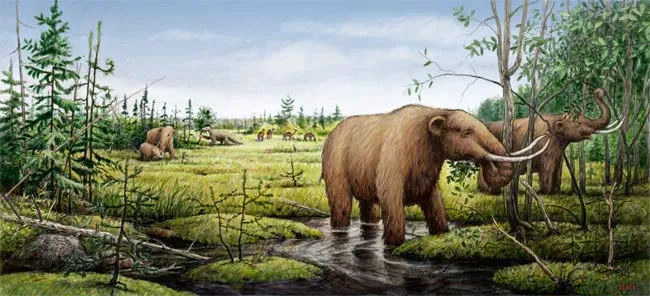
The last breaths of mammoths and mastodons some 13,000 years ago have garnered plenty of research and just as much debate. What killed these large beasts in a relative instant of geologic time?
A question asked less often: What happened when they disappeared?
A new study, based partly on dung fungus, provides some answers to both questions. The upshot: The landscape changed dramatically.
"As soon as herbivores drop off the landscape, we see different plant communities," said lead researcher Jacquelyn Gill of the University of Wisconsin, Madison, adding the result was an "ecosystem upheaval."
Gill and her colleagues found that once emptied of a diversity of large animals equaling or surpassing that of Africa's Serengeti, the landscape completely changed. Trees once kept in check by the mammoth gang popped up and so did wildfires sparked by the woody debris.
The results, which are detailed in the Nov. 20 issue of the journal Science, could paint a picture of what's to come if today's giant plant-eaters, such as elephants, disappear.
"We know some of these large animals are among the most threatened that we have on the landscape today and they have a lot of large habitat requirements and they eat a lot of food," Gill told LiveScience. "If these animals go extinct we can expect the landscape will respond."
Get the world’s most fascinating discoveries delivered straight to your inbox.
Dung fungus
Gill and her colleagues analyzed sediment samples collected from Appleman Lake in Indiana as well as data from sites in New York.
They focused on a dung fungus called Sporormiella that must pass through a mammal's gut to complete its life cycle and reproduce via spores. More of such spores indicate more dung and more megafauna around to contribute to the fecal contents. Within that same sediment, the team looked at pollen and charcoal as proxies for vegetation and fires, respectively.
Sediment layers accumulate over time and can indicate when the stuff embedded in it was around. By matching up the dung spores along with vegetation and fire indicators in certain layers, the researchers figured the large herbivores were already declining before the vegetation started changing or wildfires took off.
The changes in spore abundance suggest the megafauna began to decline some time between 14,800 and 13,700 years ago. By 13,500 years ago, the decline was in full force, Gill said.
Rather than getting vaporized in an instant, the results suggest the animals gradually dwindled for about 1,000 years.
Here's how it may have gone down: The large herbivores started to decline. Without such leafy eaters to keep broad-leaved species in check, trees such as black ash and elm took over a landscape once dominated by conifers. Soon after, the accumulation of woody debris sparked an increase in wildfires, another key shaper of landscapes, the researchers say.
What killed the mammoths?
As for what drove the beasts into their graves, Gill says the findings don't put the nail in the coffin, but do rule out some ideas. To explain the extinction, scientists have put forth climate change, hunting by humans such as the Clovis people (known for using advanced spear tips), and even impact by a comet. The answer could be a combination of several factors, scientists say.
Gill says this new study is a strong one because all of the evidence comes from one place, and so the researchers aren't making comparisons across different regions whose sediments may be off in terms of timing.
If the timing is accurate, as Gill says it should be, the findings can rule out the idea of a meteor or comet killing off the creatures some 13,000 years ago.
And since the plant community didn't change until after the big guys began to decline, that's a mark against climate change. (A warming climate was considered the cause of a revamping of vegetation, and thus animal habitat.)
"At this site, we can say that habitat loss didn't cause the decline, because the major habitat shift happens after the collapse [of the megafauna]," Gill said. "And habitat change is a big line of argument in the climate camp. If climate change is causing these extinctions, you'll have to evoke another process than habitat loss."
Hunting, at least that by the Clovis people, can also be ruled out at the site.
"It seems as though the animals were already in decline by the time [Clovis] people adopted this tool kit," Gill said, referring to the advanced spear tips thought to be more efficient at taking down large prey than hunting instruments used by humans prior to the Clovis.
The new study was funded by the Wisconsin Alumni Research Foundation, the UW-Madison Center for Climatic Research in the Nelson Institute for Environmental Studies, and the National Science Foundation.
- Images: The World's Biggests Beasts
- Mammoth News, Information & Images
- Greatest Mysteries: What Caused Mass Extinctions?
Jeanna Bryner is managing editor of Scientific American. Previously she was editor in chief of Live Science and, prior to that, an editor at Scholastic's Science World magazine. Bryner has an English degree from Salisbury University, a master's degree in biogeochemistry and environmental sciences from the University of Maryland and a graduate science journalism degree from New York University. She has worked as a biologist in Florida, where she monitored wetlands and did field surveys for endangered species, including the gorgeous Florida Scrub Jay. She also received an ocean sciences journalism fellowship from the Woods Hole Oceanographic Institution. She is a firm believer that science is for everyone and that just about everything can be viewed through the lens of science.