Bat's Wrinkly Face Improves Sonar

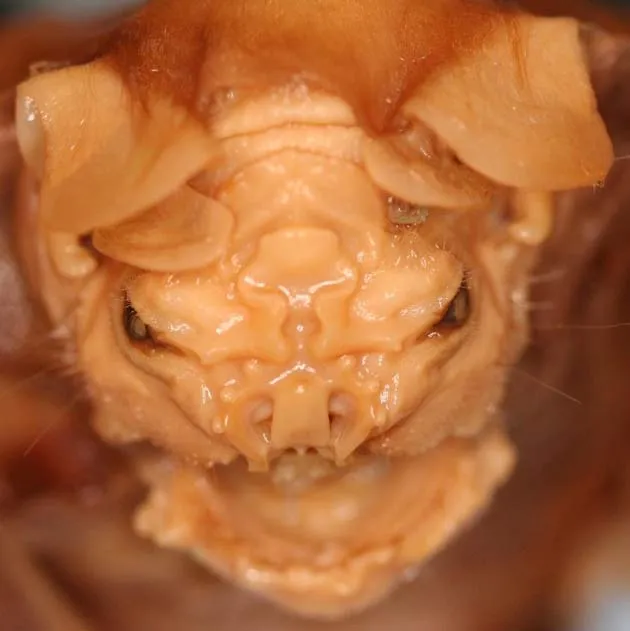
The strangely intricate wrinkles and grooves around the nostrils of many bats apparently could help them "see" in the dark by focusing their sonar, scientists in China have found.
The discovery could help scientists improve sonar and radio technology, the researchers said.
Bats are famous for their ability to "see" in the dark by listening to the echoes of their ultrasonic calls. This is known as echolocation, or "biosonar."
While most bats emit sonar from their mouths, roughly 300 species fire it from their noses. These bats often have bizarrely elaborate, intricately shaped flaps dubbed "noseleaves" around their nostrils that are adorned with grooves and spikes [image].
100-year-old riddle
Scientists have long speculated these noseleaves might help shape bat sonar, but nobody knew for certain, explained biologist turned computational physicist Rolf Müller at Shandong University in Jinan, China. He and his doctoral student Qiao Zhuang have now discovered precisely how one kind of bat facial feature improves biosonar, solving "a 100-year-old riddle," Müller told LiveScience.
The researchers employed X-ray scans to generate three-dimensional computer models of the noseleaves of the rufous horseshoe bat, native to southern Asia. Müller and Zhuang then simulated how ultrasound pulses the bats emit interact with the noseleaves.
Get the world’s most fascinating discoveries delivered straight to your inbox.
The bats send ultrasonic pulses that start at about 60 kilohertz in frequency, quickly rise to a constant frequency of roughly 80 kilohertz, and then fall back to 60 kilohertz at the end. Computer simulations revealed horizontal furrows along the top of the noseleaves behaved as cavities that resonate strongly with certain frequencies of sound, just as blowing into "a set of clarinets," can produce deep, resonant tones, Müller said.
Sound advantage
As a result, the grooves cause the different frequencies of sound to focus different ways. The lower frequency 60-kilohertz sound gets spread vertically, while the 80-kilohertz frequency continues to be focused ahead.
The noseleaves essentially help the bats make the most of the ultrasound they emit, Müller explained.
"For the bat, sound energy is like money to us—we usually only have a limited amount of it and we must make a choice on how to distribute it," he said. The furrows the researchers investigated help shape how the lower frequency sound "illuminates" the environment, while the other frequencies remain untouched and thus able to scan the world in different ways.
The complexity the noseleaves add to the bat ultrasound beams could help "in performing difficult sonar tasks like navigating in complex environments such as dense forests or doing several things at once, such as looking for prey and avoiding obstacles," Müller speculated.
More to study
Facial grooves and flaps are even found on bats without noseleaves. Their findings suggested "all facial structures seen in bats are now candidates for acoustic 'beam-shaping devices,'" Müller said.
Likewise, "the outer ears of most bats also have intriguing shape features," Müller said. "These features could act in similar ways as the noseleaves."
The goal of this research is to not only better understand how bat echolocation works, but to apply the principles to improving antenna technology, for use in sonar, scanners and wireless communication, Müller said.
Müller and Zhuang reported their findings in the Nov. 24 issue of the journal Physical Review Letters.
Which Animal
is the Ugliest?


You Decide >>>