













Bats Fly By Feel, Too

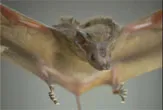
Bats may hunt by hearing, but a new study finds they have a feeling for flight, too.
The theory--that bats fly by touch--was first proposed in the 1780s by French biologist Georges Cuvier, but it fell out of fashion in the 1930s when researchers discovered the creatures could navigate by emitting high-frequency calls and listening to the echoes as they bounce back, a process called echolocation that's akin to a submarine's sonar.
John Zook, a neurobiologist from Ohio University who conducted the new study, found that touch-sensitive receptors on the bats' wings help them maintain altitude and catch insects in midair.
Zook believes the touch-receptors work together with echolocation to make bats better, more accurate nocturnal hunters. It's thought that echolocation helps bats detect their surroundings, while the touch-sensitive receptors help them stick to their flight path and snag prey.
The touch receptors look like tiny bumps on the wing surface. The bumps contain Merkel cells, a type of touch receptor found on the skin of most mammals, including humans. The touch-sensitive bumps on the bats are unique, however: each has a tiny hair poking out of the center.
When Zook recorded the electrical activity of the Merkel cells, he found they were sensitive to air flowing across the wing. These cells were most active when airflow--particularly turbulent airflow--stimulates the hair.
The receptor cells give bats constant feedback about their wing positions. When a bat's wing isn't properly angled or curved during flight, air passing next to the wing can become turbulent. Merkel cells help bats remain aerodynamically efficient by alerting them when their wing position or curve is incorrect, preventing the creatures from stalling in midair.
Get the world’s most fascinating discoveries delivered straight to your inbox.
"It's like a sail or a plane. When you change the curve of a wing a little bit, you get improved lift," Zook said. "But if you curve it too much, the bat--or plane--may suddenly lose lift, hitting a stall point and falling out of the air."
Hairs help bats turn
To test his hypothesis, Zook removed the delicate hairs from the bats' wings with a hair removal cream. Then he let them fly.
The bats appeared to fly normally when following a straight path, but when they'd try to take a sharp turn, such as at the corner of a room, they would drop or even jump in altitude, sometimes erratically. When the hairs grew back, the bats once again made normal turns.
"Without the hairs, the bats were increasing the curve of their wings too much or not enough," Zook said.
The bats' flight behavior also depended on where on the wing the hairs were removed. When Zook removed hairs along the trailing edge of the wings and on the membrane between the legs, for example, the bats could fly and turn effectively, but they tended to pitch forward because they couldn't control their in-flight balance.
Using nerve recordings, Zook also revealed the importance of a second type of receptor cell in the membranous part of bats' wings that respond when the membrane stretches. Zook calls areas on the wing where these stretch-sensitive cells overlap "sweet spots" because they are where bats like to snag their prey.
In the lab, Zook shot mealworms covered with flour into the air and recorded how the bats caught them. He could tell from the flour imprints on the wings that the bats caught their prey almost exclusively in the stretch-sensitive sweet spots.
Zook presented preliminary findings from his research at the Society for Neuroscience meeting in November with the full account of the discoveries announced this week.
