
 Live Science Plus


Monkeys Use 'Code Words' to Warn of Predators
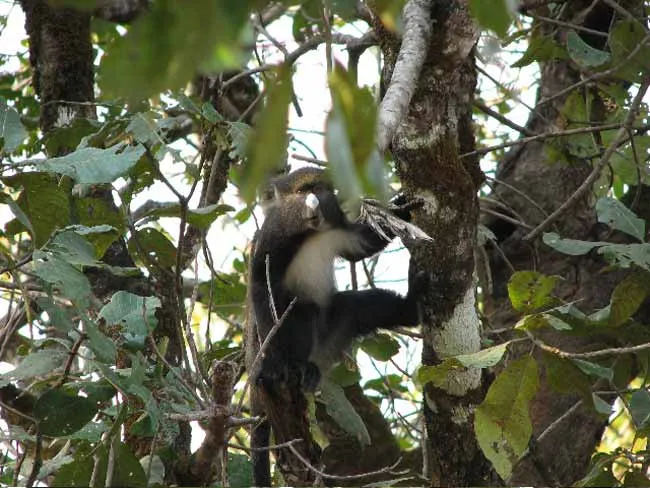
If you're a putty-nosed monkey and you hear a friend whoop out a loud "pyow" call, you know there's a leopard sneaking around and it's time to boogie.
Similarly, if you hear a "hack," it means you should watch out for a hungry eagle.
A new study reveals that these monkeys can mix the two calls into a "pyow-hack" sequence to broadcast other types of information.

The findings, reported in the May 18 issue of the journal Nature, indicate that non-human primates can combine calls into higher-order sequences that have a particular meaning.
Putty-nosed monkeys, Cercopithecus nictitans, are about the size of a cat. They live among the trees in African rainforests. Their three main goals in life are to reproduce, eat, and not get eaten.
To take care of the latter two objectives, the monkeys rely on two calls. If the male let's out a "pyow," the monkeys scramble away from the lower levels of the trees. If they hear a "hack," they climb away from the canopy to avoid getting picked off by an eagle.
Researchers from the University of St. Andrews in Scotland followed a group of putty-nosed monkeys for two months and recorded the lead male's calls. They observed that the males sometimes let out a combination of "pyow-hacks," which on average gets the pack moving a little quicker and further—up to 100 yards in half an hour—than either call on its own.
Get the world’s most fascinating discoveries delivered straight to your inbox.
"They might make a 'pyow-hack' in response to a predator, but the strange thing is they also do it early in the morning while foraging," said study co-author Klaus Zuberbuhler. "If the male wants to move on, he produces that sequence, which is followed by the group moving."
Once the male makes the call, which is sometimes spurred on by input from the elder females in the group, the rest of the monkeys congregate around the leader to see which way to head next.
"The visibility in rainforest is terrible, maybe 10 meters, which is why these acoustic signals are so crucial," Zuberbuhler told LiveScience.
- Creatures of the Wild: Your Amazing Images
- Scientists Discover New Monkey Genus In Africa
- Monkeys Pay to See Female Monkey Bottoms
- GALLERY: Endangered and Threatened Wildlife