















Chimps Prove Altruistic and Cooperative
Felix Warneken was in a tough spot. While hanging laundry, he had "accidentally" dropped a clothespin out of reach. Stretch as he might, he couldn’t grab it.
He even cried out, "My pin!"
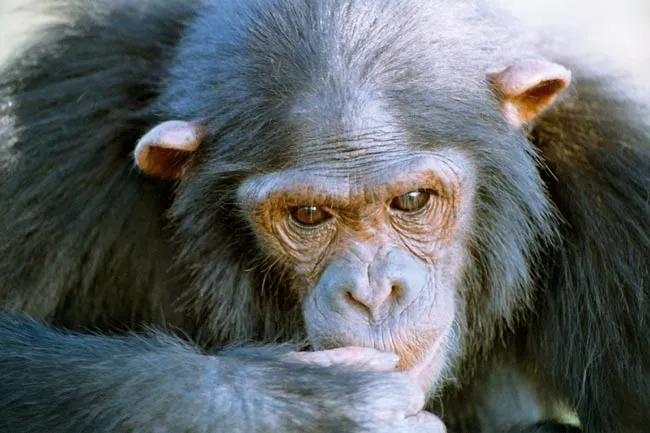
A young chimpanzee sitting nearby picked up on Warneken’s distress and retrieved the clothespin for him.
Since the chimp received no reward, or even a "thank you," this experiment indicates chimps can be altruistic, a quality many scientists thought only humans possessed.
Warneken, a scientist at the Max Planck Institute, performed the same experiment with human infants and found them equally helpful.
Interestingly, if Warneken threw the pin deliberately, neither chimps or humans would pick it up. They only retrieved it if they could infer that Warneken needed it to complete his task.
"We may be biologically prepared to pick up on these [cues] naturally," said Warneken.
Get the world’s most fascinating discoveries delivered straight to your inbox.
While infants helped on a variety of tasks, the chimps weren’t as willing to help with some of the more difficult chores.
"Maybe closing a door, stacking books, or putting things in a box are tasks that don’t really make sense to a chimpanzee, and that’s why they don’t help," Warneken told LiveScience.
The research is detailed in the March 3 issue of the journal Science.
In another study in the journal, researchers observed that when a task requires more than one set of hands, chimps call on "experts" to help out.
Researchers placed a food tray outside the chimp’s cage. Pulling on a both ends of a rope attached to the tray was the only way to bring the food within reach. But the ends were so far apart that the chimp had to enlist a helper.
"The experiments show that chimpanzees spontaneously recognize that when they are faced with a problem they cannot solve on their own they need to recruit help," said study coauthor Brian Hare of the Max Planck Institute.
The chimps quickly figured out which chimp was best at rope-tugging and selected the expert more frequently.
- Case Closed: Apes Got Culture
- Like Humans, Chimps Bow to Social Pressure
- VIDEO: Nature Presents: Jane Goodall's Wild Chimpanzees
- Altruistic Love Related to Happier Marriages