
 Live Science Plus


Baboons Vocalizations Hint at Origins of Human Speech

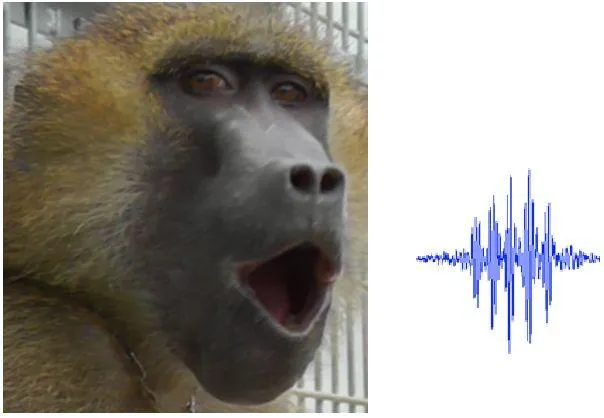
A baboon's grunt is different from its bark, and new research has found that the primates use five distinct vowel-like soundsthat were previously thought to be unique to modern humans.
The ability to create clear vowel sounds is connected to the origins of speech, according to researchers. However, previous research asserted that the human larynx, located lower in the neck, is required in order to produce sets of distinct vowels. Nonhuman primates' higher-located larynx, therefore, was believed to be insufficient to create the distinct sounds.
But now, a cross-disciplinary team of scientists has studied 1,335 spontaneous vocalizations produced by 15 male and female Guinea baboons. These vocalizations included distinct types of grunts, a bark, a yak, a "wa hoo" and a sound made during copulation. [8 Humanlike Behaviors of Primates]

The distinct vowel-like sounds the baboons make are difficult to compare to human speech, because human speech is intertwined with language and the vocalizations are different, said study co-author Tom Sawallis, a linguist at the University of Alabama. Moreover, unlike human language, the baboons' vowel-like sounds are made in calls, such as the yak or "wa hoo" call, he added.
"First of all, the 'ooo' sound — it's like the scary ghost 'Oooooo,'" Sawallis told Live Science. "And the 'a' is like in 'cat.'"
The baboons also make an "aw" sound, an "ih" sound and an "uh," the researchers said.
Humans create vowel sounds with precise movements of the tongue — high, low, front and back. The researchers found that baboons similarly have muscles in their tongues to control sound in the same way.
The scientists studied the vocal-tract anatomy of two baboons that died of natural causes, and dissected the tongues. They found that compared with humans, baboons have a child-like vocal tract (which filters sound produced in the larynx) and adult-like vocal cords. Audio recordings of the baboons demonstrated that the animals can create vowel-like sounds, the researchers said.
Beyond confirming that baboon vocalizations have similarities to human vowels, the new research suggests a much earlier origin of speech, according to the scientists.
"The previous hypothesis [of requiring a low larynx to produce vowel sounds] meant there was a hard boundary before which nothing significant could have evolved for speech," Sawallis said. "We have shown that you can get five contrasting vowel-like sounds from monkeys. So, we infer that there was a vowel-production seed that was available in our last common ancestor with baboons."
The idea that distinct speech patterns were restricted to modern humans, who originated in Africa about 400,000 years ago, left scientists thinking that language originated relatively recently, within the past 70,000 to 100,000 years. However, the researchers noted that the last common ancestor of baboons and humans would have had the vocalization ability to produce vowels. This would place the potential origin of speech at about 25 million years ago, according to the study.
The detailed findings were published online Jan. 11 in the journal PLOS ONE.
Original article on Live Science.
