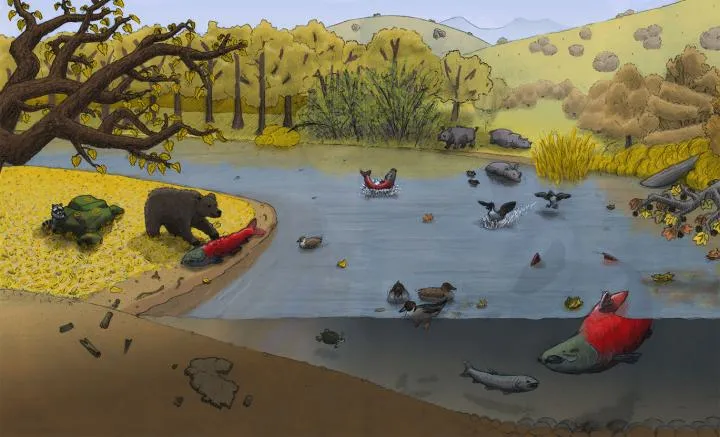
Giant, spike-toothed salmon that weighed almost 400 lbs. (180 kilograms) once made their home in the ancient coastal waters of the Pacific Ocean, according to new research.
The now-extinct salmon species spawned in California rivers approximately 11 million to 5 million years ago, the scientists said. The fish measured up to 9 feet (2.7 meters) long, with spike-like teeth that were more than 1 inch (3 centimeters) long. Though its dagger-like teeth could have been deadly for prey, the ancient salmon was probably a filter feeder rather than a predatory species, meaning the fish took in water full of plankton as it swam, as modern Pacific salmon do, they added.
The team of researchers, led by vertebrate paleontologist Julia Sankey, studied 51 fossils from the extinct salmon species in both freshwater and saltwater environments.
"Scientifically, our research on the giant salmon is filling in a gap in our knowledge about how these salmon lived and, specifically, if they developmentally changed prior to migration upriver like modern salmon do today," Sankey said in a statement.
An illustration by Jacob Biewer of what the giant, spike-toothed salmon may have looked like.
(Image credit: Society of Vertebrate Paleontology)
Modern salmon experience physical changes, especially in their skull, prior to spawning, the scientists said. They noted that modern male salmon will fight to defend their eggs, and their ancient ancestors likely exhibited the same behavior.
The new study found that teeth from the giant salmon found in freshwater environments were consistently longer and more sharply curved than those of the salmon found in the saltwater environments, and showed signs of wear. They added that these differences suggest that the salmon experienced changes prior to migrating upriver to spawn.
Sign up for the Live Science daily newsletter now
Get the world’s most fascinating discoveries delivered straight to your inbox.
The salmon's spiky teeth also may have been used to display a sign of dominance, the researchers said.
"These giant, spike-toothed salmon were amazing fish," Sankey said. "You can picture them getting scooped out of the Proto-Tuolumne River [near Modesto, California] by large bears 5 million years ago."
Sankey and her colleagues presented their research Oct. 27 at the annual meeting of the Society of Vertebrate Paleontology in Salt Lake City.
Kacey Deamer is a journalist for Live Science, covering planet earth and innovation. She has previously reported for Mother Jones, the Reporter's Committee for Freedom of the Press, Neon Tommy and more. After completing her undergraduate degree in journalism and environmental studies at Ithaca College, Kacey pursued her master's in Specialized Journalism: Climate Change at USC Annenberg. Follow Kacey on Twitter.