















Sorry, ET fans: The mysterious signal detected by a Russian radio telescope last year probably had an Earthly cause.
This past weekend, reports emerged that, in May 2015, a team of astronomers using Russia's huge RATAN-600 telescope had spotted an intriguing radio signal coming from the vicinity of the star HD 164595, which lies about 94 light-years from Earth.
The signal was consistent with something an alien civilization might produce, astronomers said — but they stressed that there was probably a more prosaic explanation. [Video: SETI Signal a False Alarm, But the Search Continues]
Such reminders not to get too carried away were well placed, it turns out.
"Subsequent processing and analysis of the signal revealed its most probable terrestrial origin," astronomer Yulia Sotnikova wrote in an update published today (Aug. 31) by the Special Astrophysical Observatory of the Russian Academy of Sciences. "It can be said with confidence that no sought-for signal has been detected yet."
The May 2015 signal may have been caused by a Russian military satellite. Such a spacecraft was responsible for a similar detection during the Soviet period, Alexander Ipatov, director of the Institute of Applied Astronomy at the Russian Academy of Sciences, told the Russian news agency TASS.
False alarms like this one are all part of the process of hunting for extraterrestrial life. Researchers find something interesting, and then they — and their colleagues around the world — try to figure out what it means, said Seth Shostak, senior astronomer with the SETI (Search for Extraterrestrial Intelligence) Institute in Mountain View, California, who was not part of the detection team.
Get the world’s most fascinating discoveries delivered straight to your inbox.
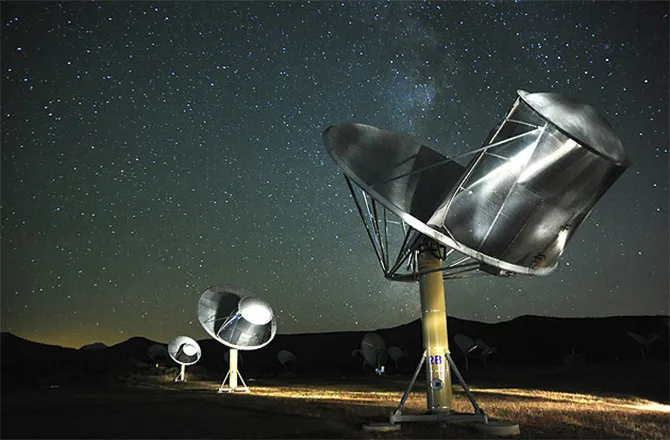
Indeed, the SETI Institute pointed the Allen Telescope Array, a network of radio dishes in northern California, at HD 164595 on Sunday and Monday nights (Aug. 28 and Aug. 29).
They found nothing. But Shostak and his colleagues will continue investigating promising candidate signals and exoplanet targets throughout the galaxy, he said.
"One can easily get kind of cynical about these things — 'Oh, man, another one of these false alarms,'" Shostak told Space.com on Monday, speculating that the HD 164595 signal might be a false alarm. "You have to guard against that, because, in this business, there are going to be a lot of false alarms."
Follow Mike Wall on Twitter @michaeldwall and Google+. Follow us @Spacedotcom, Facebook or Google+. Originally published on Space.com.
