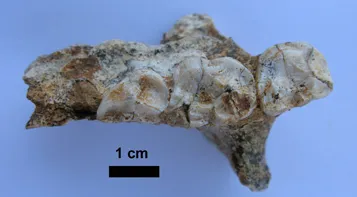
The remains of an extinct species of giant lemur were recently discovered in Madagascar, the first addition to the group in more than 100 years, according to a new report.
The species, Palaeopropithecus kelyus, confirms 20 years of speculation on its existence, said lead author Dominique Gommery, a paleontologist at the National Center for Scientific Research (CNRS) in Paris, France. Lemurs are a group of primates (which are mammals) that are found only in Madagascar. A total of 71 species of lemurs lives there.
P. kelyus is now the third member of a group of subfossil giant lemurs. Unlike classic fossils, subfossils are from bones of recently deceased species, and are only partially mineralized. The discovery may help scientists understand the evolutionary patterns in biodiversity hotspots such as Madagascar.
Latest Videos From
Giant lemurs have a tree-hopping motion that resembles that of South American sloths. They move from branch to branch using all four limbs, with their head downwards.
P. kelyus joins the two other species of giant lemur, P. ingens and P. maximus, which were discovered more than 100 years ago. P. kelyus is the smallest of the three giant lemurs, with an estimated weight of 77 pounds (35 kg). The largest living lemur, the Indri, weighs only 22 pounds (10 kg).
Small teeth and other dental features in the upper jaw distinguish P. kelyus from the other giant lemurs.
These features suggest that P. kelyus might have chewed tougher foods such as seeds. The other two giant lemurs are though to have fed mostly on leaves and fruit.
P. kelyus was discovered in northwest Madagascar, an area situated between large bays and rivers that may have isolated P. kelyus from the other giant lemurs.
The discovery project, dubbed Mission archéologique et paléontologique dans la province de Mahajanga (MAPPM), is a French and Malagasy collaboration. The findings are published online in the journal Comptes Rendus Palevol.
- Video – Too Many Lemur Species
- Gallery – Evolution's Most Extreme Mammals
- Top 10 New Species