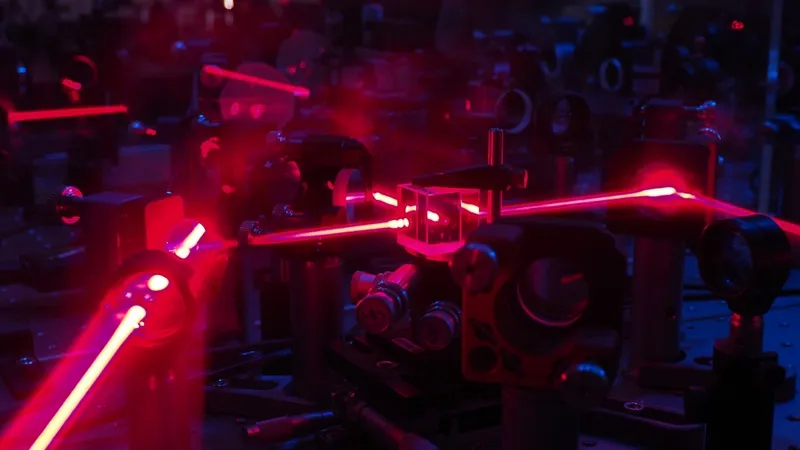
Quantum physics can fly in the face of human intuition—even that of a physicist such as Mario Krenn at the University of Vienna. This counterintuitive quality makes it difficult for researchers to design experiments to explore the field. Now, to avoid intuitive pitfalls, Krenn and his colleagues have devised a computer program to automatically design new quantum experiments that they would not have thought of themselves.
The way that all known particles behave can be explained with quantum physics. A major feature of this branch of physics is that the world becomes a vague, bizarre place at its very smallest levels. For example, atoms and other basic building blocks of the universe can exist in states of flux known as superpositions, meaning they can seemingly be located in two or more places at the same time, or spin in opposite directions simultaneously; and with the phenomenon of quantum entanglement, two or more objects can get connected such that what happens to one instantaneously affects whatever is linked to it, no matter how far apart they are in the universe.
The surreal nature of quantum physics can be hard to swallow, even for scientists. The most famous analogy for superposition, Schrödinger's cat, which presents a cat that may be simultaneously alive and dead, was intended by physicist Erwin Schrödinger to highlight the absurdity of the concept of superposition, not to popularize it. In addition, Einstein famously rebelled against the concept of entanglement, calling it “spooky action at a distance.” Numerous experiments, however, have proved quantum physics's stranger phenomena over the decades—for instance, Krenn's advisor Anton Zeilinger helped set the current record distance for entanglement of 144 kilometers, from La Palma to Tenerife in the Canary Islands.
Illustration of a robot hand drawing the design for a quantum experiment.
(Image credit: Robert Fickler/University of Vienna)
Krenn and his colleagues were having trouble generating a complex form of entanglement where three entities shared three properties. After weeks of educated guesses to produce these so-called Greenberger–Horne–Zeilinger (GHZ) states Krenn says he realized that his intuition was not working, “so maybe a more radical approach would work.”
The answer was a program Krenn named MELVIN. The software takes common building blocks of quantum experiments such as mirrors and holograms and virtually arranges these elements to find unintuitive configurations that achieve whatever goals that researchers desire, such as a specific quantum state. Once it finds a working result, it automatically simplifies the design and reports it to the scientists. "I started the program in the evening and by the next morning, after a few hundred thousand different trials, it found one correct solution," Krenn says of his first use of MELVIN to find the GHZ states. "You can imagine that was a pretty exciting day." The scientists detailed their findings online March 4 in Physical Review Letters.
In another test of MELVIN researchers found the program could take sets of entangled particles and change them so they switched properties such as polarization with one another in a cyclical way. Such cyclic operations could help be useful in nigh-unhackable quantum cryptography, one of the main potential future applications of superposition and entanglement.
The scientists added that MELVIN came up with unexpected solutions they were unlikely to have thought up themselves. For instance, 50 of the 51 experiments the program developed for producing GHZ states included shining an entangled light beam directly onto a detector that did not interact with other beams and components of the experiment. “I still find it very difficult to intuitively understand the final solution, even though I can perfectly calculate it,” Krenn says.
Sign up for the Live Science daily newsletter now
Get the world’s most fascinating discoveries delivered straight to your inbox.
MELVIN starts by shuffling components randomly but "it has the ability to learn from experience," Krenn says. “That means if it found one good solution, it stores the good solution and can use it for follow-up experiments. This improves its speed significantly, by more than one order of magnitude.”
When asked if MELVIN's results were all that counterintuitive or useful, however, Nicolas Gisin, a physicist at the University of Geneva who did not participate in this study, says "I am not impressed." He adds that "this paper is likely to trigger lots of debates."
In contrast, quantum physicist Seth Lloyd of the Massachusetts Institute of Technology, who also did not take part in this research, thought MELVIN was a good idea. "It is true that the weird nature of quantum mechanics can make it hard to come up with ideas for experiments," Lloyd says. Still, he also did not find MELVIN groundbreaking, comparing this research with how scientists have long used computers to simulate the properties of drugs and other molecules before manufacturing them. But "the method has the potential to help generate useful complex quantum states," he adds. "It would be great if they could find novel states with completely unexpected properties."
Charles Q. Choi is a contributing writer for Live Science and Space.com. He covers all things human origins and astronomy as well as physics, animals and general science topics. Charles has a Master of Arts degree from the University of Missouri-Columbia, School of Journalism and a Bachelor of Arts degree from the University of South Florida. Charles has visited every continent on Earth, drinking rancid yak butter tea in Lhasa, snorkeling with sea lions in the Galapagos and even climbing an iceberg in Antarctica.