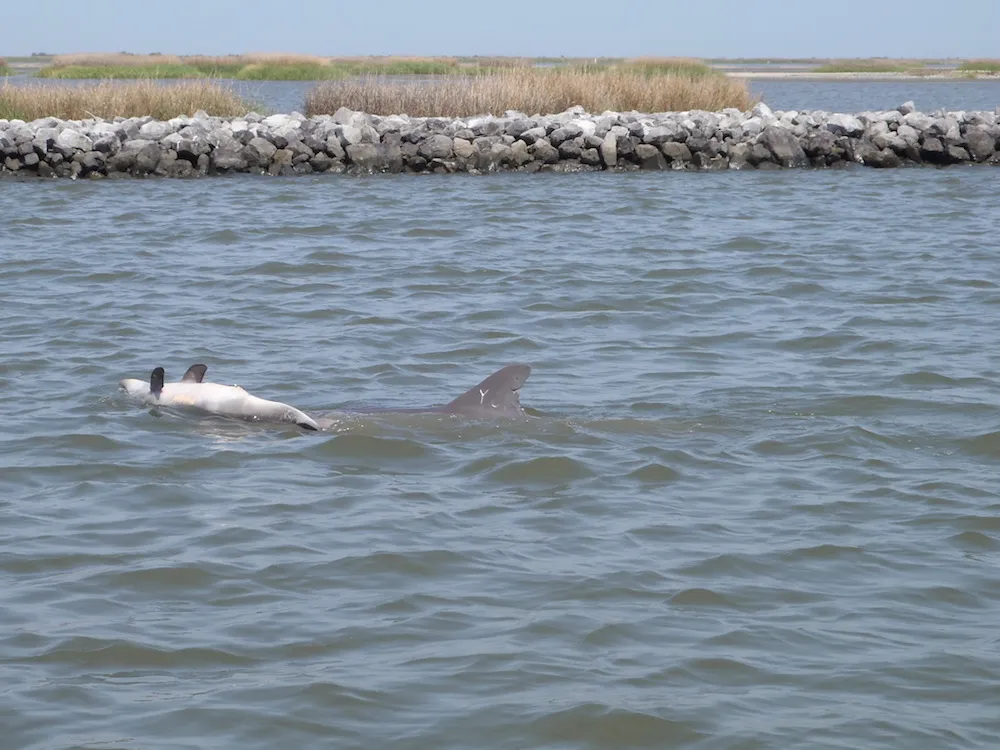
In March 2013, researchers saw the female dolphin known as Y01 pushing a dead calf in waters affected by the Deepwater Horizon oil spill. This behavior is sometimes seen in females when their newborn calves do not survive.
(Image credit: Louisiana Department of Wildlife and Fisheries)
Bottlenose dolphins swimming in waters affected by the Deepwater Horizon oil spill are dying earlier and birthing fewer calves than dolphins living in other areas, a new study shows.
Just 20 percent of pregnant dolphins in Barataria Bay — a part of the Gulf of Mexico that was most heavily tainted by oil from the spill — gave birth to surviving calves, much lower than the 83 percent success rate in other dolphin populations, the researchers found.
In addition, just 86.8 percent of the Barataria Bay dolphins survive every year. In comparison, this "annual survival rate" is 95.1 percent for dolphins near Charleston, South Carolina, and 96.2 percent for dolphins in Florida's Sarasota Bay, the researchers said. [See Images of the Impact from the Deepwater Horizon Oil Spill]
"This dolphin population, as well as other dolphin and whale populations that were exposed to the DeepwaterHorizon oil, will take a long time to recover," saidstudy lead investigator Lori Schwacke, a wildlife epidemiologist with the National Oceanic and Atmospheric Administration.
The researchers started following the dolphins shortly after the Deepwater Horizon oil rig exploded on April 20, 2010. That oil spill leaked about 4.9 million barrels (205 million gallons) of oil into the Gulf of Mexico, making it the worst marine oil spill in U.S. history, according to government estimates.
In August 2011, the researchers conducted a health assessment of the dolphins in Barataria Bay. After assessing 32 dolphins, the researchers concluded that the Barataria bottlenose dolphins (Tursiops truncatus) had oil-associated health issues.
Ultrasounds of a living dolphin fetus (top) and a nonviable fetus (bottom), both taken during August 2011. Researchers later saw the female with the viable fetus swimming with a calf in 2012.
(Image credit: Cynthia Smith, National Marine Mammal Foundation)
The health assessment showed that the dolphins had a high prevalence of lung disease, and almost 50 percent had abnormally low levels of the hormones that help the body respond to stress, the researchers said. Moreover, many of the dolphins were underweight and anemic, and had low blood sugar and symptoms of liver disease, the researchers reported in the 2013 study, published in the journal Environmental Science and Technology.
Sign up for the Live Science daily newsletter now
Get the world’s most fascinating discoveries delivered straight to your inbox.
For the new study, the researchers continued to monitor the tagged dolphins, including 10 that were pregnant during the health assessment, to determine the marine mammals' reproductive and survival rates.
The researchers followed the dolphins for nearly four years (47 months), and found that the dolphins in Barataria Bay had an approximately 60 percent lower pregnancy success rate compared with dolphins at a reference site, Schwacke said
What's more, 57 percent of the pregnant females that did not successfully have calves were sick with moderate to severe lung disease during the 2011 health assessment, the researchers found.
However, because they were unable to medically examine the fetuses or stillborn dolphins, the researchers had to find ways to rule out other factors that may have influenced the dolphins' health. For instance, water samples and various necropsies (an animal autopsy) and health assessments show that harmful algal toxins and exposure to pollutants, such as pesticides, that have been linked to reproductive failure are not to blame for the high amount of reproductive failure in the bay, the researchers found.
Both oil spill-associated lung disease and hormonal issues are known to harm pregnancies, Schwacke said. Furthermore, high rates of pregnancy failure were also observed in sea otters following the 1989 Exxon Valdez oil spill into Alaska's Prince William Sound, the second largest oil spill in U.S. history, she said. [In Photos: Animals at Risk from Deepwater Horizon Oil Spill]
"The population has not only lost adult (reproductive) females that died following the spill, but this study now shows that the remaining females are not able to birth calves at a normal rate," Schwacke told Live Science in an email. "The restoration efforts that are being planned for the Gulf, including efforts to reduce further harm or injury and to mitigate other stressors on marine mammal populations, will be critical to promote recovery."
The low annual survival rate among Barataria Bay dolphins is also of concern, as it "indicates excess mortality of about 8 to 9 percent per year for dolphins in Barataria Bay," Schwacke said. "[But] this finding was not a huge surprise, because we knew from the increased stranding rate of dolphins in this area that dolphin mortality had been increased since the Deepwater Horizon spill."
Laura is the managing editor at Live Science. She also runs the archaeology section and the Life's Little Mysteries series. Her work has appeared in The New York Times, Scholastic, Popular Science and Spectrum, a site on autism research. She has won multiple awards from the Society of Professional Journalists and the Washington Newspaper Publishers Association for her reporting at a weekly newspaper near Seattle. Laura holds a bachelor's degree in English literature and psychology from Washington University in St. Louis and a master's degree in science writing from NYU.