


In Photos: Giant Amphibian Ruled Ancient Rivers
Researchers have discovered a mass graveyard filled with the bones of a giant amphibian that lived between 220 million and 230 million years ago in what is today southern Portugal. Here's a look at the dig site, bones and what the creature would have looked like so long ago. Images are courtesy of Steve Brusatte/Richard Butler/Octavio Mateus/Seb Steyer. [Read the full story on the super salamander]
Digging for treasure

The team uncovers fossils of the new amphibian, now called Metoposaurus algarvensis, from the Algarve region in southern Portugal, where a gradulate student, Thomas Schroeter, in the late 1970s to early 1980s found speciments possibly from the same group of amphibians. The researchers relocated this bonebed in 2009, where they have found nearly 10 different skulls and several other bones from this newfound species.

From beyond the grave

Here, a model of the Metoposaurus algarvensis amphibian, a member of the metoposaurids, which had yet to be found on the Iberian Peninsula. The creature, which was equipped with hundreds of sharp teeth and a big, broad head (like other metoposaurids) would have filled crocodile-like predator niches when alive.
A peak into the past
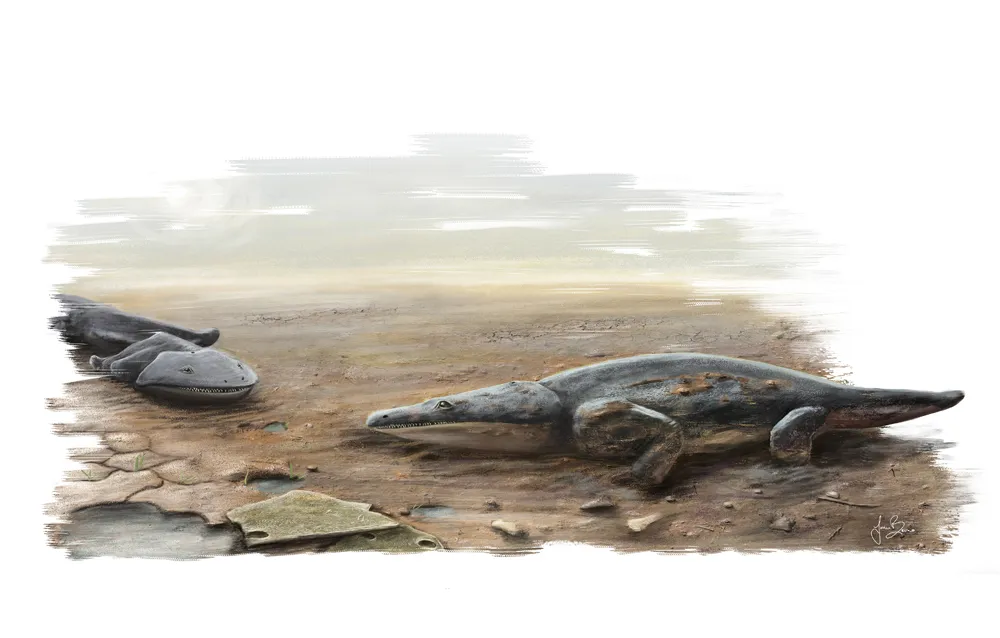
This artist's conception highlights the flat "toilet-seat-shaped" head of Metoposaurus algarvensis, as co-researcher Steve Brusatte of the University of Edinburgh describes it. The beast would have swung its flat head around to snag fish in the rift valleys on the supercontinent Pangaea.
Get the world’s most fascinating discoveries delivered straight to your inbox.
Digging for history

Brusatte uncovers some of the bones of Metoposaurus algarvensis at their dig site. Hundreds of these creatures may have died at once when their lakebed dried up, leaving behind a jackpot of bones for paleontologists to discover. The rest of their kin, along with most metoposaurids and half of the planet's species, went extinct around 201 million years ago. That mass extinction at the end of the Triassic is thought to have paved the way for the rise of dinosaurs.
A strange sight

Here, the clavicle of a Metoposaurus algarvensis. The creature would have grown to about 6.5 feet (2 meters) in length, ruling the waterways where it lived. "This new amphibian looks like something out of a bad monster movie," Brusatte said in a statement. "It was the type of fierce predator that the very first dinosaurs had to put up with if they strayed too close to the water, long before the glory days of T. rex and Brachiosaurus."
What a large mouth it had...

The lower jawbone of the recently uncovered Metoposaurus algarvensis. Various features distinguished this animal from other metoposaurids, including some differences in the brain region, the lower jaw and openings for nerves and the spinal cord. Though it would not have been any match for the larger dinosaurs and mammals, some of the smaller land dwellers likely stayed clear of the giant amphibian, the researchers speculated.
More fossils

The shoulder girdle bones of the newly discovered Metoposaurus algarvensis. The animal's puny limbs suggest that while it was a good swimmer, it was likely pretty awkward on land, Brusatte said.
A huge find

The skull of the newfound amphibian Metoposaurus algarvensis. The researchers have excavated just a small portion of the bonebed and hope to continue digging there, where they expect to find even more bones like this one.
Unusual bones

Part of the Metoposaurus algarvensis amphibian's palate and skull.
Evidence uncovered

Skulls of the Metoposaurus algarvensis discovered together at the site in Portugal.
Follow Jeanna Bryner on Twitter and Google+. Follow us @livescience, Facebook & Google+.
Jeanna Bryner is managing editor of Scientific American. Previously she was editor in chief of Live Science and, prior to that, an editor at Scholastic's Science World magazine. Bryner has an English degree from Salisbury University, a master's degree in biogeochemistry and environmental sciences from the University of Maryland and a graduate science journalism degree from New York University. She has worked as a biologist in Florida, where she monitored wetlands and did field surveys for endangered species, including the gorgeous Florida Scrub Jay. She also received an ocean sciences journalism fellowship from the Woods Hole Oceanographic Institution. She is a firm believer that science is for everyone and that just about everything can be viewed through the lens of science.