Extremely tiny newfound habitats hidden within oil could expand the potential for life in the universe, researchers say.
Scientists have discovered microbes living in microscopic droplets of water inside a giant asphalt lake on Earth, suggesting that alien life could perhaps exist within ponds of sludge on distant landscapes such as Saturn's largest moon Titan.
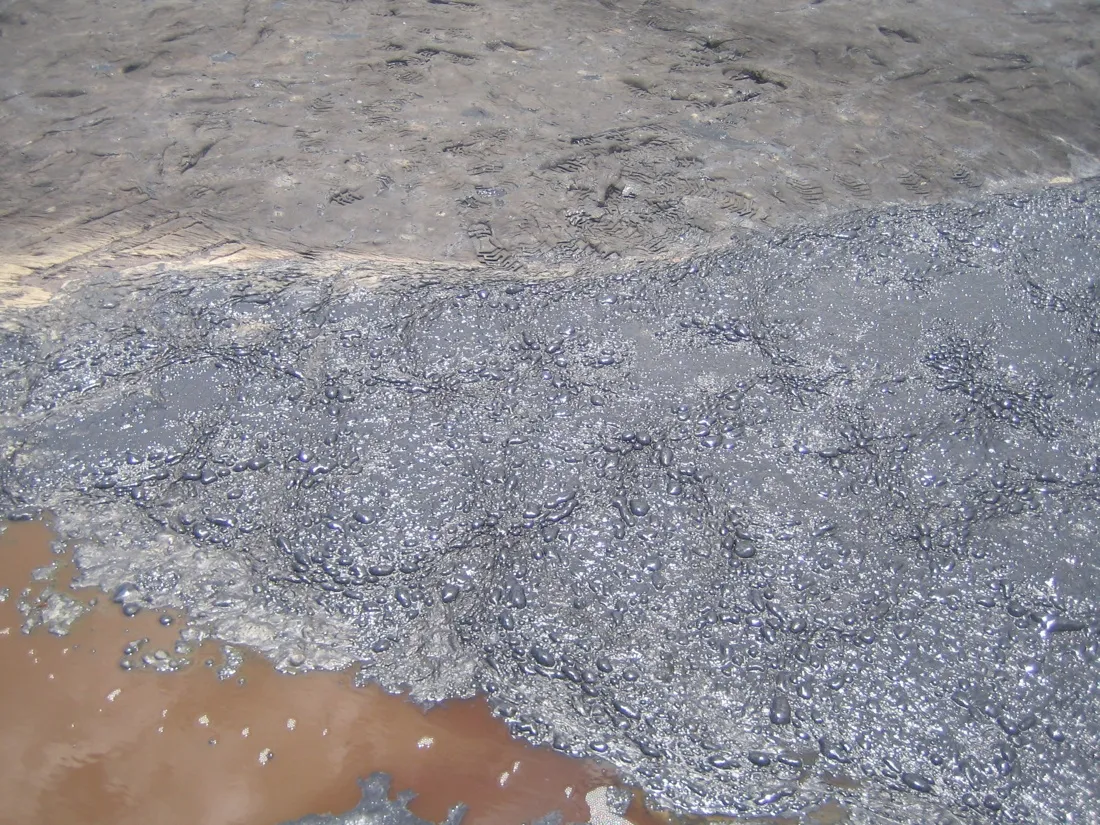
Researchers investigated the largest naturally occurring asphalt lake on Earth, Pitch Lake on the Caribbean island of Trinidad. Black goo there oozes across roughly 114 acres (0.46 square kilometers), an area equivalent to nearly 90 football fields. [See Photos of Pitch Lake and 'Alien Life' Oil Droplets]
Prior studies had found that microbes could thrive at the boundary where oil and water meet in nature, helping to break down the oil. However, investigators had thought oil was too toxic for life, and that the levels of any water inside the oil were below the threshold for life on Earth.
"Oil was considered to be dead,"said lead study author Rainer Meckenstock, an environmental microbiologist at Helmholtz Zentrum München, in Germany.
Now, scientists find microbes active within Pitch Lake, dwelling inside water droplets as small as 1 microliter, about one-fiftieth the size of an average drop of water.
Sampling on Pitch Lake in Trinidad and Tobago.
(Image credit: Rainer Meckenstock.)
"Each of these water droplets basically contains a little mini-ecosystem,"study co-author Dirk Schulze-Makuch, an astrobiologist at Washington State University in Pullman, told Live Science.
Sign up for the Live Science daily newsletter now
Get the world’s most fascinating discoveries delivered straight to your inbox.
These droplets contain a diverse group of microbial species that are breaking the oil down into a variety of organic molecules. The chemistry of the droplets suggests this water does not come from rain, but from ancient seawater, or brine from deep underground.
"The microbes most likely were enclosed in droplets in the deep subsurface and ascended together with the oil," Meckenstock told Live Science.
These findings suggest microbes could play a greater role in breaking down oil than previously thought, Schulze-Makuch said.
"Even at the highest oil concentrations in, for example, an oil spill or contaminated groundwater, you can expect a vibrant microbial community eating the oil," Meckenstock said.
However, while microbes could break down oil more than previously suspected, this does not mean oil deposits will suddenly vanish, Meckenstock said. These processes are still "extremely slow and take geological time frames, say millions of years," Meckenstock said. "We have very little droplets and enormous amounts of oil."
The discovery of these new microscopic habitats for life may also have implications for Titan, which has hydrocarbon lakes on its surface, Schulze-Makuch said. Water-ammonia mixtures may rise up to Titan's surface from below, just as the water found in droplet form in Pitch Lake is thought to have. [4 Places Where Alien Life May Lurk in the Solar System]
The researchers plan to investigate "how life in the droplets works and how the ecology of these mini-ecosystems functions," Meckenstock said.
Understanding how life can survive in water droplets trapped within oil "would give us better ideas how organisms on Titan, if they exist, could adapt to live in those hydrocarbons," Schulze-Makuch said.
The scientists detailed their findings in the Aug. 8 issue of the journal Science.
Charles Q. Choi is a contributing writer for Live Science and Space.com. He covers all things human origins and astronomy as well as physics, animals and general science topics. Charles has a Master of Arts degree from the University of Missouri-Columbia, School of Journalism and a Bachelor of Arts degree from the University of South Florida. Charles has visited every continent on Earth, drinking rancid yak butter tea in Lhasa, snorkeling with sea lions in the Galapagos and even climbing an iceberg in Antarctica.