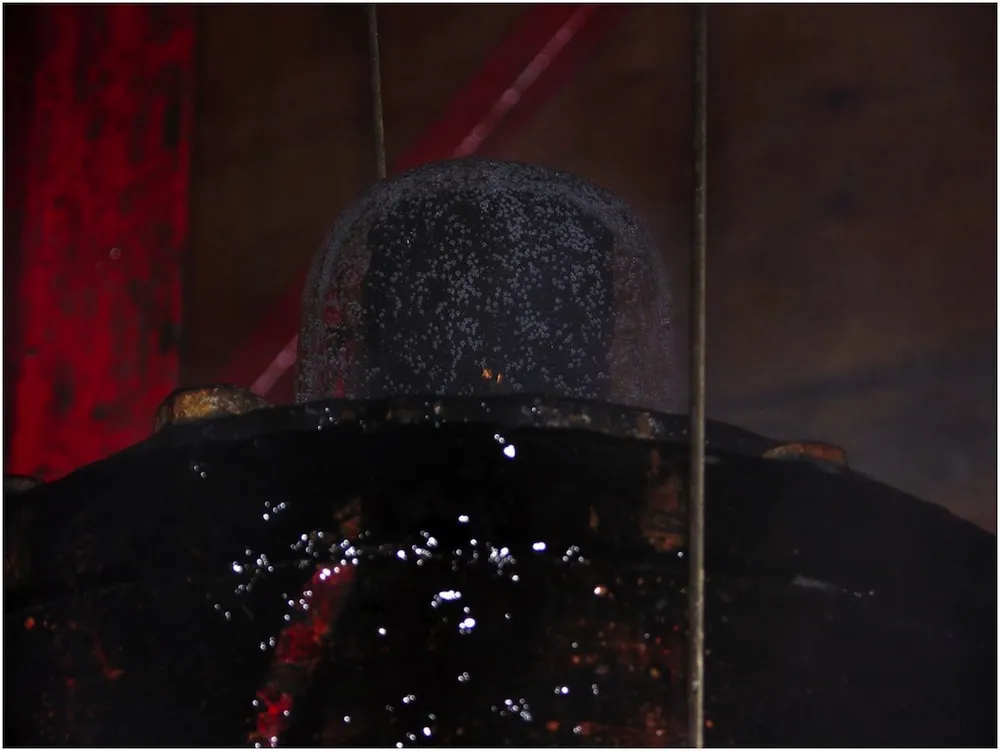
Gas bubbles in groundwater flowing from an open drill-stem casing during a drilling project at the Chesapeake Bay crater. Very high concentrations of helium helped scientists identify the salty water’s origin as Early Cretaceous North Atlantic seawater.
When scientists drilled deep into the center of a huge crater beneath the Chesapeake Bay, they discovered ancient seawater that had been locked up in sediments since the early Cretaceous Period. The water, which is also twice as salty as the water in today's oceans, is thought to be more than 100 million years old.
Researchers examined the saltiness, or salinity, of water retrieved from drilled cores deep under Chesapeake Bay— a sprawling estuary bordered by Maryland and Virginia — and determined that the briny samples dated back to when the North Atlantic was transitioning from being a closed basin to the wide, open ocean we see today.
The findings offer a glimpse into the evolution of the North Atlantic Ocean, which formed approximately 130 million years ago, when the ancient supercontinent Pangaea began drifting apart, said study lead author Ward Sanford, a hydrologist at the U.S. Geological Survey (USGS) in Reston, Va. [The World's Biggest Oceans and Seas]
"This is really the first solid look at the North Atlantic at the time it was opening, to see how that salinity was changing over time," Sanford told LiveScience.
The new study began as an offshoot to a joint project by the USGS and the International Continental Scientific Drilling Program to bore deep below Chesapeake Bay. Thirty-five million years ago, a nearly 2-mile-wide (3 kilometers) asteroid or comet slammed into the North Atlantic Ocean, leaving a giant pockmark beneath the shallow waters of the modern-day bay. Researchers were curious to investigate the crater, and Sanford was in charge of collecting samples of water as the team drilled deeper and deeper.
"We didn't know what we'd get when we were sampling, but we encountered this section that was quite high in salinity," Sanford said.
The researchers drilled to a total depth of nearly 5,800 feet (about 1,800 meters) beneath the seafloor, and found that salinity gradually increased with depth. The core samples were placed in centrifuges to extract water, which was then tested for chemical signatures, including dissolved levels of chloride, magnesium and bromide.
Sign up for the Live Science daily newsletter now
Get the world’s most fascinating discoveries delivered straight to your inbox.
Based on its chemical makeup, the scientists determined that seawater in the Chesapeake Bay crater had been trapped and remained undisturbed for 100 million to 145 million years.
The new research offers a reasonable explanation for the high salinity found beneath the Chesapeake Bay, and the changes in salinity over time, as the North Atlantic Ocean formed, said Raymond Schmitt, a senior scientist at the Woods Hole Oceanographic Institution in Woods Hole, Mass., who was not involved with the study.
The Chesapeake Bay crater impact site.
(Image credit: USGS)
"They show the Cretaceous North Atlantic to be a small marginal sea located under the subtropical high," Schmitt told LiveScience in an email. "The highest open ocean salinities are found at about 25 North (and South) latitude(s), where dry subsiding air under the sunny subtropical high pressure system caused enhanced evaporation."
As water evaporated from the ocean, it would have left the salt behind. The mass of continents surrounding the burgeoning North Atlantic would have kept less salty ocean water from mixing in.
"With the South Atlantic closed off, there would not be enough connection with the rest of the world ocean to dilute the high salinity of this small basin," Schmitt explained. "And I do think that there is no way to raise the average salinity of the global ocean that much; it must have been a regional event."
Sanford and his colleagues suggest that by the start of the late Cretaceous Period, roughly 100 million years ago, water in the widening North Atlantic Ocean was more diluted, with salinity levels that are similar to that of modern seawater.
The results of the new study were published online today (Nov. 13) in the journal Nature.
Denise Chow was the assistant managing editor at Live Science before moving to NBC News as a science reporter, where she focuses on general science and climate change. Before joining the Live Science team in 2013, she spent two years as a staff writer for Space.com, writing about rocket launches and covering NASA's final three space shuttle missions. A Canadian transplant, Denise has a bachelor's degree from the University of Toronto, and a master's degree in journalism from New York University.