















Massive magma eruptions may have ripped Africa and South America apart
Huge outpourings of magma accompanied the split between South America and Africa 135 million years ago.

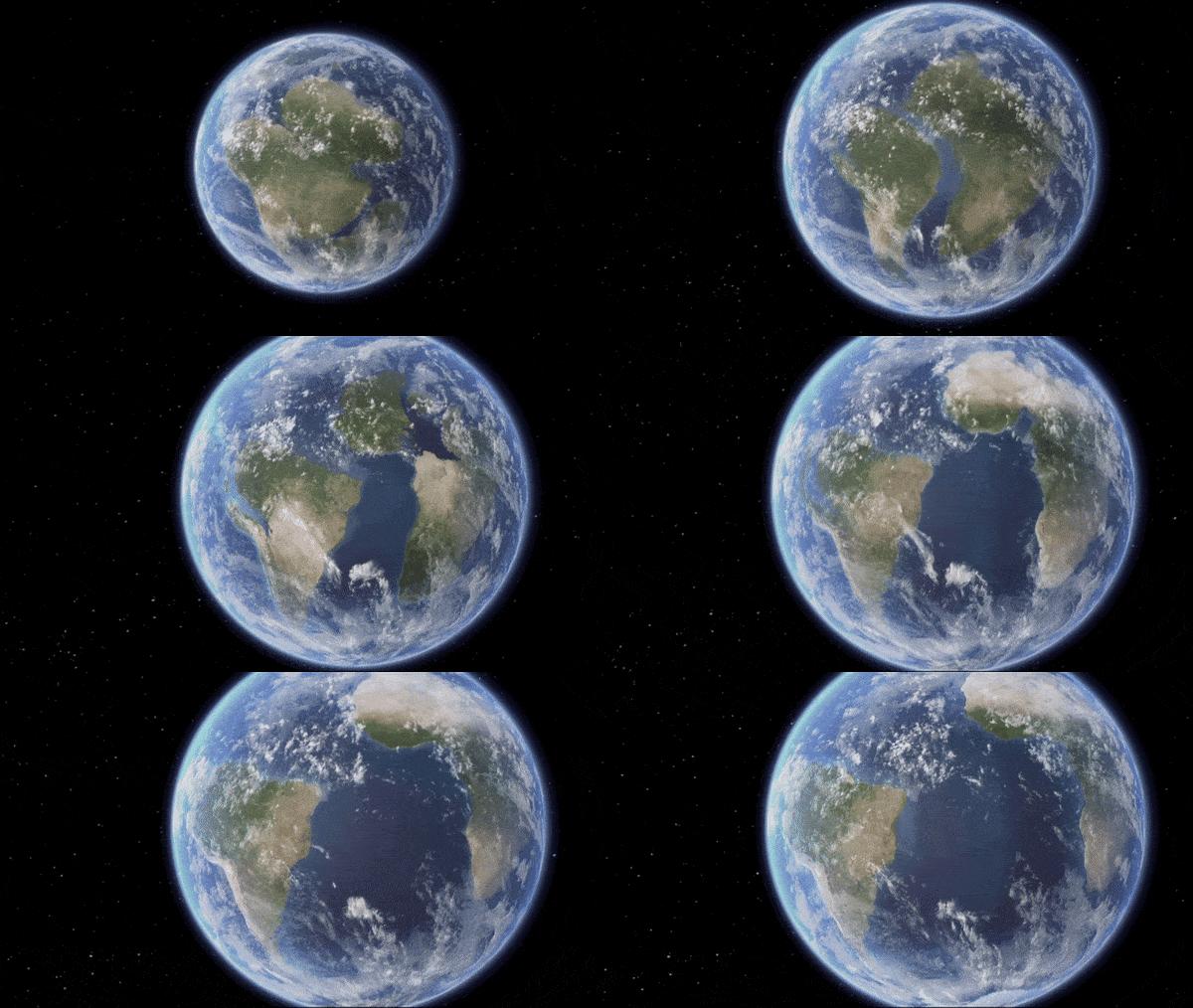
The split between South America and Africa 135 million years ago was a fiery affair, new research finds.
The continental breakup spewed over 3.8 million cubic miles (16 million cubic kilometers) of magma that still persists as volcanic rocks in South America, in Africa, and on the seafloor of the Atlantic Ocean. In some places in Namibia and Angola, these volcanic rock layers are up to 0.6 mile (1 kilometer) thick.
The new study — which combines multiple sources of previously collected data from South America, Africa and the ocean floor — finds that the main magma eruptions occurred between 135 million and 131 million years ago, with a peak around 134.5 million years ago. This improved understanding of the eruption timing could give researchers a better idea of what triggered the breakup as well as its impacts on the climate.
"We get some extinctions and also some perturbations on the climate" around 134.5 million years ago, said study lead author Mohamed Mansour Abdelmalak, a geologist and geophysicist at the University of Oslo in Norway. Knowing the precise age of the magma helps tie the eruptions to these events.
The new research also finds evidence of a "thermal anomaly" beneath what was then southern Pangaea, the supercontinent that began breaking up 200 million years ago into the continents present today. This breakup was slow, with South America and Africa splitting 135 million years ago, and North American not completing its schism with Europe until 55 million years ago. Previous research has suggested that the breakup of southern Pangaea happened, in part, because of what's known as a mantle plume — a rising column of superhot rock from Earth's middle layer, the mantle. These plumes melt and thin the continental crust from below.
The new research hints that the thermal anomaly that helped separate South America and Africa may have been caused by that mantle plume, Abdelmalak told Live Science, but the hypothesis is still controversial.
"We don't have many samples, so we don't know exactly if this volcanism is related to the mantle plume," he said. Samples are particularly needed from the rock that now sits under the deep ocean off the coast of Argentina and Uruguay, where very little deep-sea drilling has been done, he said.
Get the world’s most fascinating discoveries delivered straight to your inbox.
RELATED STORIES
There is a modern-day example of a mantle plume leading to outpourings of magma in Iceland, however, Abdelmalak said. There, the Mid-Atlantic Ridge — which is still pulling apart at a rate of 0.8 to 2 inches (2 to 5 centimeters) a year — is on land. This land has been formed by the Iceland hotspot, which studies suggest is driven by a plume reaching deep into the mantle.
Additional deep rock samples from Africa and the deep ocean could help researchers understand how much magma erupted during the split between Africa and South America and how the eruptions affected the climate, Abdelmalak said. In most large eruptions, the climate warms because volcanoes spew huge amounts of greenhouse gases. But there was a period of cooling 134 million years ago, which may have been because the magma that erupted broke down, or weathered, quickly. In weathering, rocks break down and chemically react with the air, pulling carbon dioxide out of the atmosphere.
The findings appear in the May issue of the journal Earth-Science reviews.

Stephanie Pappas is a contributing writer for Live Science, covering topics ranging from geoscience to archaeology to the human brain and behavior. She was previously a senior writer for Live Science but is now a freelancer based in Denver, Colorado, and regularly contributes to Scientific American and The Monitor, the monthly magazine of the American Psychological Association. Stephanie received a bachelor's degree in psychology from the University of South Carolina and a graduate certificate in science communication from the University of California, Santa Cruz.
You must confirm your public display name before commenting
Please logout and then login again, you will then be prompted to enter your display name.