Get the world’s most fascinating discoveries delivered straight to your inbox.
You are now subscribed
Your newsletter sign-up was successful
Want to add more newsletters?
Join the club
Get full access to premium articles, exclusive features and a growing list of member rewards.
An account already exists for this email address, please log in.
An ocean of magma formed early in Earth's history and it may still influence our planet today, study finds
Remnants of a liquid layer of magma near Earth's core, formed in the first few hundred million years of the planet's history, may still persist today as odd anomalies in the mantle.
Earth held a deep ocean of magma beneath its surface in its early history, new research finds, potentially explaining odd anomalies seen in the mantle today.
This basal magma ocean has been hotly debated for years. Some geochemical evidence indicates that in the first few hundred million years of the planet's existence, a persistent sea of melt formed at the boundary between Earth's core and its middle layer, the mantle. But models of the planet's formation suggested that when Earth was new and molten, it solidified from the bottom up, making it hard to understand how a deep magma ocean could exist.
The new study, published March 26 in the journal Nature, found that not only could a magma ocean exist, but that its presence was inevitable. No matter the precise location where the molten newborn planet started to crystallize into a solid, a basal ocean still formed, the study revealed.
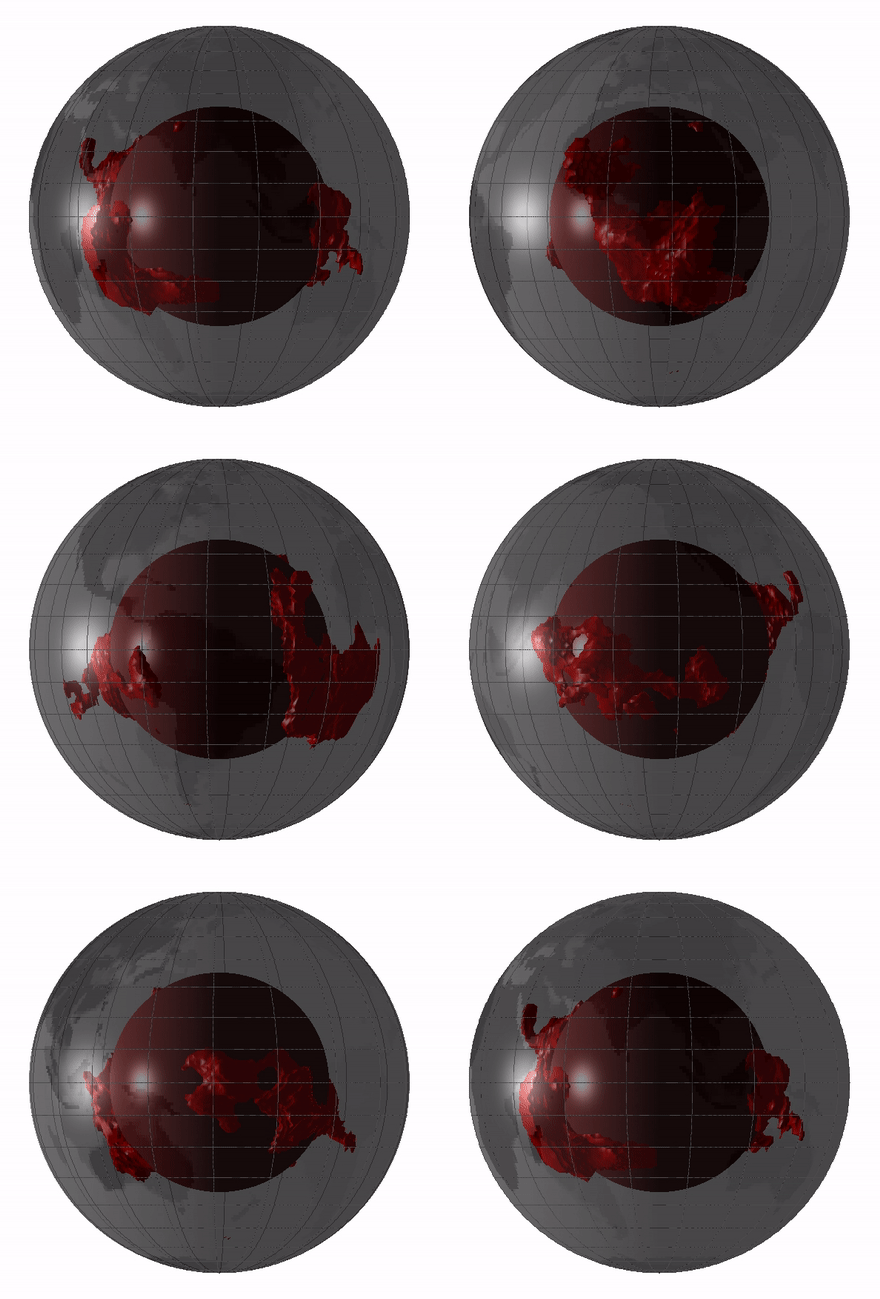
Remnants of this hidden magma sea could still exist today in the form of large low-shear velocity provinces (LLVPs) or mantle "blobs," which are giant regions of the deep mantle where earthquake waves travel more slowly than they do through the rest of the mantle.
Scientists have debated whether these LLVPs are the remains of oceanic crust that have been pushed deep into the mantle, meaning they date back a few hundred million years, or whether they're the leftovers from Earth's basal magma ocean, making them 4.4 billion years old.
The new study argues for the latter and the findings could have major implications for how researchers understand Earth's history, said study lead author Charles-Édouard Boukaré, a planetary physicist at York University in Toronto.
"It would affect thermal communication between the core and the mantle," Boukaré told Live Science. "It might affect the location of tectonic plates."
Sign up for the Live Science daily newsletter now
Get the world’s most fascinating discoveries delivered straight to your inbox.
Earth's early days
The researchers built a new model of Earth's formation that considered both geochemical data and seismic data — the two main methods of peering into Earth's deep history. In particular, there are important trace elements that chemically prefer to stay in the magma while other minerals crystallize into rock. The amount of these trace elements in rock can reveal when and in what order the rocks of the mantle solidified.
Most studies of this era of Earth's formation focus on the initial solidification of the mantle and the dynamics when the mantle was still mostly liquid.
Boukaré and his team focused a little later, looking at the point at which the mantle would have been crystallized enough that it was behaving as a solid rather than a liquid. They found that regardless of where the solidification first started — in the middle of the mantle, or right at the boundary with the core — a basal magma ocean formed.
Remnants of the magma ocean my still exist today as LLVPs, or giant "blobs" in Earth's mantle.
The process would have started with a thin crust of solids forming on the surface of the new Earth, but the solids were cold and less buoyant than the underlying mantle, so they sank and remelted.
However, as the mantle continued to cool, solids that formed in the upper mantle started to sink and accumulate in the lower mantle. These solids were rich in iron oxide, which is dense and has a low melting point, so these solids sank deeper and often remelted. Because of how dense iron oxide is, even in its liquid form, this melt did not rise back up, as liquids usually rise above solids. Instead, it stayed in the deep mantle, where the heat from the core kept it melted. This formed the basal magma ocean.
The researchers varied the conditions in their model to alter the depth of the solid formation, but those parameters didn't change anything. Even in the least conducive circumstances for a deep magma ocean, one still formed.
The findings suggest that the main structure of the planet formed very early in its history, Boukaré said. "Another way to say this is there is a memory," he said. The seeds of the planet's dynamics would have been planted very early, with these ancient structures continuing to influence how the planet changed moving forward.
"We might say if we have some initial condition of the planet and we can model the very early stages of planetary evolution, we can then predict most of its behavior on long timescales," Boukaré said.
He next plans to improve the modeling by incorporating more trace elements. It would also be interesting to apply the model to other planets such as Mars to see if other rocky planets go through similar transitions, Boukaré said.
"Maybe this basal ocean thing is not something that is unique to the Earth," he said.
Stephanie Pappas is a contributing writer for Live Science, covering topics ranging from geoscience to archaeology to the human brain and behavior. She was previously a senior writer for Live Science but is now a freelancer based in Denver, Colorado, and regularly contributes to Scientific American and The Monitor, the monthly magazine of the American Psychological Association. Stephanie received a bachelor's degree in psychology from the University of South Carolina and a graduate certificate in science communication from the University of California, Santa Cruz.
You must confirm your public display name before commenting
Please logout and then login again, you will then be prompted to enter your display name.