It's quick and easy to access Live Science Plus, simply enter your email below. We'll send you a confirmation and sign you up for our daily newsletter, keeping you up to date with the latest science news.
ANCHORAGE, Alaska — Mount St. Helens is nowhere near another eruption, but new magma is rising underground, heaving the volcano upward and outward by the length of a fingertip, researchers said here today (May 2) at the annual meeting of the Seismological Society of America.
A small amount of magma started pooling 2.5 to 3 miles (4 to 5 kilometers) beneath the volcano in 2008, said lead study author Seth Moran, a seismologist with the Cascades Volcano Observatory in Washington state. The depth comes from the pattern of surface swelling, measured with GPS, and from earthquakes triggered by the molten rock pushing upward. GPS units moved away from the center of the volcano by up to 0.5 inches (12 millimeters) between 2008 and 2013. (Imagine that Mount St. Helens' magma chamber is like a balloon inflating deep beneath the volcano, pushing everything above it out of the way as it fills with a fresh batch of molten rock.) [Gallery: The Incredible Eruption of Mount St. Helens]
"This doesn't mean it's getting ready to erupt," Moran told Live Science's Our Amazing Planet. "The balloon has inflated, and it could stay inflated for decades. What we can say, is when it is ready to erupt, we will know."
The observatory tracked a similar refueling pattern beneath Mount St. Helens during the volcano's quiet period in the 1980s and 1990s, Moran said. However, the earthquakes were deeper during the first quiet period, at about 4 to 5 miles (6 to 8 km) below the surface, and the magma refueled faster, according to the new results.
Digital elevation map of Mount St. Helens, showing the epicenter of earthquakes from 2008 to 2014.
(Image credit: S. Moran)
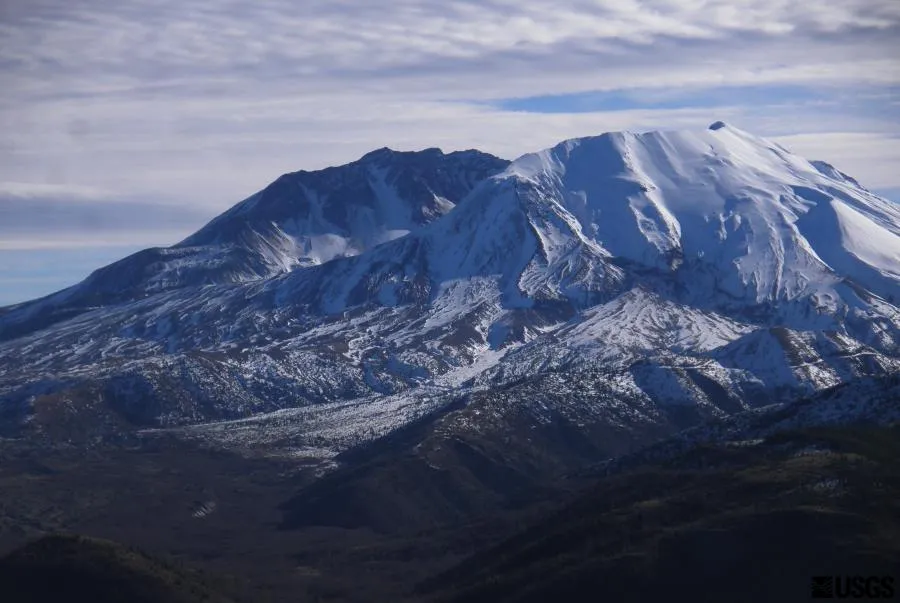
Scientists keep a close eye on the Washington volcano, which has erupted on and off since its deadly 1980 blast. Studies of past eruptions suggest Mount St. Helens is more likely to spend the next few hundred years rebuilding a beautiful, snowy peak, rather than blowing the countryside to smithereens.
Even so, the signals from the slumbering volcano are a message to be ready for the next eruption, however small, the researchers said.
"We're like the fire department," Moran said. "We've got to be ready to go."
Sign up for the Live Science daily newsletter now
Get the world’s most fascinating discoveries delivered straight to your inbox.
Becky Oskin covers Earth science, climate change and space, as well as general science topics. Becky was a science reporter at Live Science and The Pasadena Star-News; she has freelanced for New Scientist and the American Institute of Physics. She earned a master's degree in geology from Caltech, a bachelor's degree from Washington State University, and a graduate certificate in science writing from the University of California, Santa Cruz.