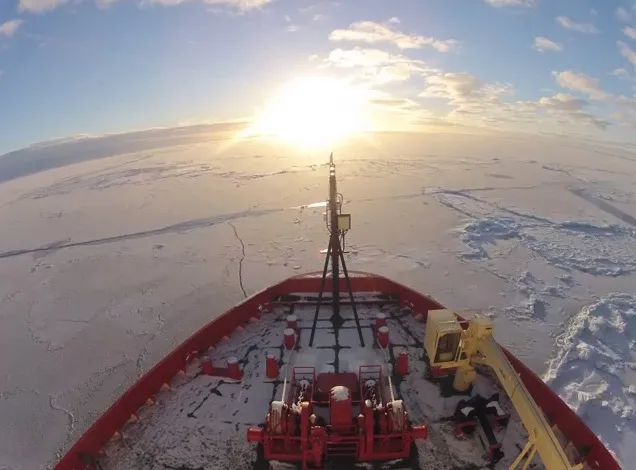
The oceans surrounding Antarctica may be littered with buried shipwrecks in pristine condition, new research suggests.
Researchers came to that conclusion, detailed today (Aug. 13) in the journal Proceedings of the Royal Society B, after burying wood and bone at the depths of the Antarctic oceans and analyzing the handiwork of worms and mollusks more than a year later.
"The bones were infested by a carpet of red-plumed Osedax worms, which we have named as a new species — Osedax antarcticus — but the wood planks were untouched, with not a trace of the wood-eating worms," study co-author Adrian Glover, an aquatic invertebrates researcher at the Natural History Museum in London, said in an email. "The wood was hardly degraded either, after 14 months on the seafloor."
Latest Videos From
That finding suggests that some of the most iconic shipwrecks — including the Endurance, the most famous ship to ever sail to Antarctica — could be perfectly preserved in the icy waters near the southern continent. [Shipwrecks Gallery: Secrets of the Deep]
Sir Ernest Shackleton first set sail for Antarctica aboard the Endurance. At the time, the ship was the strongest one ever built. Yet it was crushed by icebergs in the Weddell Sea near Antarctica in 1915 and sunk. More than 9 months later and a after a series of harrowing ordeals, the entire crew was eventually rescued.
In any other ocean, wooden ships like the Endurance are quickly devoured by shipworms or wood-boring mollusks.
Antarctica, however, has been treeless for the last 30 million years. Instead, the region is teeming with whales and other cetaceans whose bones sink to the ocean floor. That raised the possibility that, whereas ocean dwellers feast on wood in other regions, local organisms may have adapted to devour bone in Antarctica.
To see how shipwrecks and animal bones fared in the Southern Ocean, the team created massive underwater landers that were loaded with whalebones and large planks of pine and oak, Glover said. They then placed those landers at three spots in the ocean along the western Antarctic Peninsula.
Fourteen months later, the team hoisted up the landers from the seafloor. The bones, which were riddled with holes, were covered in O. antarcticus. The wooden planks, in contrast, were untouched by wood-boring mollusks.
After analyses, the team found the worms were genetically related to the worms that live in sulfuric, oxygen-poor muds and use bacteria to break down their food.
"Perhaps, at some point after whales first appeared in the oceans, ancestral worms were able to make the evolutionary leap from sulphidic muds to whale carcasses," Glover said, adding that fossil studies should help the researchers understand how that leap was made.
At least one group, Blue Water Recoveries, hopes to recover the Endurance shipwreck in the future.
Follow Tia Ghose on Twitterand Google+. Follow LiveScience @livescience, Facebook & Google+. Original article on LiveScience.

 Live Science Plus