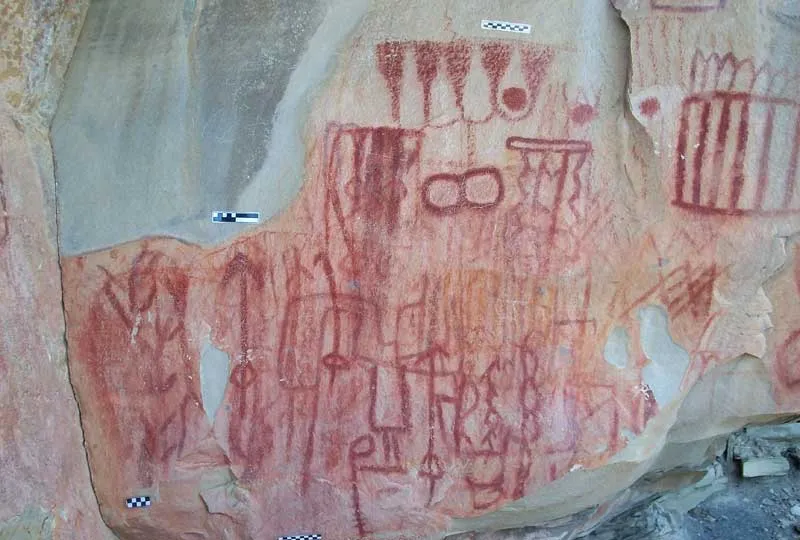
In the mountains of northeastern Mexico, archaeologists have unearthed thousands of ancient paintings on the walls of caves and ravines from a time before Spanish rule.
The rock art offers rare evidence from native cultures living in the area around the Sierra de San Carlos, a mountain range in Mexico's state of Tamaulipas, researchers say.
Almost 5,000 of these paintings were found across 11 different sites in the region, the researchers said. Created with red, yellow, black and white pigments, the images show animals from deer to lizards to centipedes, as well as people. Depictions of tents, hunting, fishing and possibly astronomical charts also offer a glimpse into the life of this mysterious culture.
The findings document the presence of pre-Hispanic groups, "where before it was said that there was nothing, when in fact it was inhabited by one or more cultures," archaeologist Gustavo Ramirez, of the Mexican National Institute of Anthropology and History, said in a statement.
The rock art was documented in the Sierra de San Carlos mountain range.
(Image credit: Mexican National Institute of Anthropology and History)
The ancient people who once inhabited the mountains of Tamaulipas left very little behind for modern archaeologists to pore over. There is little known of their languages, rituals and customs, besides references to them by conquistadors and friars who colonized and Christianized the region.
Another archaeologist, Martha Garcia Sanchez, said these people were able to resist Spanish rule by living in the mountains, "where they had water, plants and animals to feed themselves."
The rock art was rediscovered in 2006, and archaeologists first started studying the site two years ago. Researchers have not yet been able to precisely date the paintings but further testing on samples of the pigments could reveal the age of the rock art.
Sign up for the Live Science daily newsletter now
Get the world’s most fascinating discoveries delivered straight to your inbox.
"We have not found any ancient objects linked to the context, and because the paintings are on ravine walls and in the rainy season the sediments are washed away, all we have is gravel," said Ramirez.
The findings were presented during the Second Conference of Archaeological History in Mexico City.
Megan has been writing for Live Science and Space.com since 2012. Her interests range from archaeology to space exploration, and she has a bachelor's degree in English and art history from New York University. Megan spent two years as a reporter on the national desk at NewsCore. She has watched dinosaur auctions, witnessed rocket launches, licked ancient pottery sherds in Cyprus and flown in zero gravity. Follow her on Twitter and Google+.