Rainbow Retinas & Fiery Cosmic Webs: Winning Images Turn Science Into Art
Get the world’s most fascinating discoveries delivered straight to your inbox.
You are now subscribed
Your newsletter sign-up was successful
Want to add more newsletters?
Delivered Daily
Daily Newsletter
Sign up for the latest discoveries, groundbreaking research and fascinating breakthroughs that impact you and the wider world direct to your inbox.
Once a week
Life's Little Mysteries
Feed your curiosity with an exclusive mystery every week, solved with science and delivered direct to your inbox before it's seen anywhere else.
Once a week
How It Works
Sign up to our free science & technology newsletter for your weekly fix of fascinating articles, quick quizzes, amazing images, and more
Delivered daily
Space.com Newsletter
Breaking space news, the latest updates on rocket launches, skywatching events and more!
Once a month
Watch This Space
Sign up to our monthly entertainment newsletter to keep up with all our coverage of the latest sci-fi and space movies, tv shows, games and books.
Once a week
Night Sky This Week
Discover this week's must-see night sky events, moon phases, and stunning astrophotos. Sign up for our skywatching newsletter and explore the universe with us!
Join the club
Get full access to premium articles, exclusive features and a growing list of member rewards.
From the dark-matter web of the universe to the rainbow of a mouse's retina, a new trove of award-winning science images reveals little-seen worlds.
The winners of the 2011 International Science and Engineering Visualization Challenge, announced today (Feb. 2) turn dry data into vivid imagery. The informational poster "The Cosmic Web," for example, used simulations and algorithms to create a fiery, beautiful representation of matter in the universe through time. The image, by Johns Hopkins University cosmologist Miguel Angel Aragon-Calvo, won a spot on the cover of the Feb. 3 issue of the journal Science, which co-sponsors the contest with the National Science Foundation.

The contest also includes interactive games. One honoree this year created one called "Build-a-Body," in which players can drag and drop organs into a virtual human body, learning anatomy and playing surgeon. Another game allows players to "zoom in" to the human body and look at individual cells.
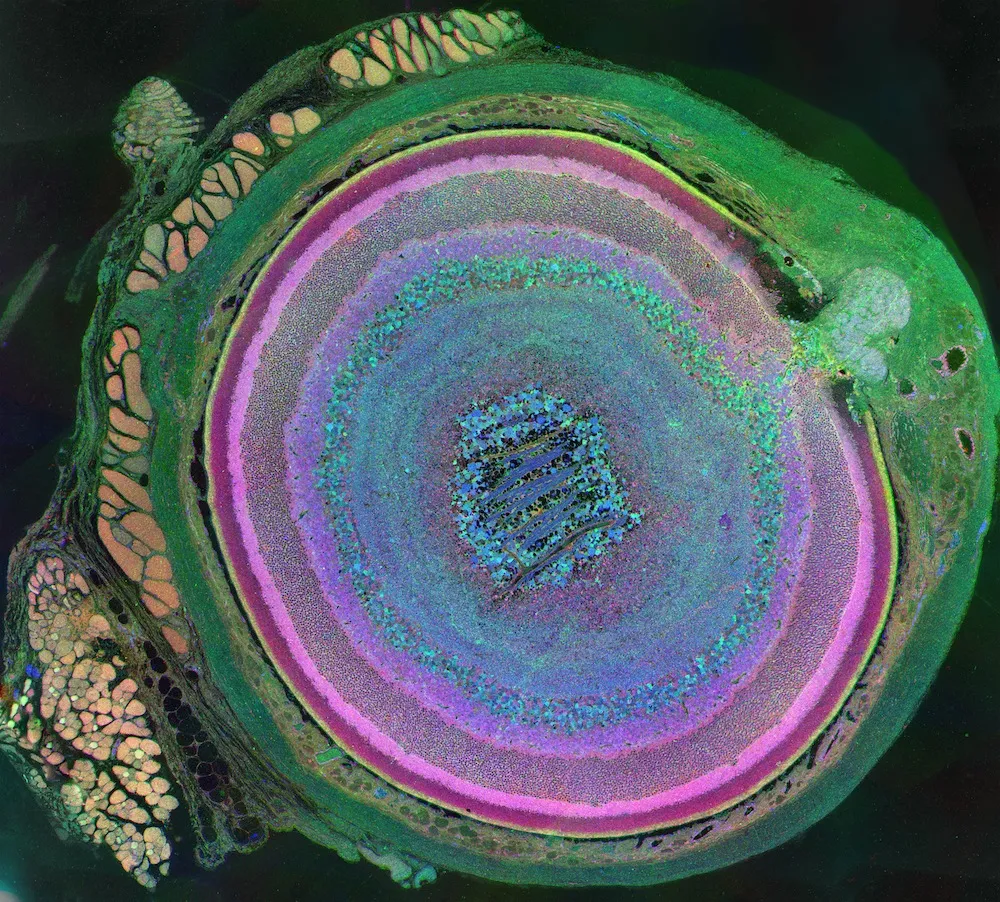
This year's winner in the photography category is a stunning photograph of a mouse's eye. Using a technique called computational molecular phenotyping, University of Utah neuroscientist Bryan William Jones reveals the metabolic diversity of the cells in the creature's retina. [See the Winning Images]
Another amazing close-up photograph captures the trichomes on the skin of a young cucumber. These vegetable defenses are tiny sharp spikes filled with bitter compounds to send plant-eaters running.
The contest, in its ninth year, had 212 entries. Judges picked those they felt had the most impact, the most effective communication, and the most originality. The goal is to honor recipients who use visuals to communicate the complexities of scientific research.
"The talent of these award winners is remarkable," Monica Bradford, the executive editor of the journal Science, said in a statement. "These winners communicate science in a manner that not only captures your attention, but in many instances strives to look at different ways to solve scientific problems through their varied art forms."
Get the world’s most fascinating discoveries delivered straight to your inbox.
You can follow LiveScience senior writer Stephanie Pappas on Twitter @sipappas. Follow LiveScience for the latest in science news and discoveries on Twitter @livescience and on Facebook.

Stephanie Pappas is a contributing writer for Live Science, covering topics ranging from geoscience to archaeology to the human brain and behavior. She was previously a senior writer for Live Science but is now a freelancer based in Denver, Colorado, and regularly contributes to Scientific American and The Monitor, the monthly magazine of the American Psychological Association. Stephanie received a bachelor's degree in psychology from the University of South Carolina and a graduate certificate in science communication from the University of California, Santa Cruz.