It's quick and easy to access Live Science Plus, simply enter your email below. We'll send you a confirmation and sign you up for our daily newsletter, keeping you up to date with the latest science news.
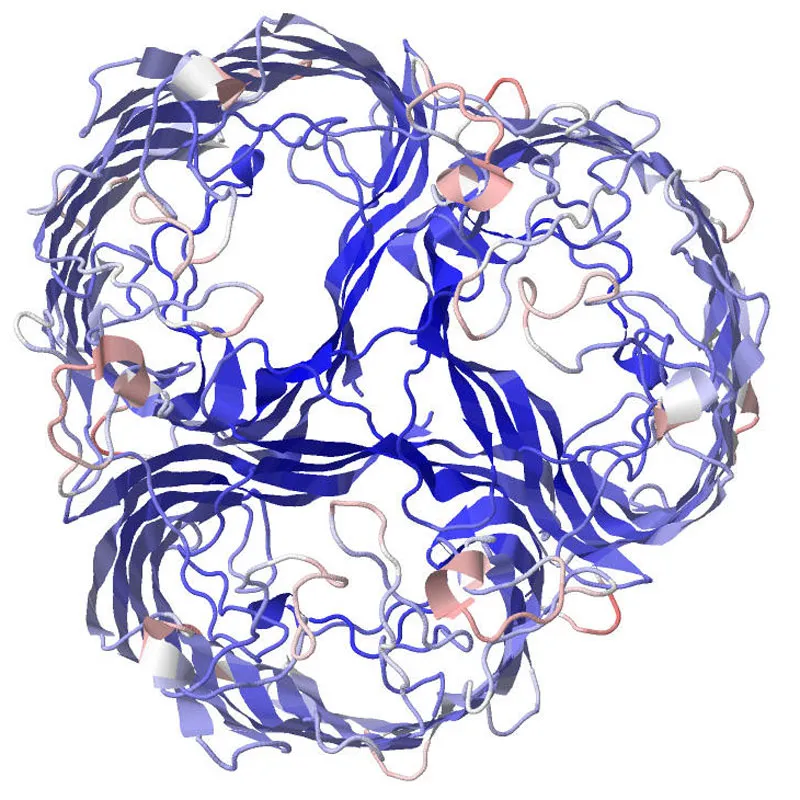
An image of a protein, LamB, found on the surface of the bacterial cell. Scientists examined what happened when a virus could no longer infect the bacteria through this protein.
The arms race between a virus and the bacteria it attacks has helped scientists better understand one of the mysteries of evolution: How new traits evolve.
In a series of experiments, the bacteria-infecting viruses repeatedly acquired the ability to attack their host bacteria through a different "doorway," or receptor on the bacteria's cellular membrane, explained Justin Meyer, the lead researcher and a graduate student at Michigan State University. [Video: The Virus Mutates]
Their results offer insight into a difficult question about evolution: Where do new traits come from?
According to evolutionary theory, natural selection can favor certain members of a population because of traits they possess, such as camouflage or an ability to get at food others can't reach. These favored organisms are more likely to reproduce, passing on the genes for their helpful traits to future generations.
While it's clear how natural selection causes a population to change, or adapt, explaining how new traits arise has been trickier, Meyer said.
For instance, do random genetic mutations gradually accumulate until they produce new traits? Or, does natural selection drive the process from the start, favoring certain mutations as they arise, until a whole new trait appears?
To get an idea, he and others, including two undergraduate researchers, prompted a virus to evolve a new way to infect the bacteria, then looked at the genetic changes associated with this new ability. They also found that changes in the bacteria could prevent the virus from acquiring this new trait.
Sign up for the Live Science daily newsletter now
Get the world’s most fascinating discoveries delivered straight to your inbox.
An E. coli cell. In the experiment, bacterial cells like this one evolved resistance to a virus, prompting the virus to evolve a new way to attack..
(Image credit: Brian D. Wade and Alicia Pastor, Center for Advanced Microscopy, MSU)
In 102 trials, they combined E. coli cells with the virus, called lambda. Lambda normally infects the bacteria by targeting a receptor, LamB, on the bacterium's outer membrane. The virus does this using a so-called J protein at the end of its tail; this protein unlocks the door into the bacterial cell, Meyer said.
When cultured under certain conditions, most E. coli cells developed resistance to the virus by no longer producing LamB receptors. To infect the bacterial cells, then, the virus had to find another doorway into the cell. (Once inside, the virus hijacks the bacteria's cellular machinery to copy its own genetic code and reproduce.)
In 25 of the 102 trials, the virus acquired the ability to infect bacteria through another receptor, called OmpF. The viruses were genetically identical at the beginning of the experiment, so the researchers looked to see what genetic changes had occurred.
They found that all the strains that could infect the bacteria shared at least four changes, all of which were in the genetic code for the J protein, and which worked together, according to Meyer.
"When you have three of the four mutations, the virus is still unable to infect [the E. coli]," Meyer said. "When you have four of four, they all interact with each other. … In this case, the sum is much more than its component parts."
However, natural selection appears to have driven the rise of these individual mutations, he said, because the same mutations arose over and over again, and because they appear to affect the function of the J protein.
"The mutations are really centered on a small part of the gene and genome that would affect binding," he said.
Two lambda viruses. Four genetic mutations in viruses like these lead them to find a new way to attack their bacterial hosts.
(Image credit: Brian D. Wade and Alicia Pastor, Center for Advanced Microscopy, MSU)
So, why, in most cases, did the virus fail to acquire the ability to enter through the OmpF doorway? The researchers looked to see if other changes in the virus, or changes in the bacteria, interfered.
They found that while other changes in the virus did not seem to interfere, a specific change found in the E. coli populations from 80 trials did. Disruptions appeared in bacterial genes responsible for producing a protein complex, called ManXYZ, in the inner membrane. That change in the inner membrane meant the virus couldn't get all the way inside the cell, whether through LamB or OmpF.
"So there is this interesting co-evolutionary dance," Meyer said. "One mutation in the host and four mutations in the virus lead to a new virus. One mutation [in the host] and only a few mutations in the virus and a second mutation in the host, and the whole system shuts down."
You can follow LiveSciencesenior writer Wynne Parry on Twitter @Wynne_Parry. Follow LiveScience for the latest in science news and discoveries on Twitter @livescience and on Facebook.
Wynne was a reporter at The Stamford Advocate. She has interned at Discover magazine and has freelanced for The New York Times and Scientific American's web site. She has a masters in journalism from Columbia University and a bachelor's degree in biology from the University of Utah.