
 Live Science Plus


The Guppy: Newest Top Predator?

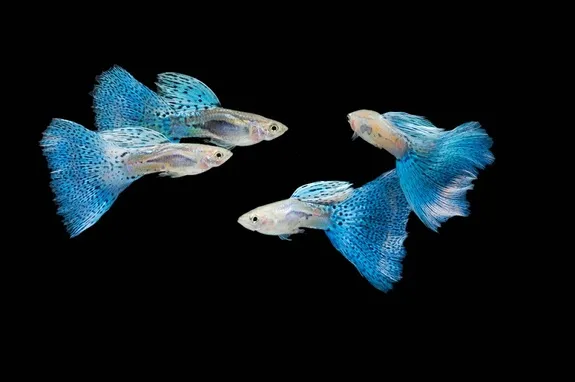
SAN FRANCISCO — Lions and tigers and bears and… guppies?
Don't let its tiny size, delicate tail or fondness for aquarium life fool you; a new chemical analysis places the guppy high up on the food chain, above even a shark, according to Greg Michalski, an assistant professor at Purdue University. The little fish becomes the "great white guppy," as he calls it.

Nitrogen-15 increases with each level on the food chain because animals' bodies prefer to excrete the lighter form, nitrogen-14, leaving the heavy stuff behind. So, each animal keeps the heavy nitrogen from the animals it eats, while losing some of the lighter stuff. With each step up the food chain, the ratio of heavy to light shifts in favor of nitrogen-15.
Michalski, who uses isotopes to study pollution and nitrogen cycling, had his students test seafood as a training exercise. Not surprisingly, they found that filter-feeding animals, like clams, came up with relatively low nitrogen-15 levels. Fish at the top of the food chain, like tuna and swordfish, had the most.
Then they moved on to more threatening subjects. In the common guppy, they found some of the highest levels of heavy nitrogen ever recorded.
Nitrogen enrichment is measured in comparison to the ratio of heavy to light nitrogen in the air. In the guppy, however, they found an increase in heavy nitrogen of 0.149 percent relative to that ratio. By comparison, they analyzed a sample from a thresher shark — a long-tailed, predatory shark — and found it had a 0.143-percent enrichment.
The reason is in the fish food. Their analyses revealed that all by itself, fish food landed in the middle of the food chain, in the vicinity of salmon, mahi mahi, octopus or cod.
"So we looked it up, and we realized that fish flakes are produced by the leftovers from commercial fisheries: fish heads, guts and fins," Michalski said. "They cut that off and make fish flakes out of it."
Then the heavy nitrogen contained in the fish flakes becomes further concentrated when eaten by the top predator, the common guppy, Michalski said.
This research was presented here Monday (Dec. 5) as part of a series of posters on "Fun with Isotopes" at the annual American Geophysical Union meeting.
You can follow LiveScience senior writer Wynne Parry on Twitter @Wynne_Parry. Follow LiveScience for the latest in science news and discoveries on Twitter @livescience and on Facebook.
