













How MIT Won Balloon Search-and-Rescue Challenge

When a child goes missing or a criminal is on the run, finding the best way to recruit others into helping your cause can mean the difference between life and death.
Now a contest between teams of scientists that hunted down balloons across the nation is revealing what the best strategies might be to mobilize a society.
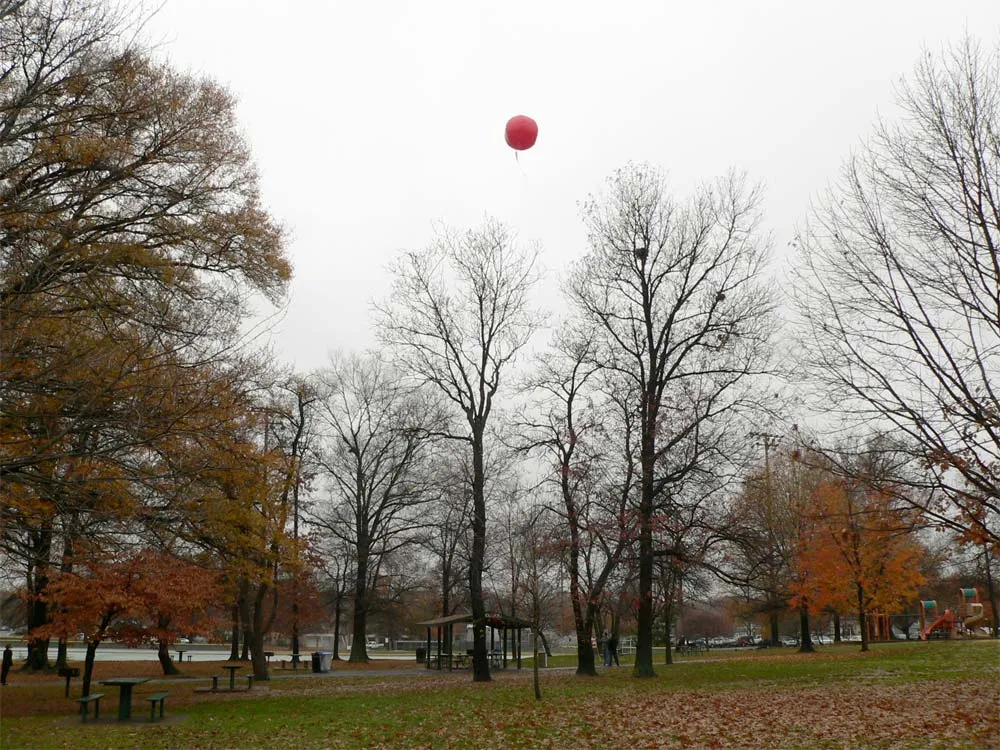
In the competition, held by the Defense Advanced Research Projects Agency (DARPA), 10 red weather balloons were placed at different locations around the continental United States. Fifty to 100 contending teams were then challenged to be the first to locate them all for a prize of $40,000. According to DARPA, a senior analyst at the National Geospatial Intelligence Agency characterized the problem as impossible using conventional intelligence-gathering methods.

The winner of the contest, a team from the Massachusetts Institute of Technology (MIT), leveraged the power of the World Wide Web to find all the balloons in less than nine hours with the help of nearly 4,400 volunteers recruited from across the country about 36 hours before the competition began. They not only offered prize money to anyone who located a balloon, but also offered money to each go-between who helped relay knowledge about a balloon to MIT.
Specifically, the MIT team's plan allocated $4,000 to each of the 10 balloons. They promised $2,000 per balloon to the first person to send in the correct balloon coordinates. Another $1,000 was pledged to whoever told the balloon-finder about MIT's reward, $500 to whoever told that teller about the reward, $250 to whoever told that taller, and so on. In this way, volunteers were both motivated to recruit others and to keep an eye out for the targets.
This winning strategy, called "recursive incentive," could be used for emergency response, such as finding survivors after disasters, "and for addressing 'tragedy of the commons' problems — 'Can we get everyone to save energy when no one person's actions alone have a significant effect on sustainability?'" researcher Alexander Pentland, a connection science pioneer at MIT, told LiveScience.
No other team located all 10 balloons. A team from the Georgia Tech did locate nine balloons within nine hours with the help of about 1,400 volunteers recruited over the course of a few weeks before the contest began. Two more teams found eight balloons, and five other teams found seven balloons.
Get the world’s most fascinating discoveries delivered straight to your inbox.
Now the researchers are testing other social incentives "to include healthy living, energy saving, and more," Pentland said. "The general goal is to provide the sorts of incentives that get people all happily working together to do all the things we need to make a better society."
"The biggest question is whether you can use this for everything that needs mass search," Pentland added. "The answer is probably no, at least not today — our mechanism requires that people pay attention to the problem at least a little bit, and attention is a scarce resource. In the future, where we have computer agents to help us with our social relationships, then possibly yes."
Although MIT's strategy proved the most successful at mobilizing groups for this kind of task, "for other tasks, other mechanisms will be best," Pentland noted. For instance, other problems might fare better with the altruism-based strategy employed by second place winner Georgia Tech, which offered to donate all of the prize money to the American Red Cross, or the strategy of hacker George Hotz, who used his fame to solicit help and find a total of eight balloons — four from his Twitter network of more than 35,000 followers, four through trades with competing teams.
The scientists detailed their findings Oct. 28 in the journal Science.
