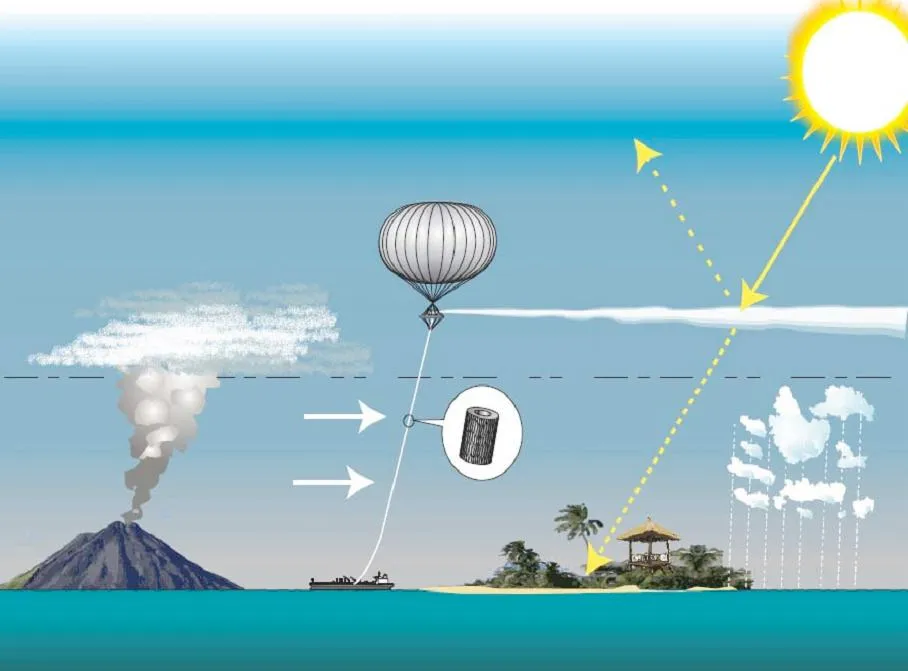
Envisioning a worst-case scenario in which climate change spirals out of control, researchers in the United Kingdom are planning to test a hose-and-balloon device that spews particles into the atmosphere in an attempt to bring global temperatures back down.
The method is a geoengineering technique that would mimic the cooling effect of giant volcanic eruptions. When thrown high into the atmosphere by volcanoes, small particles reflect sunlight into space, decreasing the amount of heat energy that arrives on Earth. If humans could place similar particles up high, we could theoretically offset the effects of greenhouse gas warming, researchers reason. [Read: Top 10 Craziest Environmental Ideas]
The upcoming tests, led by engineer Hugh Hunt at the University of Cambridge, would suspend a hose 0.6 miles (1 kilometer) into the atmosphere using a gigantic helium-filled balloon that is similar to a weather balloon. The hose will carry only water for now as researchers grapple with the challenges of keeping the hose aloft and functional. No actual geoengineering will take place.
Latest Videos From
"We've done lots of computer simulations on how balloons work in the wind, but now we need to do the tests," Hunt told LiveScience. "This is the next logical thing we have to do."
But not all scientists are sold on the idea of taking geoengineering experiments outside.
"There are issues involved in this that I don't think they're addressing with the experiment," said Alan Robock, a Rutgers University professor of environmental sciences. Among those barriers, Robock told LiveScience, are the rotating winds and cold temperatures at the high altitudes where particles would eventually need to be placed. Testing liquid water is also very different from testing the sulfur dioxide gas that would likely be the main ingredient in this type of geoengineering scheme, Robock said. In the atmosphere, sulfur dioxide combines with water to create reflective sulfuric acid particles.
The sticky ethics of engineering the climate
Engineering the climate to offset global warming is a controversial notion. The American Meteorological Society (AMS) and the American Geophysical Union (AGU) both hold the position that even if geoengineering could be done perfectly, humans have to slow greenhouse gas emissions.
"If we don't do that, then geoengineering is going to be needed at such a large scale that it can't possibly reduce all of climate change," said Robock, who helped write the AGU's 2009 position statement on geoengineering.
Geoengineering also has ethical pitfalls. Many researchers worry that the potential for rejiggering the planet's climate could lull people into a sense of complacency, removing the motivation to stop producing so many greenhouse gases. That would be a dangerous situation, Robock said, because if humans stopped maintaining the geoengineering infastructure (say, by running out of money to keep the hose and balloon functional) the buildup of greenhouse gases in the atmosphere would cause very rapid climate change, much faster than under current circumstances.
There's also a question of "whose hand would be on the thermostat," Robock said. Geoengineering would have to be a global solution, but different nations might have different interests. For example, Robock said, what if Russia decided that it could benefit from a warmer climate, or low-lying Pacific islands started clamoring for extra-cool temperatures? [The World's Weirdest Weather]
"Who's going to decide?" Robock said.
Even real-world testing of geoengineering needs to be approached with caution, Robock said, because some methods could cause local environmental shifts. Widespread geoengineering would alter precipitation patterns and even ozone cover (which protects us from the sun's harmful UV rays), he said, potentially disrupting the food supply and human lives.
"It's easy to think of things that might go wrong with this," Robock said. "What would you think of this writhing hose of sulfuric acid coming down out of the sky, spraying people, if the engineers can't keep it up?"
Last-ditch effort
Hunt himself said that he is horrified at the idea that humans might eventually be so desperate to fix our environmental problems that we'd have to turn to geoengineering.
"We're designing this thing not because we want to do geoengineering, but because we think someday we'll need to," he said. "I just think we need to have some sort of reasonable strategy for something else to do if everything else fails."
Humans are already inadvertently engineering the climate by pumping roughly 35 billion tons of carbon dioxide into the atmosphere each year, Hunt added. Geoengineering plans would add only a fraction of a percent of that amount in new particles to offset the greenhouse warming, he said.
"Every time you drive your car, every time you switch on your television, we're screwing things up," he said. "So the idea that we might be doing something unreasonable here, I find that a little bit aggravating."
But major technical barriers remain to make geoengineering work. The idea of forcing more reflective particles into the atmosphere to cool the Earth has precedent in nature: In 1991, for example, Mount Pinatubo in the Philippines erupted, and the volcanic fall-out cooled global temperatures by an average of 0.9 degrees Fahrenheit (0.5 degrees Celsius) over the next year.
It's not clear that humans will be able to reproduce this effect, however. Particles have to be the right size to hang in the atmosphere, and humans may not be able to maintain an artificial layer of particles thick enough to be effective, Robock said. Even getting the particles in the air is tough: They'll have to be injected upward of 6 to 11 miles (10 to 18 km) above ground, according to the Stratospheric Particle Injection for Climate Engineering, or SPICE, project, which is running the upcoming tests. That high in the atmosphere, you run into rotational winds and icy conditions that could easily destroy any delivery device.
The upcoming experiments, to be conducted in the next month in eastern England, will essentially test the waters using a lower altitude target and water instead of sulfur dioxide. The goal, according to SPICE, is to engineer a tether 15.5 miles (25 km) long. That would be the tallest human-built structure on Earth.
"We will have to deal with very high winds, the jet stream and high-altitude wind currents, and there's not much known about how balloons behave in high winds," Hunt said. "So the main purpose of the test at one kilometer is to examine the behavior of the balloon in high winds."
While the feasibility of seeding the atmosphere with reflective particles remains to be seen, even skeptics say that research on geoengineering should continue — albeit in low-risk ways.
"I think it's important, and we have computer models that can do that," Robock said. "I'm advocating continuing to do that so we learn about those potential benefits and negative impacts. However, to start doing experiments outdoors, I think we have to be very cautious about that."
You can follow LiveScience senior writer Stephanie Pappas on Twitter @sipappas. Follow LiveScience for the latest in science news and discoveries on Twitter @livescience and on Facebook.

 Live Science Plus