
-
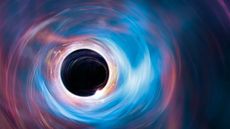 Scientists may have finally solved the problem of the universe’s 'missing' black holes
Primordial black holes are one of the strongest candidates for the universe's missing dark matter. But a new theory suggests that not enough of the miniature black holes formed for this to be the case.
black-holes -
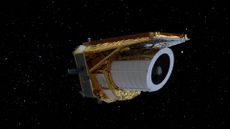 Euclid space telescope: ESA's groundbreaking mission to study dark matter and dark energy
The Euclid space telescope uses its incredibly wide field of view to hunt for two of the universe's most mysterious components: dark matter and dark energy. The six-year mission could change cosmology forever.
cosmology -
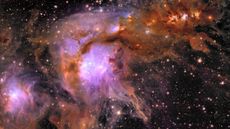 Euclid space telescope reveals more than 300,000 new objects in 1st 24 hours of observations (photos)
The Euclid space telescope has released five mesmerizing new photos of our universe, kicking off a six-year campaign to unveil the secrets of dark matter, dark energy and other cosmological mysteries.
cosmology -
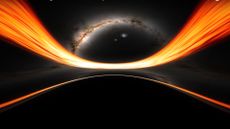 Newfound 'glitch' in Einstein's relativity could rewrite the rules of the universe, study suggests
Einstein's theory of general relativity is our best description of the universe at large scales, but a new observation that reports a "glitch" in gravity around ancient structures could force it to be modified.
physics-mathematics -
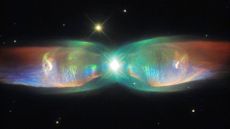 Giant 'rogue waves' of invisible matter might be disrupting the orbits of stars, new study hints
New research shows how disruptions to binary star systems could be the key to detecting space's most confounding substance — dark matter.
cosmology -
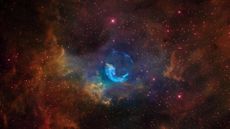 Cosmic 'superbubbles' might be throwing entire galaxies into chaos, theoretical study hints
When there are multiple supernovas in the same galaxy, they can leave enormous voids that tamper with the balance between dark matter and regular matter. Over time, this can throw entire galaxies into chaos.
cosmology -
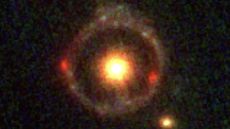 Researchers solve mystery of inexplicably dense galaxy at the heart of perfect 'Einstein ring' snapped by James Webb telescope
The James Webb Space Telescope discovered an inexplicably dense galaxy inside an "Einstein ring" last year. Now, researchers think they can explain this cosmic conundrum.
cosmology -
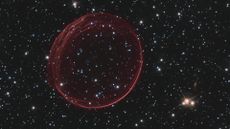 The universe may be dominated by particles that break causality and move faster than light, new paper suggests
With the nature of the universe's two most elusive components up for debate, physicists have proposed a radical idea: Invisible particles called tachyons, which break causality and move faster than light, may dominate the cosmos.
cosmology -
 Some stars may be 'infected' with black holes that destroy them from within, new study hints
Could dark matter be made of mini black holes that formed in the early universe? One way to find out is to look for missing stars, destroyed by primordial black holes, a new study suggests.
black-holes


