
-
 'The universe has thrown us a curveball': Largest-ever map of space reveals we might have gotten dark energy totally wrong
Findings from the Dark Energy Spectroscopic Instrument (DESI) suggest that dark energy could be evolving over time. If they're right, cosmology will need a new model.
21 Commentscosmology -
 Could the universe ever stop expanding? New theory proposes a cosmic 'off switch'
Dark energy, the mysterious phenomenon that powers the expansion of the universe, may undergo periodic 'violent transitions' that reverse the growth of the cosmos, a new pre-print study hints.
13 Commentscosmology -
 Evidence for Stephen Hawking's unproven black hole theory may have just been found — at the bottom of the sea
The recent discovery of a stupendously powerful neutrino has left scientists scratching their heads. New research suggests it could be evidence that Stephen Hawking was right about the nature of black holes and the early universe.
14 Commentsblack-holes -
 Most powerful cosmic rays in the universe start shockingly close to Earth, paper claims
The most powerful cosmic rays in the universe currently have no explanation. New research suggests that exotic, self-annihilating particles in our own galaxy may hold the answer.
4 Commentscosmology -
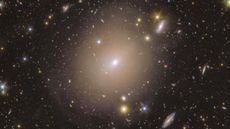 Euclid telescope spots rare 'Einstein ring' hiding near Earth — and an ancient, unnamed galaxy behind it
Einstein predicted the existence of gravitationally-warped rings of light in 1915. Now, a new one has been discovered just a cosmic stone's throw from our own planet.
cosmology -
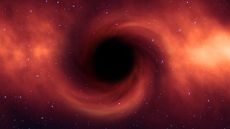 'Impossible' black holes detected by James Webb telescope may finally have an explanation — if this ultra-rare form of matter exists
Observations from the James Webb Space Telescope reveal monster black holes in the early universe that seem to have grown too big, too fast. New research points to a strange form of dark matter as a possible culprit.
18 Commentsblack-holes -
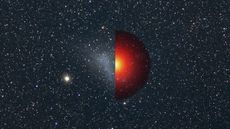 'Heavy' dark matter would rip our understanding of the universe apart, new research suggests
Because we haven't found anything yet, we've started to wonder if dark matter might be lighter or heavier than we thought.
cosmology -
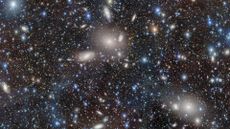 Space photo of the week: Galaxies teeter toward collision in the sparkling depths of Virgo
An ultra-deep image from the National Science Foundation's Dark Energy Camera reveals a wide variety of galaxies in the unusual Antlia Cluster.
astronomy -
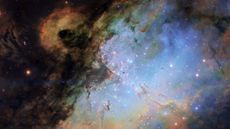 'A frankly embarrassing result': We still know hardly anything about 95% of the universe
"As yet, nobody has managed to understand what gives rise to this strange phenomenon, and explaining dark energy remains one of the most formidable challenges of modern science."
cosmology


