













Largest black hole collision ever detected
Seven billion years ago, two truly huge black holes slammed together and formed one 142 times the mass of the sun.

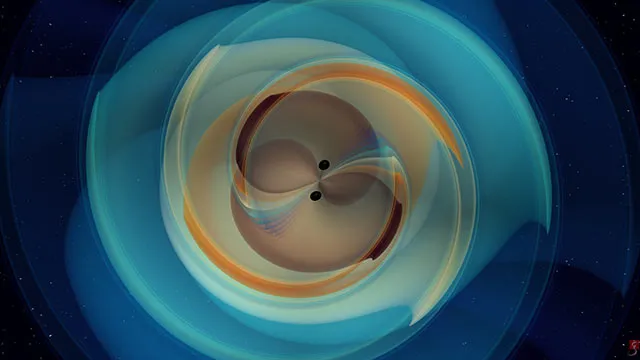
Seven billion years ago, two large black holes crashed together and formed a massive new one. It is the largest black hole collision ever detected in space, and the new black hole formed in the crash is the largest of its kind ever detected. It's so large, in fact, that physicists weren't sure it could exist at all.
The ripples from that collision reached the two Laser Interferometer Gravitational-Wave Observatory (LIGO) detectors in the U.S. and another in Italy called on May 21, 2019, after traveling through space for 2.5 billion years longer than the sun has existed. Those ripples revealed signatures of the merger of at least two black holes — one a black hole 85 times the mass of the sun and one 66 times the sun’s mass. When they collided, they formed a black hole 142 times the mass of the sun. The missing nine suns’ worth of matter got converted into energy in the collision, shaking the universe hard enough for LIGO and Virgo to detect and interpret. And that's how scientists learned that 85 solar mass black holes and monster 142 solar mass black holes can exist at all.
“This [signal] doesn't look much like a chirp, which is what we typically detect," Nelson Christensen, a member of the Virgo collaboration, said in a statement. "It is more like something that goes 'bang.'"
Related: 9 facts about black holes that will blow your mind
That "bang" shook our region of space for only about a tenth of a second after traveling for a longer period of time than any gravitational wave ever detected before. But analyzing the shape of the wave, the researchers realized the type of black holes involved and exactly how big they were. .
As Live Science previously reported, until now black holes have fallen into two categories: stellar-mass black holes and supermassive black holes.
Stellar-mass black holes, formed from collapsing stars, don't get much larger than a few dozen times the mass of the sun. These are the black holes that LIGO and Virgo have previously detected merging.
Get the world’s most fascinating discoveries delivered straight to your inbox.
At the other end of the spectrum are supermassive black holes, with masses millions or billions of times that of our sun and the gravity to grow whole galaxies around themselves. The Milky Way has one, as do most other comparable galaxies. But scientists aren't sure where they came from or how they formed; they've never detected a merger of such monstrous black holes.
Related:
In between the supermassives and the stellar-mass black holes is a wide "mass gap," a range of masses where no black holes have ever been detected. One idea is that supermassives grow out of mergers of stellar-mass black holes. But if that is the case, then they would have to pass through this mass range. Stellar-mass black holes would combine to form mass gap black holes, which would combine and combine until becoming supermassive. But until now, scientists have never seen that happen.
"One of the great mysteries in astrophysics is ‘How do supermassive black holes form?’" study co-author Christopher Berry, a Northwestern University physicist, said in a statement. "They are the million solar-mass elephants in the room. Do they grow from stellar-mass black holes, which are born when a star collapses, or are they born via an undiscovered means? Long have we searched for an intermediate-mass black hole to bridge the gap between stellar-mass and supermassive black holes. Now, we have proof that intermediate-mass black holes do exist."
Related: The 12 strangest objects in the universe
This discovery actually revealed that black holes can exist in two separate mass gaps. The 85 solar mass black hole fits into the "pair instability" gap.
Lighter stars don’t collapse into black holes because the outward pressure from photons and gas in their cores keeps them puffed up to large volumes, researchers believe. But at very large masses, the energy in a star's core converts photons into pairs of electrons and antielectrons, which together produce less pressure than photons do. That means that when the star does collapse, the process is so fast and energetic that much of the mass gets blown away into space. So a 130 solar-mass star can collapse and form a 66 solar-mass black hole.
This "pair instability" gap ranges from 66 solar masses to 120 solar masses — a range where theoretical calculations suggest no black hole could directly form from a collapsing star. The 85 solar-mass black hole detected in 2019 falls squarely in that range. The most likely explanation is that it's a "second generation" black hole, formed from two smaller progenitors. It's possible that the 66 solar-mass black hole was a second generation type as well, the researchers wrote in the study.
The 142 solar mass black hole falls into a different, bigger mass gap. A black hole that’s more massive than 120 suns could theoretically have formed from very large collapsing stars. But no black hole in that range has ever been detected, and until now researchers weren't sure whether black holes of that mass could exist at all, now matter how they formed. But this new, 142 solar-mass black hole falls squarely in that range — between the stellar masses and the supermassives. It proves that black holes of that mass can exist.
And it's still possible, the researchers wrote, that this signal doesn't reveal very large black holes as researchers assumed.
"What if something entirely new produced these gravitational waves?" Vicky Kalogera, another Northwestern researcher, said in the Northwestern statement. "It's a tantalizing prospect. ... For instance, perhaps the gravitational waves were emitted by a collapsing star in our galaxy. The signal also could be from a cosmic string produced just after the universe inflated in its earliest moments — although neither of these exotic possibilities matches the data as well as a binary merger."
Gravitational wave astronomy is still so new that it's impossible to be certain. As LIGO, Virgo and future detectors gather more data from new events, the researchers wrote, the picture should become clearer. And this event, with its promise of super-big black holes, might eventually become easier to explain.
A paper describing the discovery was published today (Sept. 2) in the journal Physical Review Letters. Another paper exploring its implications was also published today in The Astrophysical Journal Letters.
Originally published on Live Science.
