














Perseverance rover watches 'googly eye' solar eclipse from Mars
NASA's Perseverance Mars rover was treated to a 'googly eye' solar eclipse on Sept. 30 as the planet's moon Phobos passed in front of the sun.
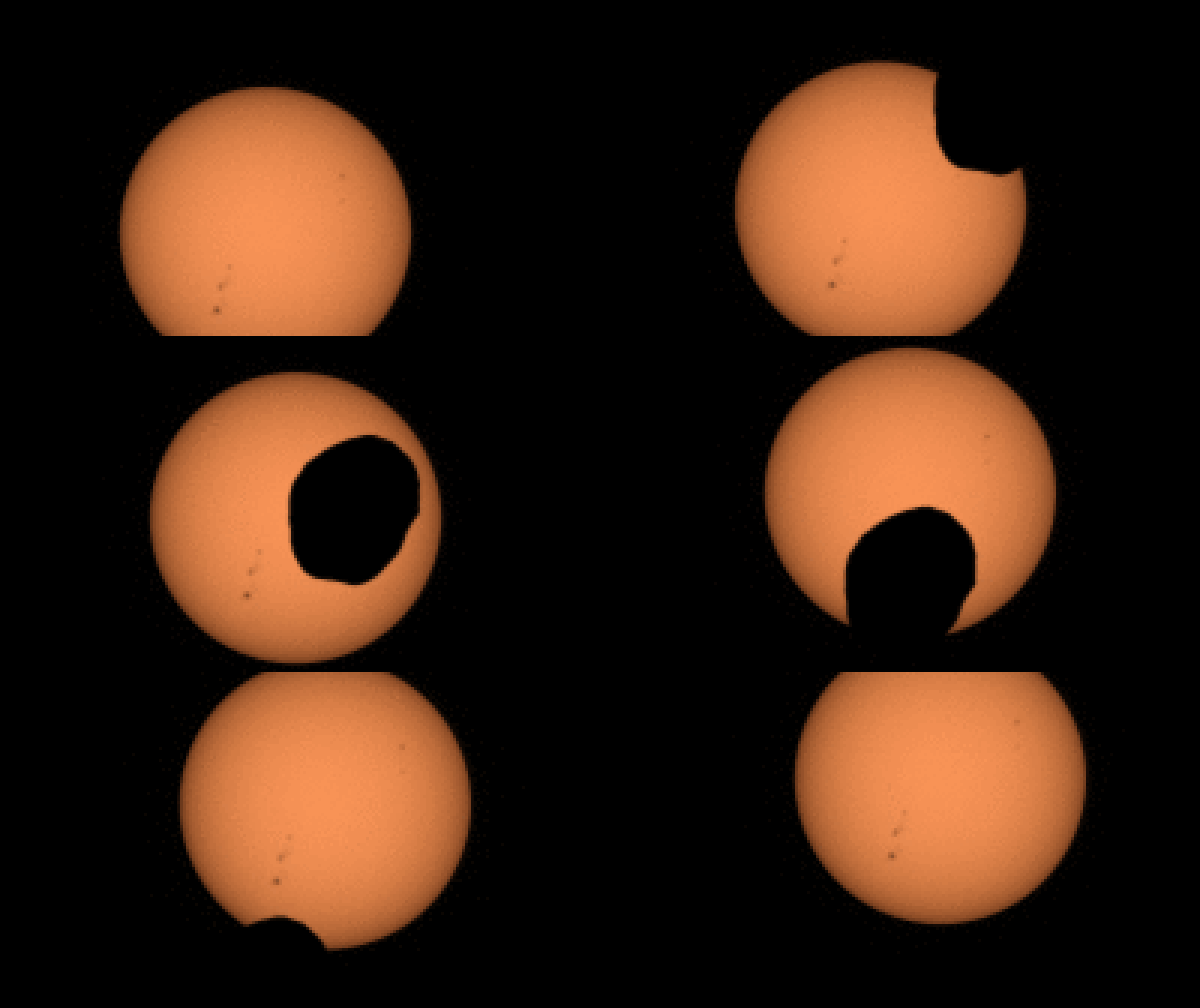
NASA's Perseverance Mars rover was treated to a "googly eye" solar eclipse as the planet's moon Phobos passed in front of the sun.
Phobos — one of Mars' two moons, along with the even tinier Deimos — traveled between the Red Planet and the sun on Sept. 30, the 1,285th Martian day of Perseverance's mission. The rover, located on the western wall of Mars' Jezero Crater at the time, captured the eclipse using its powerful Mastcam-Z camera system.
NASA recently shared a new video of footage taken by Perseverance, showing the tiny, potato-shaped moon as it moved in front of the sun's disk. Phobos appeared as a dark black object against the warm glow of the sun, creating what looks like a "googly eye" (where Phobos is the pupil) in the skies above Mars.
This is not the first time that Perseverance has witnessed a solar eclipse from Mars. In fact, given that Phobos circles the Red Planet once every 7.6 hours, this type of event is much more common on Mars, compared to eclipses on Earth.
Related: Perseverance rover watches a solar eclipse on Mars
"Because Phobos' orbit is almost perfectly in line with the Martian equator and relatively close to the planet's surface, transits of the moon occur on most days of the Martian year," NASA officials said in the statement sharing the new Perseverance video footage.
Measuring only 17 miles (27 kilometers) at its widest point, Phobos is roughly 157 times smaller in diameter than Earth's moon. Given its swift orbit, a transit of Phobos usually lasts only 30 seconds or so. The video footage shared shows the eclipse in real time, as well as sped up by four times.
Get the world’s most fascinating discoveries delivered straight to your inbox.
"At the same time that Phobos appeared as a large black disc rapidly moving across the face of the sun, its shadow, or antumbra, moved across the planet's surface," NASA officials said in the statement.
RELATED STORIES
In addition to Perseverance, NASA's Curiosity and Opportunity rovers have also been treated to solar eclipses on Mars, during which Phobos passed in front of the sun. By capturing various eclipse events over the last 20 years, scientists are able to learn more about the moon and how its orbit is changing.
This data is particularly helpful as Phobos is nearing Mars at a rate of 6 feet (1.8 meters) every 100 years. As a result, the moon is predicted to crash into the Red Planet within about 50 million years, according to the statement.
Originally posted on Space.com.