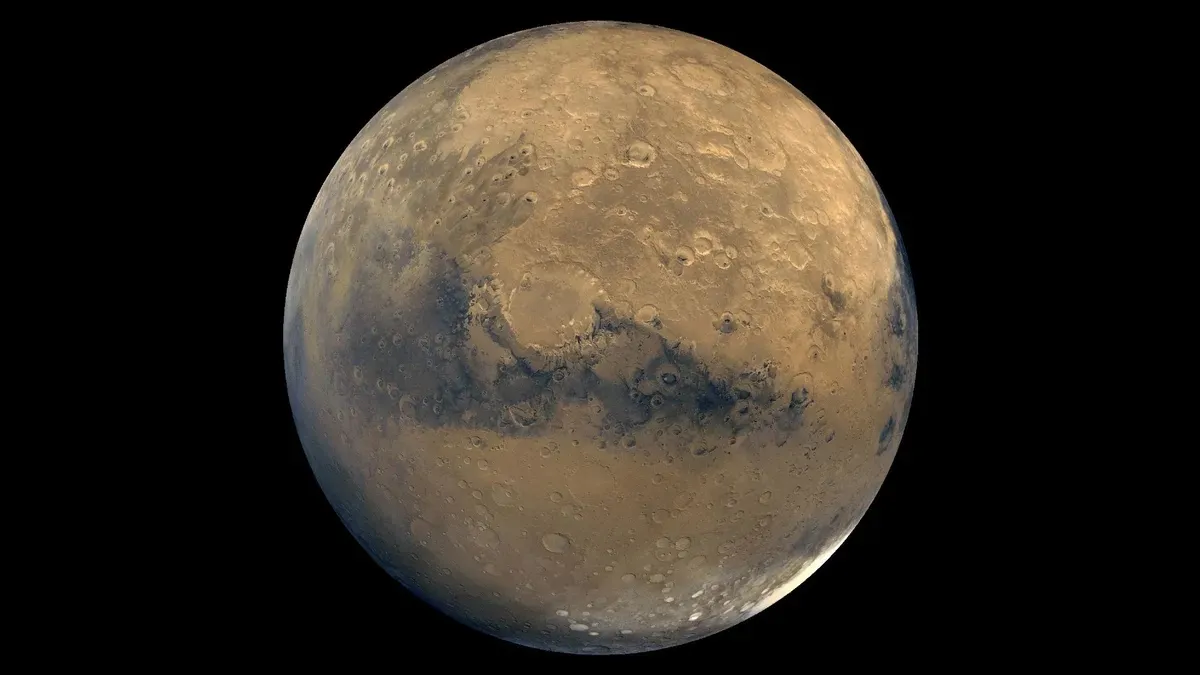
A long-lost moon could explain why Mars is so different from the other rocky planets in the solar system.
Today, Mars has two tiny moons. But early in its history, the Red Planet may have had a much larger moon, which might be responsible for Mars' weird shape and extreme terrain, Michael Efroimsky, an astronomer at the U.S. Naval Observatory in Washington, D.C., proposes in a paper that has been submitted to the Journal of Geophysical Research: Planets and is available as a preprint via arXiv.
Mars hosts some of the most extreme terrain in the solar system, including the largest canyon, the tallest mountain and the greatest highland region. This highland region, known as the Tharsis bulge or Tharsis rise, dominates Mars' western hemisphere near its equator. The Tharsis region is about 3,100 miles (5,000 kilometers) wide and rises up to 4.4 miles 7 (km) high, excluding its massive shield volcanoes, which rise even higher. Almost exactly on the opposite side of the planet from Tharsis sits Terra Sabaea and Syrtis Major, another highland region and massive shield volcano, respectively.
Either way, Nerio's significant mass altered the shape of Mars with its gravity, raising tides in the magma oceans the same way Earth's moon raises tides in our planet's oceans today. But because Mars is smaller than Earth, it cooled much more quickly and its tidal bulges became locked into the resulting form of the planet.
Somehow, Nerio got lost, Efroimsky wrote. It could have been obliterated by a collision, leaving behind Mars' current moons, Phobos and Deimos, he proposed, or it could have been scattered out of the solar system through a gravitational interaction with another body.
Such collisions and scatterings were common in the early solar system. Astronomers think Earth gained its moon through a collision with a Mars-size protoplanet and scatterings among the outer planets shifted their initial orbits, which were once much closer to the sun, into their present positions.
But as long as Nerio stayed around long enough to deform Mars as it cooled, it could have set the stage for that planet's dramatic landscape, Efroimsky said. Further geologic processes could have continued the work, uplifting the highlands and leading to Mars' odd shape.
Sign up for the Live Science daily newsletter now
Get the world’s most fascinating discoveries delivered straight to your inbox.
A screenshot from a video showing the Mars moon Phobos crossing the face of the sun. NASA’s Perseverance Mars rover captured the video on April 2, 2022, with its Mastcam-Z camera. You can also spot a group of sunspots on the left.
(Image credit: NASA/JPL-Caltech/ASU/MSSS/SSI)
Although the possibility is interesting, Efroimsky admitted that the Nerio explanation is just a hypothesis. The idea of a briefly held large moon raises many questions, especially regarding its formation and eventual disappearance. For example, if Nerio was destroyed, it should have left a series of craters along the belt aligning with its orbit, but no such string of craters exists. On the other hand, further collisions and geologic activity could have wiped away those traces.
Plus, the hypothesis requires geological processes to take the enhancements and deformations initiated by Nerio into their present-day forms, by lifting the initial highlands even higher. While it's reasonable to assume that heating and cooling processes in Mars' interior would naturally exaggerate any distortions in the planet's shape, it's not guaranteed.
Efroimsky has called on other researchers to evaluate the idea and consider whether there are clever ways to look for evidence of this lost moon.
Join our Space Forums to keep talking space on the latest missions, night sky and more! And if you have a news tip, correction or comment, let us know at: [email protected].
Paul M. Sutter is a research professor in astrophysics at SUNY Stony Brook University and the Flatiron Institute in New York City. He regularly appears on TV and podcasts, including "Ask a Spaceman." He is the author of two books, "Your Place in the Universe" and "How to Die in Space," and is a regular contributor to Space.com, Live Science, and more. Paul received his PhD in Physics from the University of Illinois at Urbana-Champaign in 2011, and spent three years at the Paris Institute of Astrophysics, followed by a research fellowship in Trieste, Italy.