Get the world’s most fascinating discoveries delivered straight to your inbox.
You are now subscribed
Your newsletter sign-up was successful
Want to add more newsletters?
Join the club
Get full access to premium articles, exclusive features and a growing list of member rewards.
An account already exists for this email address, please log in.
Chinese submersible explores previously unknown giant craters at the bottom of the Pacific — and they're teeming with life
Scientists have discovered and explored a giant hydrothermal system at the bottom of the Pacific, which could provide a window into the origins of life on Earth.
Chinese researchers have discovered a giant, previously unknown hydrothermal system at the bottom of the Pacific Ocean that could shed light on the origins of life.
The Kunlun system, northeast of Papua New Guinea, is made up of 20 large craters, the largest of which is around 5,900 feet (1,800 meters) wide and 430 feet (130 m) deep. These craters are clustered together in what the researchers called a "pipe swarm," and they release copious amounts of hydrogen, which may feed the life that thrives throughout the system.
Kunlun is similar to an Atlantic hydrothermal field known as the Lost City, which is located on the Atlantis Massif underwater mountain range. However, Kunlun has several features that make it unique, including its extraordinary size. Kunlun covers an area of about 4 square miles (11 square kilometers), making it hundreds of times larger than the Lost City, according to the study published Aug. 8 in the journal Science Advances.
Image 1 of 2
(Image credit: Image by Prof. SUN Weidong, et al., 2025.)
The craters, or pipes, had lots of smaller pipes inside them.
(Image credit: Image by Prof. SUN Weidong, et al., 2025.)
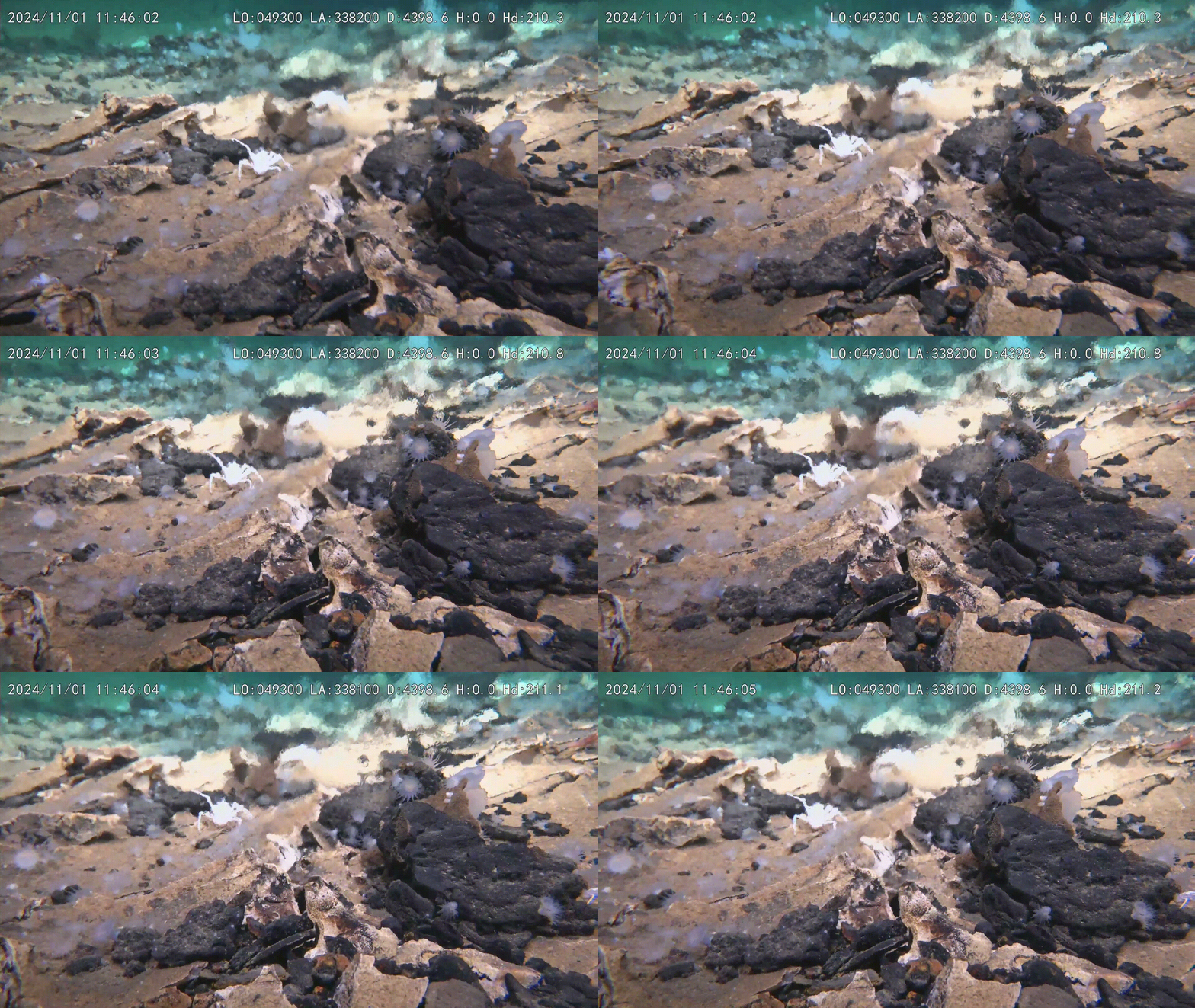
Wildlife included squat lobsters, sea anemones and shrimp (pictured here on a rock).
The Kunlun system offers scientists a new window into deep-sea serpentinization, which is the process by which seawater chemically reacts with mantle rocks beneath the seafloor to create serpentine minerals (a group of minerals known for their greenish color) and release hydrogen.
Researchers think they can study the potential links between these hydrogen emissions and the emergence of life at Kunlun. The system is thought to have hydrogen-rich fluids that are similar to early Earth's chemical environment, according to a statement released by the Chinese Academy of Sciences.
"What's particularly intriguing is its ecological potential," study co-author Weidong Sun, a professor at the Chinese Academy of Sciences' Institute of Oceanology, said in the statement. "We observed diverse deep-sea life thriving here — shrimp, squat lobsters, anemones, and tubeworms — species that may depend on hydrogen-fueled chemosynthesis."
Get the world’s most fascinating discoveries delivered straight to your inbox.
Sunlight doesn't reach the deep ocean, so life at the seafloor can't use photosynthesis — the process by which plants, algae and certain bacteria closer to the surface convert sunlight into energy. Some life in the deep ocean therefore relies on chemosynthesis, which involves using chemicals like hydrogen as an energy source to make food.
A separate Chinese-led research team recently used a crewed submersible to film chemosynthesis-based communities at the bottom of the northwest Pacific, at depths of around 31,000 feet (9,500 m). Such communities are rarely documented, with the vast majority of the ocean floor unexplored and unstudied.
In the new study, researchers used the same submersible to map Kunlun and explore four of its largest craters. By measuring the hydrogen concentrations in Kunlun's hydrothermal fluids, the researchers estimated that the field produced more than 5% of the world's non-living submarine hydrogen output — not bad for just one system.
The team proposed that the pipe swarm they documented formed in stages. First, hydrogen accumulated beneath the surface and burst out in major explosions. Fractures then formed along the edges and bottom of the resulting structures, triggering further intense eruptions of hydrogen-rich hydrothermal fluids. These fractures would then slowly become blocked by forming minerals, enabling hydrogen to accumulate again and potentially fuel additional smaller-scale explosions.
Kunlun is different from the more common volcano-powered hydrothermal seafloor systems found at plate boundaries. These systems often feature chimney-like structures, such as black smokers, that are extremely hot, running at about 750 degrees Fahrenheit (400 degrees Celsius). The serpentinization systems like Kunlun and the Lost City are cooler, with temperatures below 194 F (90 C).
Kunlun is not only bigger than the Lost City, it's also in a more unusual location. The Lost City is close to a mid-ocean ridge, which form along diverging plate boundaries and expose mantle rock, while Kunlun is in the interior of its plate, far from any ridge.
"The Kunlun system stands out for its exceptionally high hydrogen flux, scale, and unique geological setting," Sun said. "It shows that serpentinization-driven hydrogen generation can occur far from mid-ocean ridges, challenging long-held assumptions."
Patrick Pester is the trending news writer at Live Science. His work has appeared on other science websites, such as BBC Science Focus and Scientific American. Patrick retrained as a journalist after spending his early career working in zoos and wildlife conservation. He was awarded the Master's Excellence Scholarship to study at Cardiff University where he completed a master's degree in international journalism. He also has a second master's degree in biodiversity, evolution and conservation in action from Middlesex University London. When he isn't writing news, Patrick investigates the sale of human remains.
You must confirm your public display name before commenting
Please logout and then login again, you will then be prompted to enter your display name.