
 Live Science Plus


El Niño kickstarted the melting of Antarctica's 'Doomsday Glacier' 80 years ago, new study reveals
Rapid melting of the Thwaites Glacier in west Antarctica began in the 1940s following an unusually hot El Niño fluctuation, ice cores have revealed.

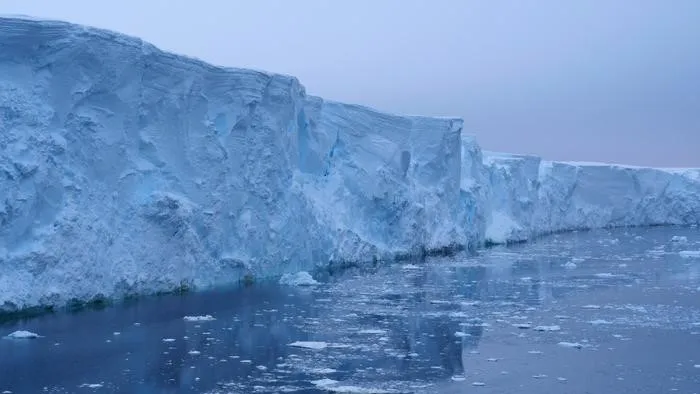
Antarctica's Doomsday glacier began its path of rapid melt 80 years ago — 30 years earlier than first thought — following an extreme El Niño, a new study has revealed.
The Thwaites Glacier, nicknamed the doomsday glacier because of its potential to increase sea levels by two feet (60 centimeters), is located in West Antarctica and is roughly the size of Florida. It has been melting rapidly since the 1980s — contributing to a 4% rise in global sea levels with the loss of roughly 595 billion tons (540 billion metric tons) of ice.
But as satellite coverage of the Antarctic only goes back to 1978, scientists weren't sure when the melting began. Now, a study published Feb 26. in the journal PNAS, has placed the beginning of the glacier's retreat at least as far back as the 1940s: when an El Niño event kickstarted the thawing of Thwaites and its northern neighbor, the Pine Island Glacier.
"What is especially important about our study is that this change is not random nor specific to one glacier," first-author Rachel Clark, a geologist at the University of Houston, Texas, said in a statement. "It is part of a larger context of a changing climate."
The Thwaites and Pine Island glaciers are enormous: Thwaites has a surface area of about 74,130 square miles (192,000 square kilometers) and Pine Island one of 62,660 square miles (162,300 square km).
To investigate when the retreat began, the researchers collected sediment cores from seven locations around the two glaciers. The glaciers had ground the particles of rock found within these cores in subtly different ways depending on their stage of melt, making the sediments remarkably accurate climate proxies.
Get the world’s most fascinating discoveries delivered straight to your inbox.
RELATED STORIES
Analysis of the cores, which date back over 10,000 years, revealed that the retreat of the glaciers was preceded by an unusually warm El Niño climate pattern between 1939 and 1942. The short period of this warming event alarmed the scientists — showing them that even if the trigger for ice melt has stopped, the glaciers' response can carry on for decades.
"Once the system is kicked out of balance, the retreat is ongoing," co-author Julia Wellner, a professor of geology at the University of Houston, Texas said.
If the Thwaites glacier were to melt completely, it would raise sea levels by more than two feet (60 centimeters). And if this melt were to cause the broader destabilization of the West Antarctic Ice Sheet, global sea levels would swell by approximately 11 feet (3.4 meters).
"The glacier is significant not only because of its contribution to sea-level rise but because it is acting as a cork in the bottle holding back a broader area of ice behind it," Wellner said. "If Thwaites is destabilized, then there's potential for all the ice in West Antarctica to become destabilized."

Ben Turner is a U.K. based writer and editor at Live Science. He covers physics and astronomy, tech and climate change. He graduated from University College London with a degree in particle physics before training as a journalist. When he's not writing, Ben enjoys reading literature, playing the guitar and embarrassing himself with chess.