















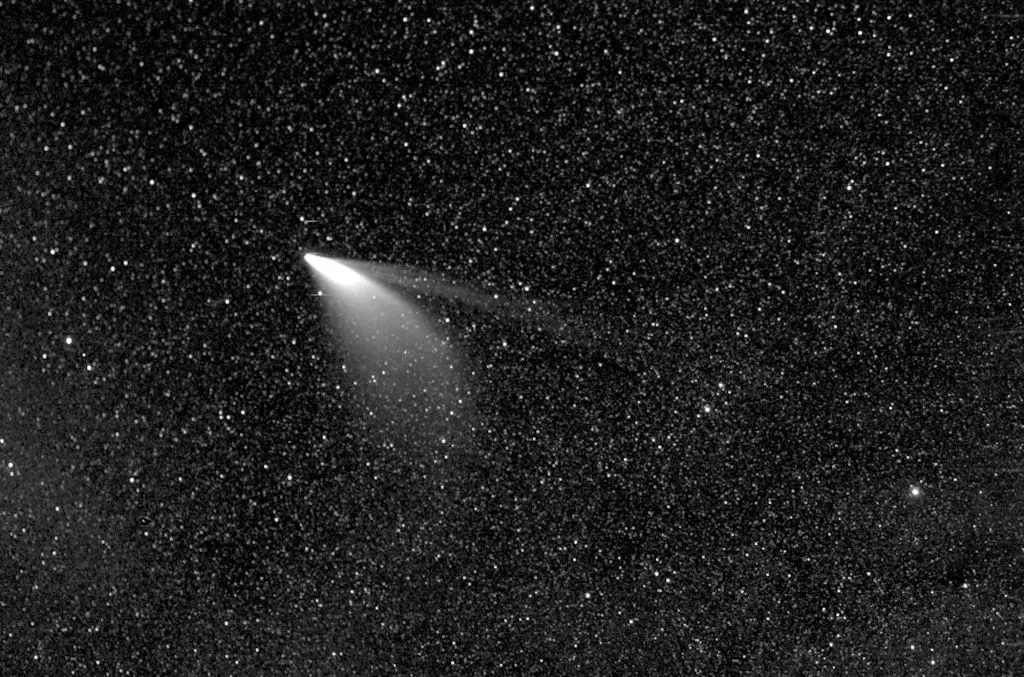
Skywatchers aren't the only people excited about Comet NEOWISE.
Astronomers are also buzzing about the icy wanderer, which observers under clear, dark skies in the Northern Hemisphere can currently see with the naked eye. The last comet to put on such an impressive show was Hale-Bopp all the way back in 1997, NASA officials have said.
Because NEOWISE is so bright, "we're able to get a lot more and better data than we typically do for most comets," Emily Kramer, a member of the science team on NASA's Near-Earth Object Wide-field Infrared Survey Explorer (NEOWISE) mission, said during a news conference Wednesday (July 15).
Related: How to see Comet NEOWISE in the night sky this month
More: Amazing photos of Comet NEOWISE from the Earth and space
"So, most comets, you can only see them from the most powerful of telescopes because they're so faint," said Kramer, who's based at NASA's Jet Propulsion Laboratory in Pasadena, California. "Here, we're able to study it with a wide variety of different telescopes. And that'll allow us to do really interesting studies, such as watching what happens to this comet over time."
Such observations could also reveal key details about the composition and structure of the 3-mile-wide (5 kilometers) NEOWISE, including how crumbly it is. And interest in this information isn't restricted to comet specialists and planetary scientists.
"We care about this because, in the unlikely — extremely unlikely — event that we find a comet that is headed our way, we'd like to know something about its structure and composition so that we have a better idea of how to push it out of the way," said NEOWISE principal investigator Amy Mainzer, of the University of Arizona.
Get the world’s most fascinating discoveries delivered straight to your inbox.
Comet NEOWISE was discovered by the NEOWISE spacecraft on March 27 of this year (hence the name). The comet made its closest approach to the sun on July 3 and is now headed back toward the outer solar system. It won't come our way again for another 6,800 years, so this is our one chance to get a look at it.
NEOWISE has already done so, of course, as have a few sun-studying spacecraft. For example, NASA's Parker Solar Probe recently snapped a gorgeous view of the comet's twin tails. The agency's Solar Terrestrial Relations Observatory-A probe has also imaged Comet NEOWISE, as has the Solar and Heliospheric Observatory, a joint mission between NASA and the European Space Agency.
Related: The 9 most brilliant comets ever seen
The comet is not a great target at the moment for most of the world's most powerful telescopes, both on the ground and in space, Kramer and Mainzer said; NEOWISE is still too low in the sky and too close to the sun. But things should change in the near future.
"I would expect that most of the large telescopes would be observing this comet once it gets further away from the sun," Kramer said.
Comet NEOWISE should continue putting on a sky show for the next few weeks or so, she added. But don't assume that you have that much time — go out and get a look at it now, while you can.
"Comets are notoriously difficult to predict, what's going to happen to them," Kramer said. "We're all quite excited to see how this comet progresses."
Mike Wall is the author of "Out There" (Grand Central Publishing, 2018; illustrated by Karl Tate), a book about the search for alien life. Follow him on Twitter @michaeldwall. Follow us on Twitter @Spacedotcom or Facebook.
