













Ancient Egyptians used so much copper, they polluted the harbor near the pyramids, study finds
New geoarchaeological research shows that metalworking in ancient Egypt led to significant contamination in a nearby port.


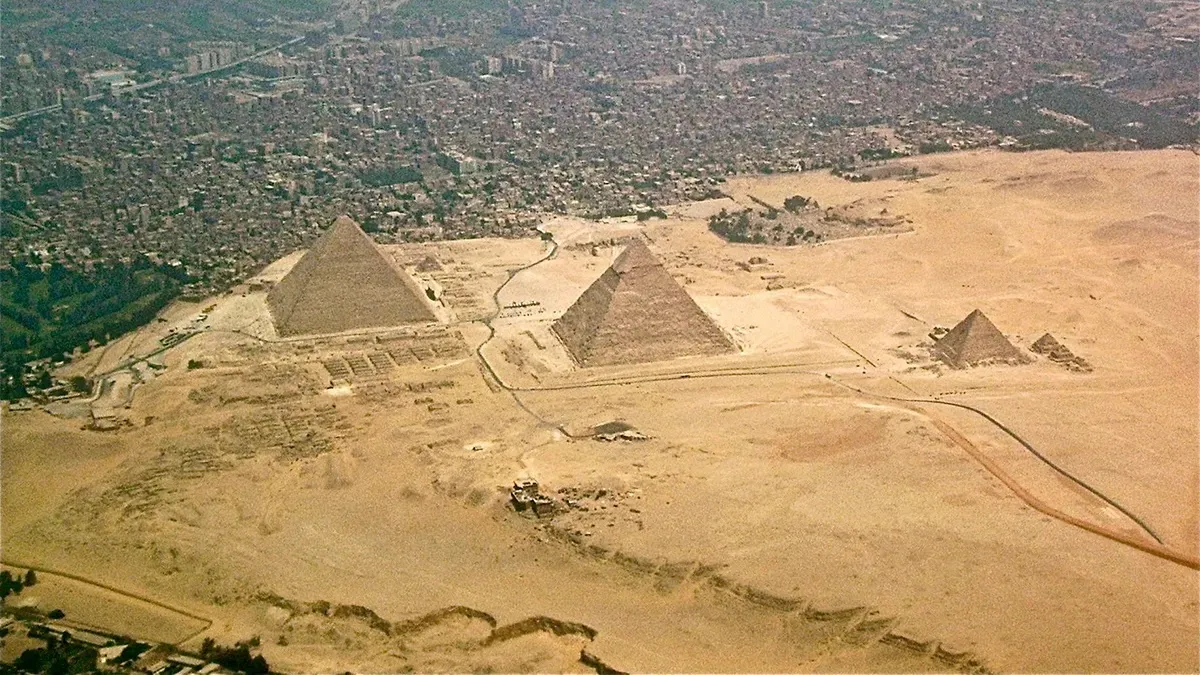
On a warm spring day in 2019, researchers bored into the earth beneath Cairo's urban streets. Just over a kilometer away, the Great Pyramid of Giza shimmered on the horizon. Some 4,600 years earlier, as laborers constructed the Great Pyramid, the contemporary dig spot lay on the sandy floor of Khufu Harbor.
In this ancient harbor—the world's oldest known port—researchers said they've identified the first major instance of human-induced metal contamination. Though the Giza necropolis is famous for its pyramids and shriveled mummies, a new study published in Geology offers unprecedented evidence of a largely unheralded aspect of ancient Egyptian civilization: persistent, centuries-long metalworking.
The discovery sheds light on life beyond the pharaonic and princely elites of ancient Egypt, researchers said. "We'd like to know more about 95% of the people rather than the elite," said Alain Véron, a geochemist from France's Aix-Marseille Université. His sentiments echo the thoughts of Christophe Morhange, a geoarchaeologist from the same institution, who underscored the importance of the sedimentary record in reconstructing historical narratives.
Related: Long-lost branch of the Nile was 'indispensable for building the pyramids,' research shows
"The sediments are as important as monuments," Morhange said, highlighting the often-overlooked significance of the ground beneath our feet.
A surprising history of contamination
The researchers used geochemical tracers to investigate metalworking activities around ancient Khufu Harbor. Located along a now defunct branch of the Nile near the Giza Plateau, the harbor was essential for transporting materials and was the site of a major copper toolmaking industry. These tools, some of which workers alloyed with arsenic for added durability, included blades, chisels, and drills to work materials like limestone, wood, and textiles. Researchers used inductively coupled plasma–mass spectrometry (ICP-MS) to measure levels of copper and arsenic, as well as of aluminum, iron, and titanium, with six carbon-14 dates to establish a chronological framework.
The study traced the onset of metal contamination to around 3265 BCE, earlier than researchers anticipated. Contamination during this Predynastic period suggests that human occupation and metalworking at Giza began more than 200 years earlier than previously documented.
Get the world’s most fascinating discoveries delivered straight to your inbox.
Although researchers have found direct evidence of Predynastic civilization in only 13 graves north of Giza, Morhange believes the geoarchaeological record yields more clues. With so much focus on the pyramids and other tombs, he explained, previous researchers might have overlooked evidence of the site's earlier occupation.
"You only find what you are looking for," he said.
Researchers found that metal contamination peaked during late pyramid construction around 2500 BCE and persisted until about 1000 BCE. "We found the oldest regional metal contamination ever recorded in the world," Véron said. Levels of copper during this period were "5 to 6 times higher than the natural background," he continued, indicating significant local industrial activity.
Andrew Shortland, an archaeological scientist from Cranfield University in the United Kingdom who was not involved in the study, expressed concerns about the proposed timeline. "I don't think six dates is enough," he said, referring to the number of carbon-14 dates used.
Nevertheless, Shortland acknowledged the study's broader conclusions about human-induced metal contamination at Giza.
Adapting to environmental hardship
The study provided further insight into how ancient Egyptians adapted to environmental challenges. As the Nile River receded and Khufu Harbor shrank, metalworking continued. As the Nile reached its lowest level, around 2200 BCE—a period marred by civil unrest and grim rumors of cannibalism—metal contamination remained high, suggesting a resilient infrastructure and workforce.
RELATED STORIES
Véron explained that the receding Nile initially presented opportunities for local communities. Previous palynological research—the study of pollen grains—has shown that agricultural activity surged as the waning Nile exposed fertile floodplains. Even as pyramid construction at Giza ceased, metalworking likely persisted to support burgeoning pastoral activities.
Dominik Weiss, a geochemist from Imperial College London, found the study "extremely well done and carefully conducted." Noting the allure of high-visibility sites like the Giza necropolis, he celebrated the new link between geochemistry and history and the possibility of shedding light on the lives of everyday ancient Egyptians.
"The chemical imprint of human activity remains, and that cannot be erased," Véron said.
This article was originally published on Eos.org. Read the original article.

Evan Howell is a Colorado-based science journalist, contributing to Live Science with a focus on Earth science. His work has appeared in Science, Scientific American, Eos Magazine, and other outlets. Evan holds a bachelor’s degree from Appalachian State University and a master’s in Geology from Northern Arizona University. Before journalism, he spent over a decade working as a Senior Geologist.