













Last meal of crocodile mummified in ancient Egypt revealed in CT scans 3,000 years later

What do you think of when you think about ancient Egyptian mummies? Perhaps your mind takes you back to a school trip to the museum, when you came face to face with a mummified person inside a glass case. Or maybe you think of mummies as depicted by Hollywood, the emerging zombie-like from their sandy tombs with dirtied bandages billowing in the breeze.
It might surprise you to know that the Egyptians also preserved millions of animals.
In a recent study, my colleagues and I revealed extraordinary details about the final hours in the life of a crocodile that was mummified by the ancient Egyptian embalmers. Using a CT scanner, we were able to determine how the animal died and how the body was treated after death.
To the Egyptians, animals served an important religious function, moving between the earthly and divine realms. Hawks were associated with the sun god, Horus, because they flew high in the sky, closer to the sun (and therefore to the god himself). Cats were linked to the goddess Bastet, a brave and ferociously protective maternal figure.
Most animal mummies were created as votive offerings or gifts.
Animal mummies provide a snapshot of the natural world, taken between approximately 750BC and AD250. Some of these mummified species are no longer found in Egypt.
For example, ancient Egyptians would have seen sacred ibises, long-legged wading birds with curved beaks, along the banks of the Nile every day. The birds were mummified in their millions as offerings to Thoth, the god of wisdom and writing. The birds are no longer in Egypt as climate change and the effects of desertification have made them move south to Ethiopia.
Get the world’s most fascinating discoveries delivered straight to your inbox.
Another commonly mummified animal was the crocodile. Although crocodiles lived in the Nile during ancient times, the completion of the Aswan Dam in 1970 prevented them from moving northwards towards the delta in lower Egypt.
RELATED: 7 famous mummies and secrets they've revealed about the ancient world
Crocodiles were associated with Sobek, Lord of the Nile and the god whose presence signalled the annual Nile flood which provided water and nutrient-rich silt to their agricultural land.
Crocodiles were mummified in huge numbers as offerings to Sobek. They were used as talismans throughout pharaonic Egypt to ward off evil, either by wearing crocodile skins as clothing, or by hanging a crocodile over the doors of homes.
Most crocodile mummies are of small animals, which suggests that the Egyptians had the means to hatch and keep the young alive until they were required. Archaeological evidence reinforces this theory, with the discovery of areas dedicated to the incubation of eggs and rearing of hatchlings. Some were pampered as cult animals and allowed to die a natural death.
As the crocodiles grew larger, the risk to crocodile keepers increased, suggesting perhaps that larger specimens were captured in the wild and hastily dispatched for mummification. Research on the mummified remains of larger animals has revealed evidence of skull trauma inflicted by humans probably as an attempt to immobilise and kill the animal.

The scans showed a hook still lodged inside the crocodile.
What we found
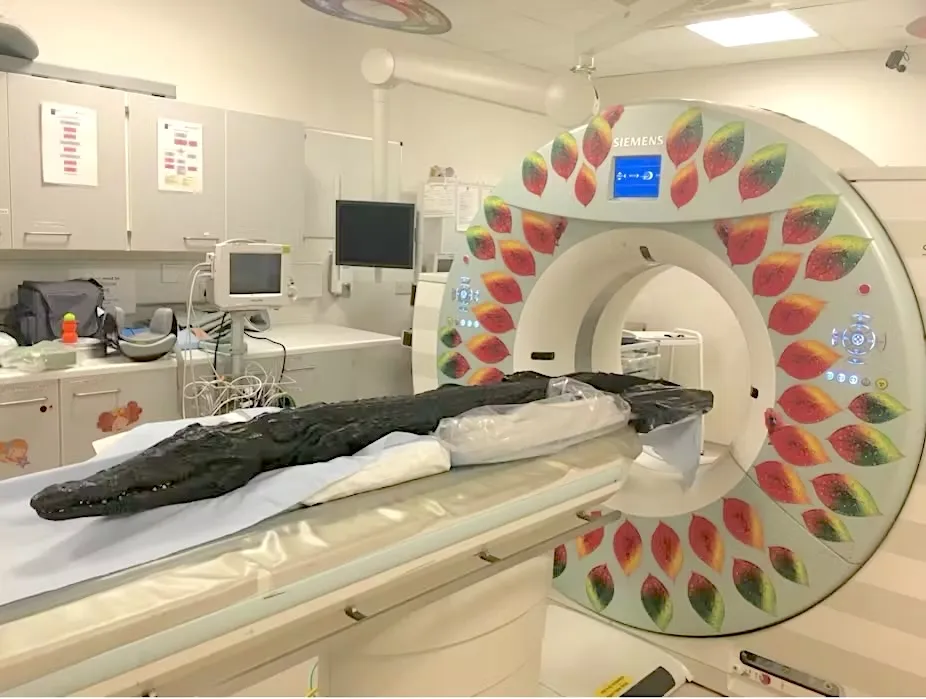
The crocodile mummy in our study holds evidence to suggest how these animals might have been caught. The mummy is held in the collection of Birmingham Museum and Art Gallery, UK, and measures 2.23 metres long. In May 2016, the large crocodile mummy, which formed part of a wider study by a team of researchers I work with from the University of Manchester, was transported to the Royal Manchester Children's Hospital to undergo a series of radiographic studies.
Medical imaging techniques allow researchers to study ancient artefacts without destroying them, the way that studies of mummies once did.
X-rays and CT scans showed that the animal's digestive tract was filled with small stones known as "gastroliths". Crocodiles often swallow small stones to help them digest food and regulate buoyancy. The gastroliths suggest the embalmers did not carry out evisceration, the process of removing the internal organs to delay putrefaction.
Among the stones, the images also showed the presence of a metal fish hook and a fish.
The study suggests that large, mummified crocodiles were captured in the wild using hooks baited with fish. It adds weight to the account of Greek historian, Herodotus, who visited Egypt in the 5th century BC and wrote about pigs being beaten on the banks of the river to lure the crocodiles, which were caught on baited hooks placed in the Nile.
RELATED STORIES
Unlike many aspects of life in ancient Egypt, little information was recorded relating to animal worship and mummification. Classical writers who travelled to the country remain some of our best sources of information.
Colleagues from the Birmingham School of Jewellery helped replicate the hook in bronze, the metal most likely to have been used to create the ancient original, for display alongside the crocodile mummy.
Modern technology is helping us to learn more and more about our ancient past. I can only imagine what secrets technology might help reveal in the future.
This edited article is republished from The Conversation under a Creative Commons license. Read the original article.

My research focuses on the non-invasive study of mummified animal remains from ancient Egypt. I lead a project which reunites archaeological remains in museums around the world to enable the cross-examination of a large and varied dataset. Through the project, known as the Ancient Egyptian Animal Bio Bank, a programme of radiographic analysis (X-ray and CT scanning) of mummified animal remains is conducted in collaboration with partners in the NHS, private healthcare providers and veterinarians, to obtain high-quality imaging data revealing the contents of linen-wrapped mummies. Identification of taxa through radiography alone can be problematic, particularly in the case of incomplete bodies or fragmented remains, both of which are commonplace in material of this nature. I am currently developing a protocol for mummy investigation using enhanced imaging modalities and computer visualisation techniques, combined with 3D printing to replicate anomalous material contained within mummies, thereby enabling more accurate identification. Improving our ability to correctly identify material within animal mummies in turn enables a more comprehensive understanding of their role within the social and religious framework of ancient Egypt.