













2nd-century Alexander the Great statue with lion's-mane hairstyle unearthed in Turkey
The discovery shows the popularity of the ancient ruler hundreds of years after his death.
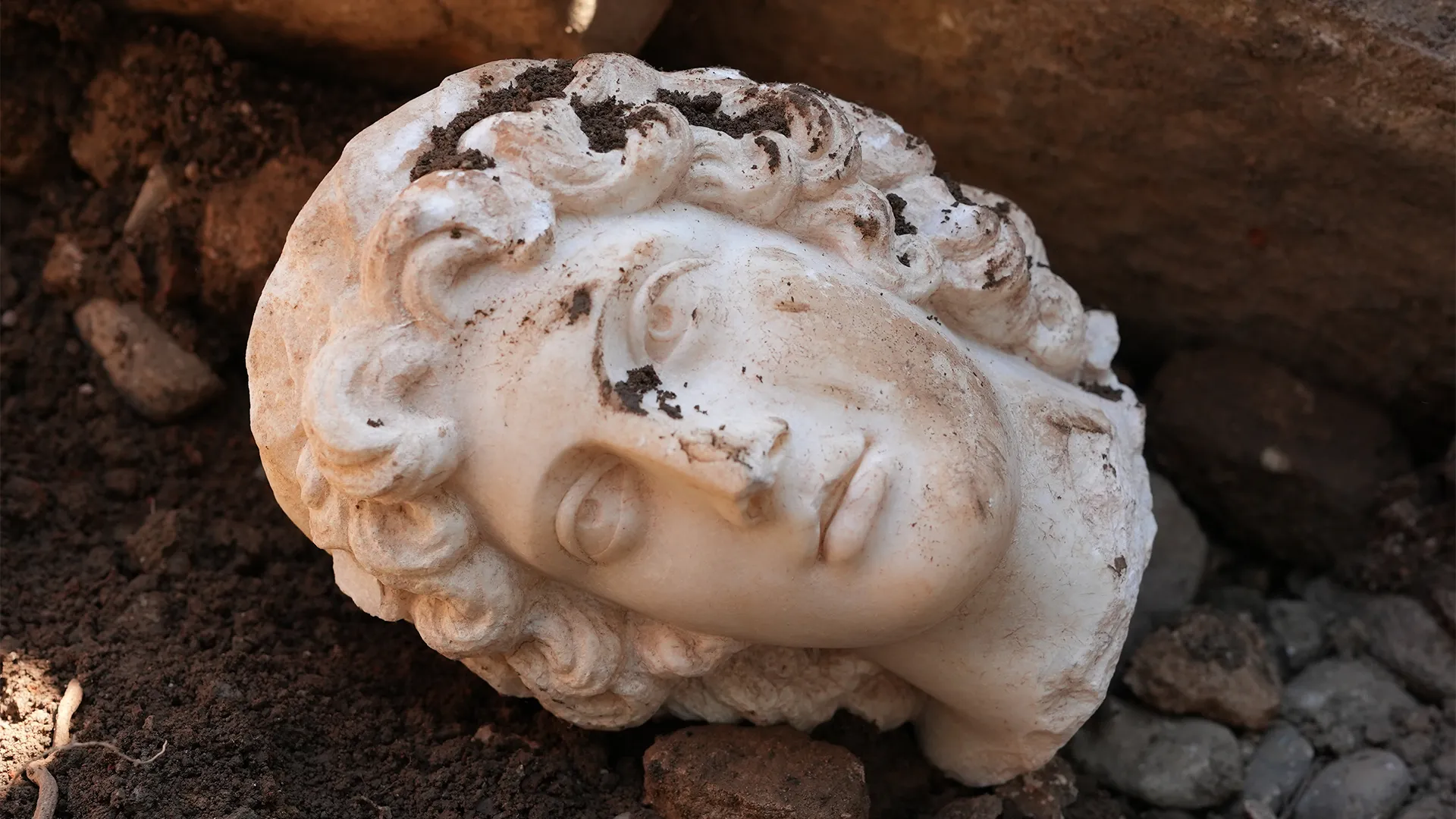
The head of a marble statue of Alexander the Great unearthed in Turkey shows the enduring popularity of the ancient ruler hundreds of years after his death, experts say.
The object was found amid the ruins of the upper levels of a Roman-era theater at Konuralp, north of Düzce and near Turkey's northwest coast, and is thought to date to the second century. Alexander the Great died in 323 B.C, so the statue may have been made more than 400 years after his death.
The remains of other marble statues, including heads of the Greek god Apollo and the mythical monster Medusa, have also been found in the ruins of the theater, the Düzce Municipality wrote in a statement in Turkish.
Alexander was a popular figure in the ancient world long after his untimely death at age 32 at Babylon beside the Euphrates river, historian Paul Cartledge, a professor at the University of Cambridge and the author of "Alexander the Great: the Hunt for a New Past" (Overlook Press, 2004), told Live Science.
One reason for Alexander's enduring popularity was that his successors promoted him as an ideal ruler whom they hoped to emulate. "The contenders for his throne, and therefore his empire, used his name and said 'he was terrific,'" said Cartledge, who wasn't involved in the new discovery.
It also became common for later rulers to make coins containing Alexander's image as a way to legitimize their reigns, he said.
Macedonian king

Experts say the marble head has many distinctive features from a statue of Alexander the Great, including a hairstyle meant to look like a lion's mane and upward-looking eyes.
After analyzing the marble head, historical experts determined it was a portrayal of Alexander, according to the statement.
Get the world’s most fascinating discoveries delivered straight to your inbox.
"[He] is depicted with deep and upward-looking eyes … and a slightly open mouth that barely reveals its teeth," Düzce Municipality officials said in the statement, which also noted the distinctive hairstyle on the statue. "The two tufts of hair in the middle of the forehead, which are separated to the back and sides, are like a lion's mane," they said in the translated statement. "This depiction is a hairstyle unique to Alexander the Great."
Alexander was one of the most famous rulers of the ancient world. Born in 356 B.C., he became the king of Macedonia, a territory north of Greece, in 336. His father, Philip II of Macedon, had already succeeded in uniting Greece under his rule.
Although not born in Greece, Alexander was enamored of Greek culture and spread it as he began a campaign of military conquests to the south and east, which culminated in his defeat of the powerful Persian Empire in a series of battles between 334 B.C. and 331 B.C.
Mighty empire

Alexander the Great died in 323 B.C. but he remained a popular figure for hundreds of years and under the Roman Empire, which ruled this region at that time.
At its height, Alexander's empire stretched from Greece and Egypt to Bactria, roughly in what's now Afghanistan, to the Punjab in what's now Pakistan. But his army refused to go any farther, and Alexander returned to Babylon, where he died a few years later — probably from an illness, but possibly from drinking too much or because he was poisoned, Cartledge said.
When the Romans conquered much of the ancient world — including the kingdom of Bithynia, in the region where the new statue was found — they, too, regarded Alexander the Great as an ideal ruler.
RELATED STORIES
Indeed, Alexander's habit of shaving his face — as opposed to sporting beards, like most past rulers did — influenced Roman emperors and led Romans to shave, because it was thought to be the correct thing for rulers to do, Cartledge said. Alexander seemed to have taken up the habit because he wanted to be seen like the Greek god Apollo, who was portrayed without a beard.
For the same reason, many statues of Alexander portrayed his eyes looking upward, toward the gods, Cartledge said, and upward-looking eyes are one feature of the statue discovered at Konuralp.
Editor's note: An earlier version of this story said Alexander was "technically not a Greek." But although he was born in Macedonia, he was descended from Greeks on his father's side.
Tom Metcalfe is a freelance journalist and regular Live Science contributor who is based in London in the United Kingdom. Tom writes mainly about science, space, archaeology, the Earth and the oceans. He has also written for the BBC, NBC News, National Geographic, Scientific American, Air & Space, and many others.