















A third of Antarctic ice shelves could collapse at current pace of warming
The difference between 2 degrees and 4 degrees of warming is measured in millions of gigatons of ice.

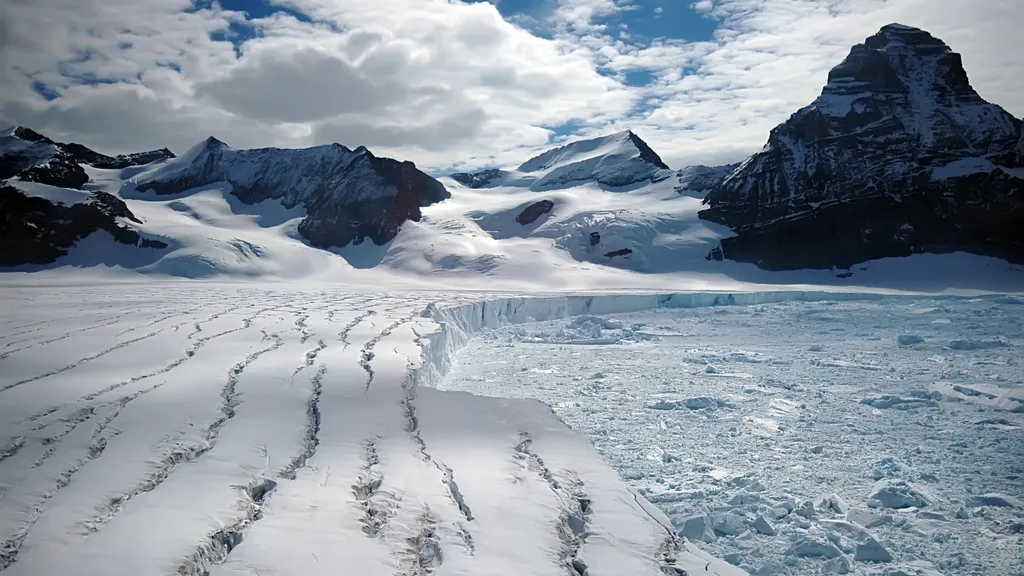
A third of Antarctica's vast offshore ice shelves could collapse into the ocean if the world warms by 4 degrees Celsius (7.2 degrees Fahrenheit) above pre-industrial levels. These floating platforms of solid water wouldn't directly raise sea levels if they melted; they already sit in the ocean. But they're important barriers preventing the immense bulk of the frozen continent's glaciers from rolling out to sea. If those inland glaciers reached open water, sea level could rise catastrophically.
Of the 34% of ice shelves at risk of collapse by the end of the 21st century, many are concentrated in the Antarctic Peninsula — a region of West Antarctica that juts northward toward South America. The at-risk ice makes up two-thirds of the peninsula's ice shelf extent. In total, 190,000 square miles (500,000 square kilometers) of Antarctic ice would be at risk. That's a region much bigger than California.
"Ice shelves are important buffers preventing glaciers on land from flowing freely into the ocean and contributing to sea-level rise. When they collapse, it's like a giant cork being removed from a bottle, allowing unimaginable amounts of water from glaciers to pour into the sea," lead author Ella Gilbert, a scientist at the University of Reading, England, said in a statement.
Related: 10 climate myths busted
The good news is that this sort of ice-shelf breakdown is far from inevitable. Right now, the world has already warmed by about 1 C (1.8 F) above pre-industrial levels. If we managed to hold warming to 2 C (3.6 F) — which some scientists suspect may not be possible, as the Associated Press reported — then just half of the 34% of threatened ice shelves would be at risk. Stop the warming at 1.5 C (2.7 F) and the impacted region would be even smaller.
The new study modeled the processes that drive melting for shelves including Larsen C, Wilkins, Pine Island and Shackleton, at a new level of detail. Some of this melting may already be in motion: Larsen C already has a habit of spitting icebergs the size of New England states into open water, as Live Science has reported.
Under normal circumstances, the ice shelves melt a little in the summer. That melt trickles down through cracks in the ice to later freeze again in their underbellies. But when too much melting occurs, water pools on their surfaces.
Get the world’s most fascinating discoveries delivered straight to your inbox.
"We know that when melted ice accumulates on the surface of ice shelves, it can make them fracture and collapse spectacularly," Gilbert said in the statement.
RELATED CONTENT
In the past, researchers have modeled the future behavior of ice shelves at the scale of the entire Antarctic, without fine attention to the details of individual ice shelves. This new study modeled ice melt in different scenarios with previously unheard-of resolution and complexity. The result: visions of Antarctica in a world where climate change goes further than even some pessimistic projections, and in a world where society makes substantial progress against greenhouse gas emissions.
"I think that we're presently on track for something between 3 to 3.5 C (5.4 to 6.3 F). That's not to say that 4 C (7.2 F) is out of the question — if we're unlucky and unwise, we could certainly get there," said Andrew Dessler, a Texas A&M University scientist who studies the prospects for future warming and was not involved in this study.
In other words, the world where climate change proceeds to the point where a third of Antarctic ice shelves are at risk would involve more major failures to curb greenhouse gas emissions or the discovery of some warming feedback mechanisms that haven't been discovered yet.
"My personal opinion is that staying below 1.5 C (2.7 F) is pretty much out of the question unless we deploy some type of solar radiation geoengineering," Dessler told Live Science, noting that not every scientist agrees on this point. "Two C (3.6 F) will be very very difficult, but I believe that we could still limit warming to that without significant economic cost if all of the world's governments work together on climate change. I'll leave it up to you to decide how likely that is."
The study was published April 8 in the journal Geophysical Research Letters.
Originally published on Live Science,
