













Ancient Tomb of Mysterious Man Named Tjt Discovered in Egypt

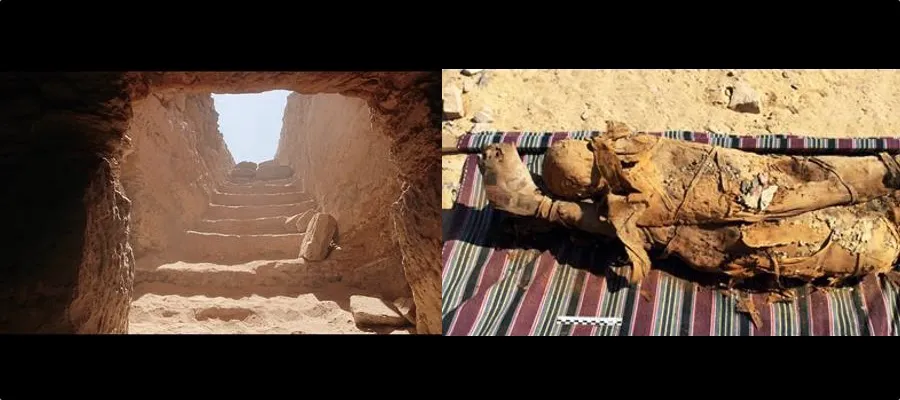
Archeologists in Egypt recently discovered a tomb near Aswan, along the Nile River. Hieroglyphic text etched on the wooden coffin fragments found inside the tomb revealed that it belonged to a mysterious man named Tjt, the Egyptian Ministry of Antiquities said yesterday (April 24) in a statement.
Though the owner of the tomb was Tjt alone, its occupants were many. It hid dozens of mummies, some of them of young children. Two of the mummies lay on top of one another, meaning they could have been a mother and her child, according to the ministry. The tomb was likely built between the sixth century B.C. and the fourth century A.D. [Gallery: Amazing Egyptian Discoveries]
There were also a variety of ancient artifacts scattered throughout the tomb, including offering vases and amphorae — tall decorated jars with tiny necks flanked by two handles. Along one wall stood an intact stretcher that ancient Egyptians likely used to bring bodies into the tomb. Next to some other mummies were vessels that still contained food.
Archaeologists also found fragments of funerary masks painted in gold and a small statue of the ba-bird. A bird with a human head that represents a person's soul, this is a typical symbol found in burials of the time.
Near the chamber's entrance, sitting next to a lamp, were materials used by ancient Egyptians to wrap mummies, including vessels of bitumen (asphalt) to preserve bodies and white, unpainted cartonnage. That material consists of linen, papyrus and plaster.
The text that mentioned Tjt also referenced ancient Egyptian gods, including Hapi, the god of the Nile River.
This tomb is just one of about 300 scattered around the area of the Mausoleum of the Aga Khan, an imam of the Shia Ismaili Muslims, according to the statement
Get the world’s most fascinating discoveries delivered straight to your inbox.
- Image Gallery: The Mummy of King Ramesses III
- Image Gallery: Egypt's Valley of the Kings
- Image Gallery: The Beautiful Sarcophagus of an Egypt Pharaoh
Originally published on Live Science.

Yasemin is a staff writer at Live Science, covering health, neuroscience and biology. Her work has appeared in Scientific American, Science and the San Jose Mercury News. She has a bachelor's degree in biomedical engineering from the University of Connecticut and a graduate certificate in science communication from the University of California, Santa Cruz.