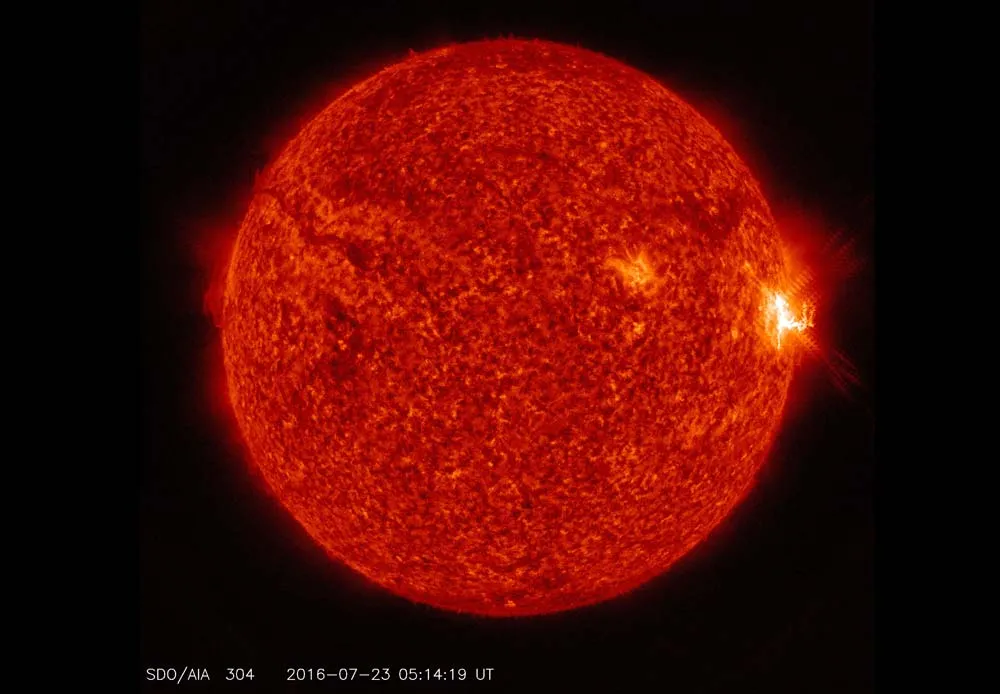
NASA's Solar Dynamics Observatory sees a mid-level M7.6 solar flare (visible as the bright flash on the right side of the sun) in this view from July 23, 2016. So far, it is the strongest solar flare of 2016.
The sun fired off its strongest solar flare of 2016 during an active weekend that saw three eruptions from the star's surface.
The uptick in solar activity occurred overnight on Friday and Saturday (July 22 and 23) when the sun unleashed three relatively moderate solar flares, all of which were captured on video by NASA's Solar Dynamics Observatory. While all three were somewhat minor, they are the first substantial solar events in months, NASA officials said in a statement.
The first solar flare registered as an M5.0 sun storm and peaked Friday night at 10:11 p.m. EDT (0211 July 23 GMT). It was followed by a second, more-intense flare, which peaked as an M7.5-class solar storm on Saturday at 1:16 a.m. EDT (0516 GMT). A third, M5.5-class flare peaked 15 minutes later, at 1:31 a.m. EDT (0531 GMT). [How Solar Flares Work (Infographic)]
A closeup of the M7.6-class solar flare that erupted from the sun on July 23, 2016 as seen by NASA's Solar Dynamics Observatory.
(Image credit: NASA)
The M7.5 flare was the strongest sun storm of 2016, according to Spaceweather.com, a website that tracks space-weather events. But it was still nowhere near the most powerful types of flares the sun can unleash.
"These flares were classified as M-level flares. M-class flares are the category just below the most intense flares, X-class flares," NASA officials explained in their statement. "The number provides more information about its strength. An M2 is twice as intense as an M1, an M3 is three times as intense, etc."
When aimed directly at Earth, the strongest X-class solar flares can potentially pose a risk to astronauts in space, and may also disrupt GPS and communications-satellite signals.
"The sun is currently in a period of low activity, moving toward what's called solar minimum, when there are few to no solar eruptions. So these flares were the first large ones observed since April," NASA officials said. "They are categorized as midstrength flares, substantially less intense than the most powerful solar flares."
Sign up for the Live Science daily newsletter now
Get the world’s most fascinating discoveries delivered straight to your inbox.
Tariq is the editor-in-chief of Live Science's sister site Space.com. He joined the team in 2001 as a staff writer, and later editor, focusing on human spaceflight, exploration and space science. Before joining Space.com, Tariq was a staff reporter for The Los Angeles Times, covering education and city beats in La Habra, Fullerton and Huntington Beach. He is also an Eagle Scout (yes, he has the Space Exploration merit badge) and went to Space Camp four times. He has journalism degrees from the University of Southern California and New York University.