













Boiling Mad: Crabs Feel Pain

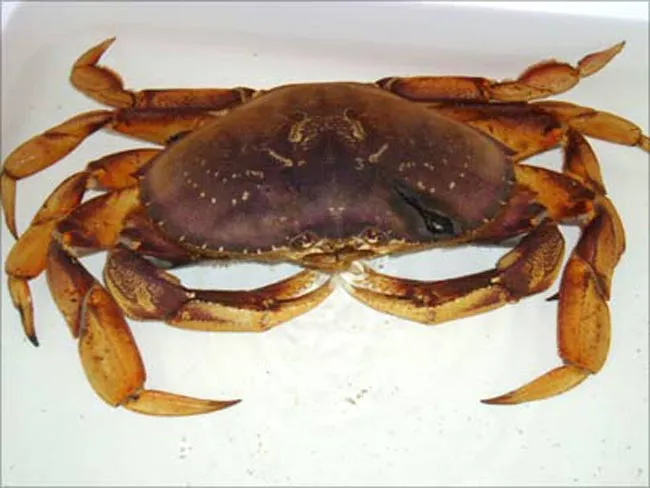
Should crabs be protected from pain? Vote below.
A favored method of preparing fresh crabs is to simply boil them alive. A longstanding related question: Do they feel pain?
Yes, researchers now say. Not only do crabs suffer pain, a new study found, but they retain a memory of it (assuming they aren't already dead on your dinner plate). The scientists say its time for new laws to consider the suffering of all crustaceans.
The study involved using wires to deliver shocks to the bellies of hermit crabs, which, being hermits, often take up residence in left-behind mollusc shells. The crabs that were shocked scampered out of their shells, "indicating that the experience is unpleasant for them," the scientists concluded; unshocked crabs stayed put.
Another test was run to see what would happen if a mild shock was delivered, one just below the threshold that would cause the crabs to leave home. These mildly shocked crabs, along with crabs that had not been shocked, were then offered a new home. The typical reaction: They'd go inspect the new shell. Significantly, those that had been shocked were more likely to pack up and move to the new residence compared to those that hadn't been shocked.
"There has been a long debate about whether crustaceans including crabs, prawns and lobsters feel pain," said study researcher Bob Elwood of Queen's University Belfast in the UK.
"We know from previous research that they can detect harmful stimuli and withdraw from the source of the stimuli but that could be a simple reflex without the inner 'feeling' of unpleasantness that we associate with pain," Elwood explained. "This research demonstrates that it is not a simple reflex but that crabs trade-off their need for a quality shell with the need to avoid the harmful stimulus."
Get the world’s most fascinating discoveries delivered straight to your inbox.
The findings are detailed in the journal Animal Behaviour.
Interestingly, scientist don't fully understand pain in humans. It is felt when electrical signals are sent from nerve endings to your brain, which in turn can release painkillers called endorphins and generate physical and emotional reactions. The details remain unclear, which his why so many people suffer chronic pain with no relief.
At any rate, Elwood compared the results of the crab study to how you might react to a painful experience.
"Humans, for example, may hold on to a hot plate that contains food whereas they may drop an empty plate, showing that we take into account differing motivational requirements when responding to pain," he said. "Trade-offs of this type have not been previously demonstrated in crustaceans. The results are consistent with the idea of pain being experienced by these animals."
A Norwegian study in 2005 concluded lobsters react to boiling water or other pain stimuli, but that they don't have the emotional capacity to experience it as pain in the way higher animals do. But a study by Elwood and colleagues in 2007 found prawns were irritated when their antennae were treated with acetic acid, and after a local anesthetic, they'd stop rubbing the antennae. He said this was evidence that they suffer pain, and that lobsters likely feel pain, too.
Elwood thinks its time for some crustacean empathy.
"Millions of crustacean are caught or reared in aquaculture for the food industry," he said. "There is no protection for these animals (with the possible exception of certain states in Australia) as the presumption is that they cannot experience pain. With vertebrates we are asked to err on the side of caution and I believe this is the approach to take with these crustaceans."
<script type="text/javascript" charset="utf-8" language="javascript" src="http://static.polldaddy.com/p/1493317.js"></script><noscript> <a href ="http://answers.polldaddy.com/poll/1493317/" >Should crustaceans be protected from pain and suffering?</a> <br/> <span style="font-size:9px;"> (<a href ="http://www.polldaddy.com"> online surveys</a>)</span></noscript>
Robert Roy Britt is the Editorial Director of Imaginova. In this column, The Water Cooler, he looks at what people are talking about in the world of science and beyond.

Robert is an independent health and science journalist and writer based in Phoenix, Arizona. He is a former editor-in-chief of Live Science with over 20 years of experience as a reporter and editor. He has worked on websites such as Space.com and Tom's Guide, and is a contributor on Medium, covering how we age and how to optimize the mind and body through time. He has a journalism degree from Humboldt State University in California.