













Mountains of Evidence Suggest Human Evolution Had Rocky Start
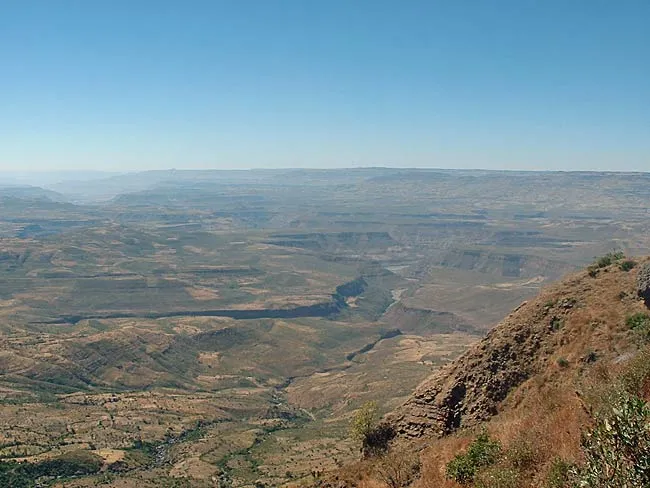
Geology may be a long-overlooked, major factor that created conditions favoring the evolution of modern humans.
That's the conclusion of geologists at the University of Utah, who detail their findings in next month's issue of the journal Geotimes.
It's fairly well-established that changing climate, and thus vegetation, in East Africa spurred human evolution, but there has been no agreement about what exactly caused that change, said Royhan Gani
He thinks the riddle's answer is in rocks, and how big slabs of it move — altering continents and building mountains — by a process called tectonics.
"The idea of tectonics influencing evolution has been discussed since at least 1983, but no one's brought it to the foreground," said Gani, who co-authored the study with his wife, Nahid Gani.
Rock pushups
The evidence the couple studied was in "the Wall of Africa," a chain of highland rocks which extends for almost 3,700 miles (5,950 kilometers) from Sudan to South Africa. Two chunks of Earth's crust moving apart created this expansive feature.
Get the world’s most fascinating discoveries delivered straight to your inbox.
"You get volcanism, but mostly an upwelling of magma pushing on the crust from below," Royhan Gani said. He compared the action to stretching plastic over a water spout: Where there are weaknesses in the film, the water pushes out bubbles.
In an Ethiopian stretch of the wall, the Ganis painstakingly mapped out the subsurface rock to show at least 3,200 feet (1 kilometer) of uplift happened between 3 million and 6 million years ago, creating valleys and basins.
This local and drastic "superplume" of tectonic activity caused the region's climatic to change, Royhan Gani said.
"These plateaus rose up and cut off much of Africa from wet Indian Ocean weather, sort of like the Rocky Mountains cut off Pacific [Ocean] air," he said. "That eventually dried up jungles into savanna and woodland."
Evicted ancestors
Gani said anthropologists found the new work compelling.
"Essentially, our ancestors were kicked out of trees and evolved full bipedalism," or walking and running on two feet, he told LiveScience. "They had to adapt to an environment with fewer and shorter trees and more spread-out food sources."
They also had to avoid being eaten.
"Some people argue running is a major reason our ancestors survived," he said. "They couldn't fight most predators face-to-face, so they fled."
Fossils indicate one of the first fully bipedal early humans, Australopithecus anamensis, emerged about 4.1 million years ago near the region the Ganis studied — placing it smack-dab in the middle of the jungle-to-savanna change.
In the future, Gani hopes to further investigate just how much tectonic activity accounts for the appearance of such early humans.
"It all happened within the right time period," he said. "Now we need to nail it down."