















Warming Could Heat Up Storms Over Eastern US

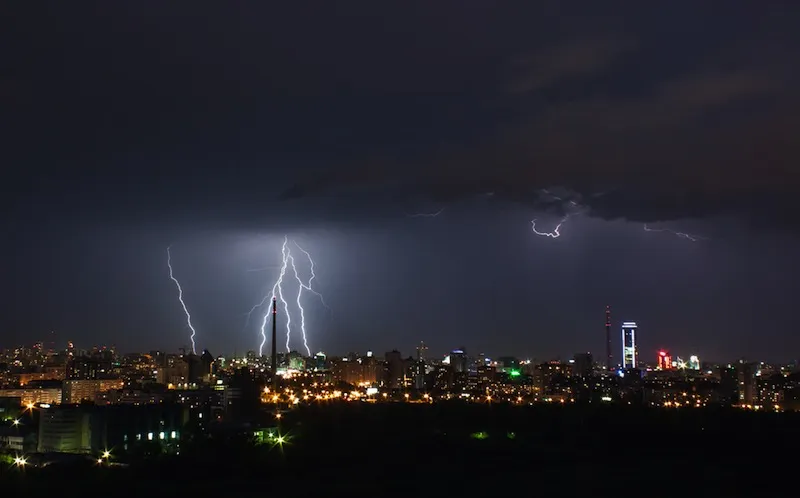
In May, residents of Tornado Alley braced themselves as the region's usual spring thunderstorms began popping up across the plains, bringing heavy rainfall that caused flash floods, high winds, hail and tornadoes. On May 20, the town of Moore, Okla., seemingly a perennial tornado target, was struck by a monster storm that was 1.3 miles (2 kilometers) wide at its peak, carving a 17-mile-long (27 km) path of destruction through the Oklahoma City suburb with winds that reached 210 mph (338 km/h).
While severe thunderstorms can happen anywhere that atmospheric conditions become ripe, there are areas like Tornado Alley where these conditions come together more often. But as human activity spews more and more greenhouse gases, such as carbon dioxide, into the atmosphere, causing the world to warm, there are concerns that global warming could substantially increase the risk of severe thunderstorms and the damage they can bring. A new study, detailed online today (Sept. 23) in the journal Proceedings of the National Academy of Sciences, suggests that this risk could increase for the eastern United States in a warming world.
"These severe thunderstorms can be very damaging events," said researcher Noah Diffenbaugh, a climate scientist at Stanford University in California. [In Images: Extreme Weather Around the World]
The study comes out in the run-up to a new report from the Intergovernmental Panel on Climate Change, the international body that reviews the most recent research on climate change and releases reports that summarize the current science and expected impacts for the world's policymakers.
Climate change conundrum
The issue of whether or not global warming would lead to an increased or decreased risk of severe thunderstorms has been a long-standing one among scientists who examine the potential impacts of climate change. The problem with answering this question lies in understanding the way warming alters the behavior of the atmosphere. While a warmer atmosphere can hold more moisture, creating the possibility of higher rainfall amounts, it could also lead to a reduction in the wind shear that causes these storms. Wind shear is a change of wind speed or direction with height in the atmosphere — a strong wind shear is needed to generate the kinds of storms that spawn tornadoes.
The lack of a reliable long-term record of severe thunderstorms makes it difficult to systematically analyze trends of where and when thunderstorms occur as climate changes that might help clarify the issue.
Get the world’s most fascinating discoveries delivered straight to your inbox.
"There's been this conundrum of competing effects that have been theorized for global warming in terms of severe thunderstorm environments," Diffenbaugh told LiveScience.
To help see what global warming might bring for the continental United States, Diffenbaugh and his colleagues tested an ensemble of global climate models to investigate how global warming might influence the kind of atmospheric environment known to support the formation of severe thunderstorms in the current climate: namely, that of strong wind shear and high convective energy. (Convection, like that in a boiling pot of water, is the engine that fuels storms.)
Stormy outlook
The researchers found this suite of global climate models suggested that even relatively moderate global warming could lead to a substantial increase in the kind of atmospheric environment linked with severe thunderstorms over the eastern United States. Overall, the scientists discovered global warming boosted the number of days with both high levels of convective energy and strong wind shear, suggesting that more of the country could see severe thunderstorms like the one that created the Moore tornado.
The climate models suggested global warming would also cause days with lower wind shear, and that overall, average wind shear would decrease. However, the researchers discovered these days of lower wind shear often coincided with days of low convective energy levels. This means the average reduction in wind shear wouldn't diminish the likelihood of severe storms because it did not hinder the potential for storm formation on the days with high convective energy.
The scientists caution their models do not simulate the emergence of severe thunderstorms, only the atmospheric environments where they are known to arise. "It's a tough challenge to perform climate model experiments that resolve individual storms," Diffenbaugh said.
Follow us @livescience, Facebook & Google+. Original article on LiveScience.
