















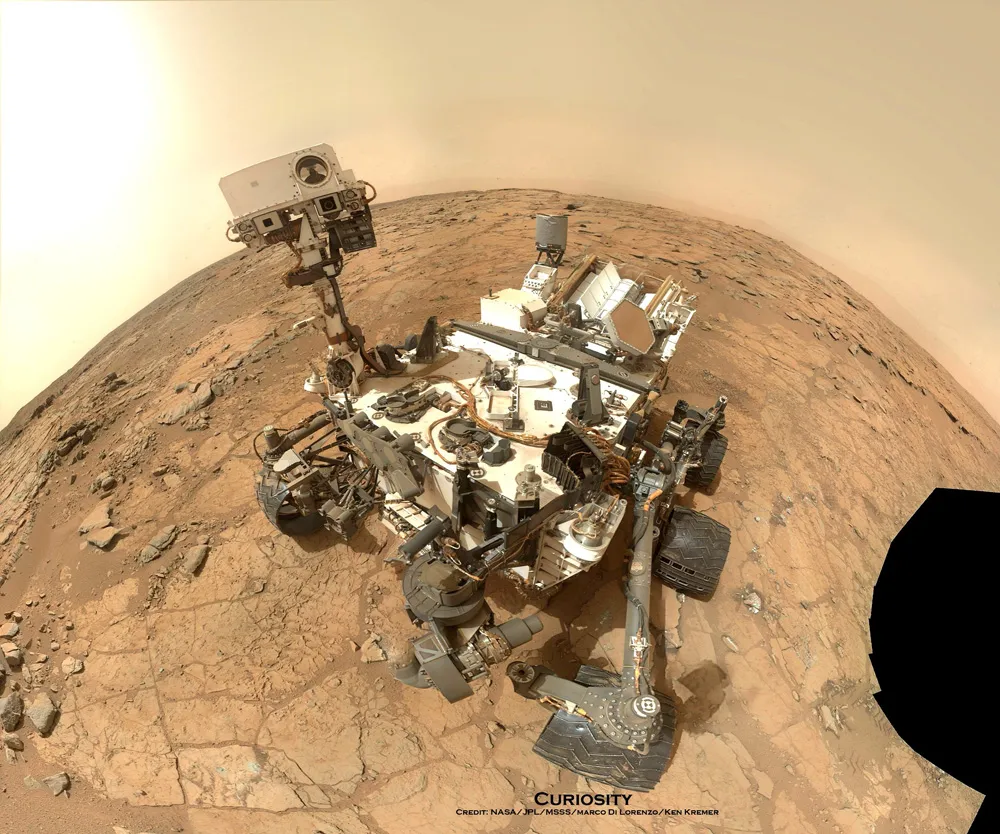
The Mars rover Curiosity's month of freedom on the Red Planet is over.
Curiosity had been on its own since early April, when Mars slipped behind the sun from Earth's perspective. Our star can disrupt communications between the two planets in this alignment, which is known as a Mars solar conjunction, so Curiosity's handlers at Mission Control had temporarily stopped sending commands to the 1-ton rover.
But the heavens have shifted, bringing Mars and Earth back in touch and the Curiosity rover back within reach of its masters.
"Can you hear me now? Conjunction is over. I have a clear view of Earth & am back to work!" NASA officials wrote on behalf of the rover via the Curiosity Twitter feed today (May 2).
Curiosity landed inside the Red Planet's huge Gale Crater last August, kicking off a two-year surface mission to determine if Mars has ever been capable of supporting microbial life.
The rover has already checked off its main mission goal. Before conjunction, Curiosity collected samples from a hole it drilled 2.5 inches (6.4 centimeters) into a rocky outcrop called "John Klein." The rover's analysis of these samples allowed mission scientists to determine that Mars was indeed habitable billions of years ago.
The post-conjunction plan involves drilling another hole nearby, mission officials have said, to confirm and extend scientists' understanding of the John Klein area. When that work is done, Curiosity will likely begin the 6-mile (10 kilometers) trek to the base of Mount Sharp, the mysterious 3.4-mile-high (5.4 km) mountain that rises from Gale's center.
Get the world’s most fascinating discoveries delivered straight to your inbox.
Mars solar conjunctions occur every 26 months, so veterans of NASA's Mars missions are used to dealing with them. While this was Curiosity's first conjunction, it was the fifth for NASA's Opportunity rover, which touched down in January 2004 and is still roving, and the sixth for Mars Odyssey, which has been orbiting the Red Planet since 2001.
While Curiosity's handlers didn't send any commands during conjunction, the rover didn't quite get the month off. Curiosity didn't do any driving or other complex operations, but it did continue monitoring Martian weather and radiation.
This story was provided by SPACE.com, a sister site to Live Science. Follow Mike Wall on Twitter @michaeldwall and Google+. Follow us @Spacedotcom, Facebookor Google+. Originally published on SPACE.com.
