













World's Smallest Bear Faces Extinction
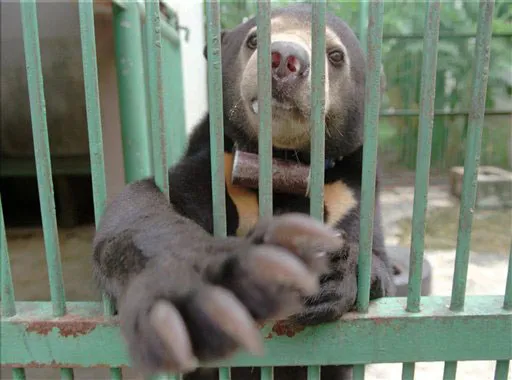
GENEVA (AP) — The world's smallest bear species faces extinction because of deforestation and poaching in its Southeast Asian home, a conservation group said Monday.
The sun bear, whose habitat stretches from India to Indonesia, has been classified as vulnerable by the World Conservation Union.
"We estimate that sun bears have declined by at least 30 percent over the past 30 years and continue to decline at this rate,'' said Rob Steinmetz, a bear expert with the Geneva-based group, known under its acronym IUCN.
The group estimates there are little more than 10,000 sun bears left, said Dave Garshelis, co-chair of the IUCN bear specialist group.
The bear, which weighs between 90 and 130 pounds, is hunted for its bitter, green bile, which has long been used by Chinese traditional medicine practitioners to treat eye, liver and other ailments. Bear paws are also consumed as a delicacy.
Another threat comes from loggers, who are destroying the sun bear's habitat, Steinmetz said.
Thailand is the only country to have effectively banned logging and enforced laws against poaching, allowing the sun bear population to remain stable there, Garshelis said.
Get the world’s most fascinating discoveries delivered straight to your inbox.
IUCN said six of the eight bear species in the world are now threatened with extinction.
Other vulnerable bear species are the Asiatic black bear, the sloth bear on the Indian subcontinent, the Andean bear in South America and the polar bear. The brown bear and the American black bear are in a lesser category of threat, IUCN said.
"The American black bear is actually doing quite well,'' said Garshelis, adding that its population is increasing in most parts of Canada, the United States and Mexico.
There are an estimated 900,000 American black bears in the three countries, more than double the number of all the other bear species combined, according to IUCN.
The brown bear is well protected in North America and Europe and therefore able to expand in certain areas, he said. But in some countries of South Asia, including Pakistan, India and Nepal, there are only tiny numbers of brown bears left, he added.
The giant panda, of which fewer than 3,000 are estimated to survive, remains in the category of endangered species despite huge Chinese efforts to conserve it, Garshelis said.
"It would be unwise to assume that in less than 10 years under the new habitat improvement policies in China (the) panda population could have dramatically increased,'' he said.
Australia's koala bear, which despite its name is not a bear but a marsupial, is considered "near threatened.''
The reassessment of the sun bear's situation will be reflected in IUCN's Red List of Threatened Species, a comprehensive inventory of some 41,000 species and subspecies compiled by a network of experts around the globe.
- Video: Showdown at Grizzly River
- Images: Endangered and Threatened Wildlife
- Top 10 Deadliest Animals