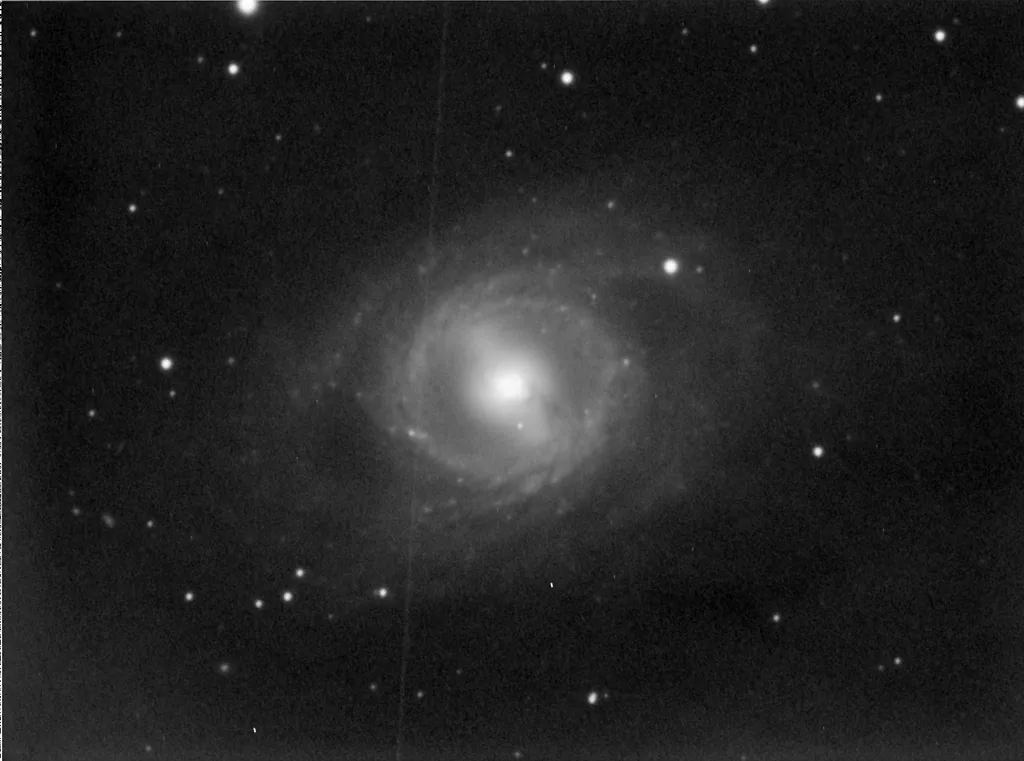
Skywatchers around the globe have jumped into action to catch a fleeting glimpse of a new star explosion, a supernova to be exact, that erupted into view recently in a nearby galaxy.
The supernova, called SN2012aw, represents the death of a massive star that collapsed in on itself and released a huge blast of radiation into space. It will be visible only for a limited time, so astrophotographers have been diligently gathering pictures while they can.
The burst occurred in the M95 galaxy, about 33 million light-years from Earth, which is relatively close, astronomically speaking. This means that though the star actually exploded about 33 million years ago, we are just seeing signs of it now.
One amateur astronomer, Óscar Martín Mesonero, captured the supernova without even planning to, while he was photographing the galaxy shining next to Mars from his location in Salamanca, Spain. [Photos: New Supernova Explodes in Galaxy M95]
Skywatcher Oscar Martín Mesonero of Salamanca, Spain, writes: " … March 18, I was doing the Messier Marathon with members of the association. One project I had in mind … was to photograph the planet Mars with several galaxies of Leo.… The surprise came this morning when I [learned] that a supernova exploded in the galaxy M95. Quickly I checked the photos of that night and ... indeed there [it] was. Unwittingly photographed a supernova of magnitude +13.5, only 2 days after its discovery."
(Image credit: Oscar Martín Mesonero)
"I heard about the supernova on 19 March," Mesonero wrote in an email to SPACE.com. "Then I remembered that two days earlier we had photographed the area of the sky during the Messier marathon we do with the association of astronomy. While everyone watched, I decided to take some photographs of the conjunction of Mars with M95 and M96. Then I reviewed the photos and there it was!"
Mesonero, who is a co-founder of the Salamanca Organization of Astronautics and Space, used a Skywatcher ED 80/600 telescope, as well as a Celestron 8-inch telescope, along with a Canon EOS 50D camera for his images.
Another observer, Efrain Morales Rivera, spotted the supernova on March 20 from Aguadilla, Puerto Rico.
Sign up for the Live Science daily newsletter now
Get the world’s most fascinating discoveries delivered straight to your inbox.
"At the time I was on the internet at my observatory and read on the possible alert of a supernova on M95," Rivera wrote in an email to SPACE.com. "I was curious and decided after some sessions on Mars to change my equipment from planetary to DSO imaging and go for the SN on M95."
Rivera caught a great view of the supernova shining in the galaxy next to a huge and glowing Mars.
And skywatcher Parijat Singh lucked out with a before-and-after picture of the galaxy showing what it looked like on March 15, in advance of the supernova, and then on March 16, when the star had exploded. The difference is a striking bright dot on the edge of one of M95's spiral arms.
Skywatcher Parijat Singh imaged galaxy M95 on the evening of March 15, 2012, a day before SN2012aw appeared (top image). The following night, March 16, he again photographed M95, showing the new supernova (bottom image). He mentions that the streaks in both images are due to satellites.
(Image credit: Parijat Singh)
The supernova isn't currently visible to the naked eye, and requires a somewhat substantial telescope to see it. However, that could change, according to observer Anthony Ayiomamitis, who photographed the blast from Athens, Greece.
"Its brightness caught me off-guard and which I later measured to be 13.32 +/- 0.004 mag," Ayiomamitis wrote to SPACE.com. "If it does continue to brighten further, it could easily become visible within a small telescope."
Some of these observers and others posted their photos on the skywatching site SpaceWeather.com.
This story was provided by SPACE.com, a sister site to LiveScience. You can follow SPACE.com assistant managing editor Clara Moskowitz on Twitter @ClaraMoskowitz. Follow SPACE.com for the latest in space science and exploration news on Twitter @Spacedotcomand on Facebook.
Clara has a bachelor's degree in astronomy and physics from Wesleyan University, and a graduate certificate in science writing from the University of California, Santa Cruz. She has written for both Space.com and Live Science.