Moon Formation Theory Challenged by New Study

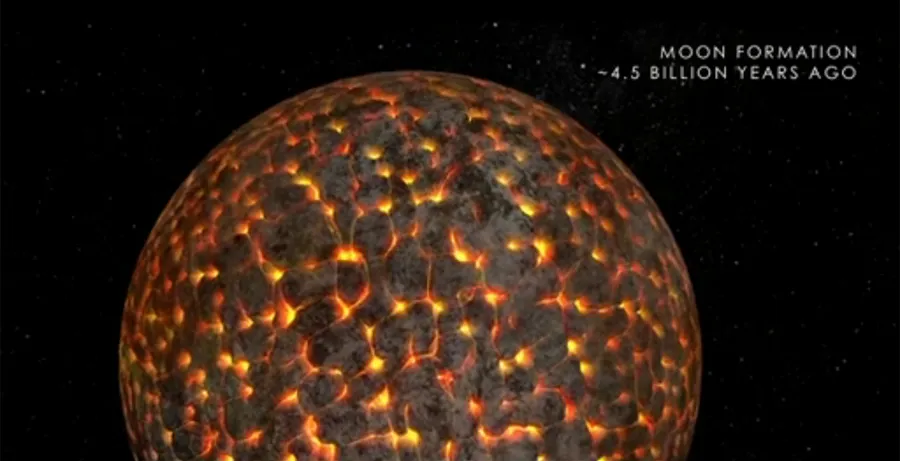
Far more of the moon may be made of material from Earth than previously thought, according to a new study that may contradict the reigning moon-formation theory.
Scientists have suggested that the moon was created when a Mars-size object named Theia collided with Earth 4.5 billion years ago, with more than 40 percent of the moon made up of debris from this impacting body. However, researchers had expected this alien world to be chemically different from Earth, and past studies have revealed that the moon and Earth appear quite similar when it comes to versions of elements called isotopes — more so than might be suggested by the current Theia model. (Isotopes of an element have differing numbers of neutrons from one another.)[Charles C1]
To compare the moon and Earth further, investigators analyzed isotopes of titanium found in moon and Earth rocks. At first, titanium isotope ratios within 24 lunar samples returned by the Apollo missions to the moon looked different from Earth's.
However, the scientists then corrected their data for isotope-ratio alterations that would result after cosmic rays from deep space collided with the moon. Cosmic rays, which are charged particles that speed through space, can generate neutrons that titanium atoms can absorb, changing their isotope type. After this adjustment, lunar titanium isotope ratios proved identical to Earth's within about 4 parts per million, said study lead author Junjun Zhang, an isotope geochemist at the Chicago Center for Cosmochemistry. [How the Moon Evolved - Video Guided Tour]
These new findings are further evidence that the moon's makeup is similar to Earth's. It seems unlikely that Theia would be nearly isotopically identical with Earth, so if Theia were a greater contributor to the moon, the moon should differ more substantially from Earth, researchers say.
On the one hand, the similarities between the moon and Earth might be explained by intense mixing of material after the moon-forming impact, leaving much of Theia's material buried within the moon. On the other hand, maybe the moon is made almost completely of Earth material that spun off from a rapidly spinning Earth after a giant impact.
Other recent studies of the moon could influence the interpretation of these lunar titanium findings. For instance, scientists recently suggested that Earth briefly had two moons, one of which collided with our current one. If so, perhaps this lost moon's isotopic composition was similar to Earth's, explaining the current moon's similarities with our planet, Zhang told SPACE.com.
Get the world’s most fascinating discoveries delivered straight to your inbox.
Other studies have also suggested the cooling rate of the moon and what the moon was like soon after formation might be different than scientists thought. This could, in turn, influence which isotopes are found on the moon's surface.
Zhang and her colleagues hope to next measure isotope ratios of other elements, such as calcium, to learn more about the history of the moon. They detailed their findings online in the March 25 edition of the journal Nature Geoscience.
This story was provided by SPACE.com, a sister site to LiveScience. Follow SPACE.com for the latest in space science and exploration news on Twitter @Spacedotcom and on Facebook.