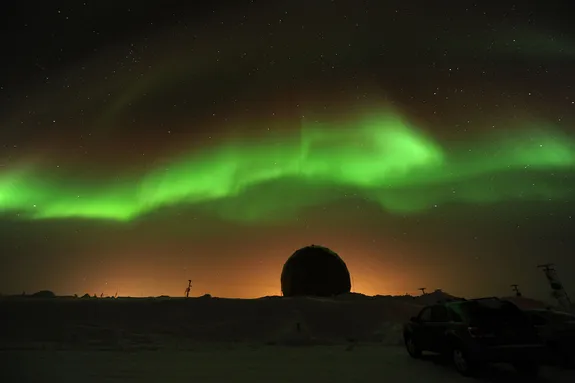
NASA space physicist James Spann took this stunning picture on March 1, 2011 from Poker Flat, Alaska, where he was attending a scientific conference to study auroras.
Skywatchers as far south as Pennsylvania should be on the lookout for auroras in the night sky sparked by a powerful geomagnetic storm, space weather experts say.
The auroras are triggered by charged solar particles that blew outward from the sun in an intense eruption on Thursday (Aug. 4). The particles are typically funneled along Earth's magnetic field to the polar regions, where they can spark stunning displays of the northern lights in the Northern Hemisphere, and southern lights in the south.
This image from the SOHO space observatory shows the M9.3 flare (fairly strong-sized) along with a coronal mass ejection (CME) as it blasted out from the sun and headed in the general direction of Earth (Aug. 4, 2011). The eruption is visible in the lower right.
(Image credit: NASA/SOHO)
"Sky watchers at all latitudes should be alert for auroras after nightfall. Tip: the best hours for aurora sightings are usually around local midnight," advised Spaceweather.com, a website that monitors space weather and skywatching events.
Scientists with NASA's Solar Dynamics Observatory (SDO) said the solar storm lasted about four hours and was expected to "likely generate bright auroras as far south as Pennsylvania and could possibly upset electronic equipment, especially in space."
Predicting the effects and time of arrival of solar flares is difficult, so while the light show is expected to reach Earth tonight (Aug. 5) it is not completely certain it will be visible so far south. Dark skies unhindered by city lights are required for skywatchers outside polar regions to view aurora displays.
The solar eruption that set off the geomagnetic storm was what astronomers call a coronal mass ejection, or CME. Several NASA space observatories, like the SDO, spotted the eruption as it occurred.
"The lopsided but fast-moving cloud of particles headed off in the general direction of Earth and may generate some aurora activity when it arrives," scientists with the Solar and Heliospheric Observatory, a joint mission by NASA and the European Space Agency, said in a statement.
Sign up for the Live Science daily newsletter now
Get the world’s most fascinating discoveries delivered straight to your inbox.
The solar storm erupted from a part of the sun called Active Region 1261 and registered as a M9.3-class solar flare. It was the third major solar flare in three days from the sun. [Video: Sun Unleashes 2 Flares in 2 Hours]
Scientists measure solar flares in three classes: Class C flares are the weakest type and have little to no impact on Earth when aimed at the planet; Class M is the mid-strength category and can spark dazzling aurora displays; Class X is the strongest type of solar flare.
When aimed directly at Earth, X-class solar flares can endanger satellites and astronauts in space, as well as affect communications, power stations and other infrastructure on the surface.
Scientists also use a scale of 1 to 9 to measure the power of a solar storm. The strength of the Aug. 4 flare registered as a K-7 on that scale, SDO scientists said.
The sun is currently in an active phase of its 11-year solar cycle, with NASA and other monitoring agencies keeping a close watch on its activity. The current sun weather cycle is known as Solar Cycle 24.
Editor's Note: If you snap a photo of the supercharged aurora this week and would like to share it with SPACE.com for a story or gallery, please send to managing editor Tariq Malik at [email protected].
This story was provided by SPACE.com, sister site to LiveScience.com. You can follow SPACE.com Managing Editor Tariq Malik on Twitter @tariqjmalik. Follow SPACE.com for the latest in space science and exploration news on Twitter @Spacedotcom and on Facebook.
Tariq is the editor-in-chief of Live Science's sister site Space.com. He joined the team in 2001 as a staff writer, and later editor, focusing on human spaceflight, exploration and space science. Before joining Space.com, Tariq was a staff reporter for The Los Angeles Times, covering education and city beats in La Habra, Fullerton and Huntington Beach. He is also an Eagle Scout (yes, he has the Space Exploration merit badge) and went to Space Camp four times. He has journalism degrees from the University of Southern California and New York University.