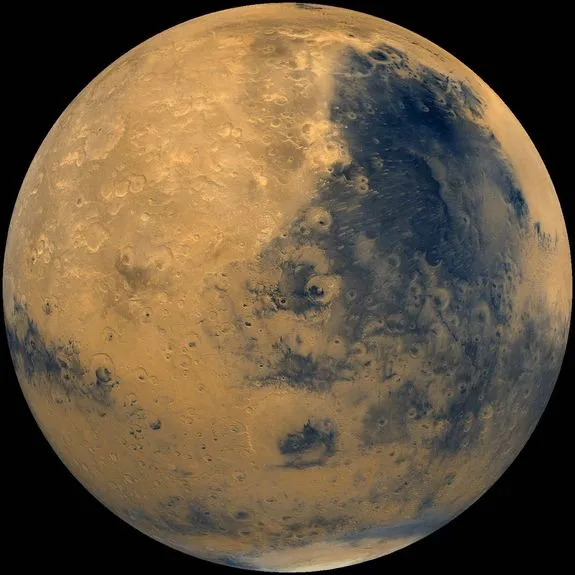
Mars apparently had a massive growth spurt when it was young, mushrooming to about half its present size in less than 2 million years, scientists say.
The rocky planets in our solar system are generally thought to have formed through titanic collisions between massive planetary embryos roughly 600 to 3,000 miles (1,000 to 5,000 kilometers) wide. For Earth, the last of the collisions apparently involved an impact with a Mars-sized protoplanet, and formed the moon 50 million to 150 million years after the birth of the solar system.
But while computer simulations of rocky planet growth work for Earth and Venus, they currently fall short when explaining the small size of Mars. [Infographic: Inside the Planet Mars]
A comparison of the sizes of planets venus (left), Earth and Mars.
(Image credit: Lunar and Planetary Institute)
Mars is born
In the new study, scientists found that Mars apparently grew very rapidly, accumulating enough dust from the protoplanetary disk that once surrounded the sun to reach half its present size in only 1.8 million years or less. [Photos of Mars from NASA Rovers]
(Image credit: Karl Tate, SPACE.com)
These findings suggest that Mars was a protoplanet that escaped merging with its siblings.
"Mars is an embryo," researcher Nicolas Dauphas, a geochemist at the University of Chicago, told SPACE.com. "When we look at that planet, we in fact look at the same material that made the Earth."
Sign up for the Live Science daily newsletter now
Get the world’s most fascinating discoveries delivered straight to your inbox.
To learn more about how the Red Planet grew, scientists analyzed data from rocks blasted off Mars by cosmic impacts that subsequently landed on Earth. These rocks are volcanic in nature, and once were magma from deep within Mars — as such, they are essentially snapshots of how the nucleus of Mars evolved over time.
The scientists detailed their findings in the May 26 issue of the journal Nature.
Martian growth spurt
The researchers examined data on specific isotopes within these Martian meteorites. Isotopes of an element all have the same number of protons in their nuclei but differing numbers of neutrons — for instance, carbon-12 has six neutrons, while carbon-13 has seven.
The unstable isotope hafnium-182 naturally decays to form the stable isotope tungsten-182, with about half a given amount of hafnium-182 decaying to tungsten-182 every 8.9 million years. By analyzing the ratios of those isotopes as well as others in the meteorites and in chondrites, the building blocks of all planetary objects, one can pinpoint how old the Martian rocks are.
In previous studies, scientists found large uncertainties in the formation history of Mars because of the unknown composition of its mantle, researchers said. The new study should help change that.
"Now we can shrink those uncertainties to the point where we can do interesting science," Dauphas said in a statement.
This story was provided by SPACE.com, sister site to LiveScience. Follow SPACE.com contributor Charles Q. Choi on Twitter @cqchoi. Visit SPACE.com for the latest in space science and exploration news on Twitter @Spacedotcom and on Facebook.
Charles Q. Choi is a contributing writer for Live Science and Space.com. He covers all things human origins and astronomy as well as physics, animals and general science topics. Charles has a Master of Arts degree from the University of Missouri-Columbia, School of Journalism and a Bachelor of Arts degree from the University of South Florida. Charles has visited every continent on Earth, drinking rancid yak butter tea in Lhasa, snorkeling with sea lions in the Galapagos and even climbing an iceberg in Antarctica.