

Whales are one of nature's most magnificent aquatic animal groups. You can read about the haunting songs of humpback whales, squid-hunting sperm whales and the largest animals on Earth, blue whales. Live Science publishes the wildest whale facts and stories, whether it's baleen whales in a record-breaking feeding frenzy, the tragedy of a blue whale's daily intake of microplastics, or a sighting of a real-life Moby Dick, so our expert writers and editors will always have compelling news, articles and features about whales for you to explore.
Discover more about whales

-
 'Like a jail door slamming': Male sperm whales' mysterious rhythmic clanging is the loudest communication sound of any animal
Researchers have studied a mysterious rhythmic clanging noise produced by male sperm whales.
whales -
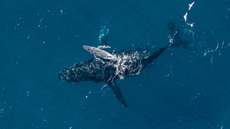 'It's incredibly rare to see a moment like this in the ocean': Camera drone captures moment humpback whale gives birth off Australian coast
A camera drone captured extraordinarily rare footage of a humpback whale giving birth off the Australian coast.
2 Commentswhales -
 'Weirdos of the sperm whale world' appear to be evolving 2 different dialects, audio recordings suggest
Thousands of recordings of sperm whale communications in the Mediterranean Sea reveal that the population might be splitting into two groups with their own dialects.
whales -
 Scientists discover 5 million-year-old whale graveyard stretching for hundreds of miles in the Indian Ocean
Researchers have discovered a "megasite" of dead whales along with new species of marine life feasting on the corpses.
3 Commentswhales -
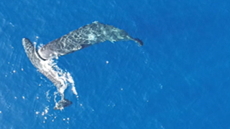 Watch sperm whale headbutt another for no apparent reason
Researchers have captured extraordinary footage of sperm whales randomly headbutting each other, confirming anecdotal reports from mariners and whalers in the 18th and 19th centuries.
whales -
 Scientists find rare tusked whale alive at sea for the first time — and shoot it with a crossbow
Researchers have identified ginkgo-toothed beaked whales alive at sea for the first time after years of searching, and in doing so solved the mystery of an odd echolocation pulse in the North Pacific.
7 Commentswhales -
 Ancient predatory whale with big eyes and razor-sharp teeth was 'deceptively cute'
Researchers have unveiled the fossils of a juvenile ancient whale that hunted off ancient Australia with large forward-facing eyes and razor-sharp teeth.
whales -
 No, blue whales aren't going silent off California. Here's why.
Reports of blue whales going silent off California don't reflect the findings of a recent study.
whales -
 Ancient whale 'graveyard' discovered under melting Russian glacier
An Arctic expedition found a collection of ancient whale remains where a rapidly retreating glacier once lay.
10 Commentswhales


