













Engineering Students Build Underwater 'Bot
This Behind the Scenes article was provided to LiveScience in partnership with the National Science Foundation.
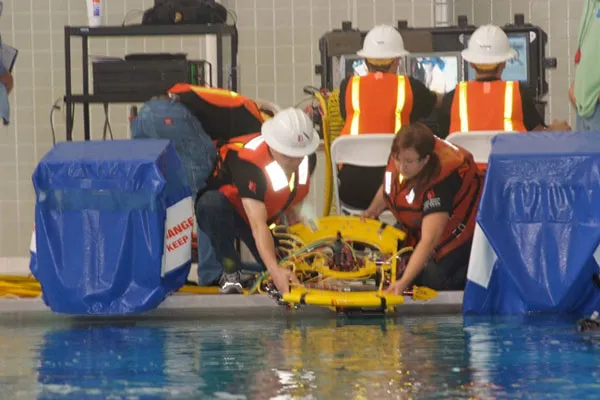
Remotely-operated vehicles, or ROVs, are underwater robots that can go where the environment is too deep or difficult for human divers. I learned how to design and build ROVs as a student in the electrical department at Long Beach City College (LBCC), where every year, students enrolled in the department's robotics class form a team that competes in the Marine Advanced Technology Education (MATE) Center's International Student ROV Competition. The MATE competition is a pool-based competition that uses props to simulate realistic underwater workplaces. The MATE Center is one of eleven Advanced Technological Education (ATE) Centers established with funding from the National Science Foundation's ATE Program. LBCC, along with student teams from all over the world, compete with ROVs that we design and build to meet contest guidelines. I've been the team's captain for the last three years. Teams compete in either the Ranger or Explorer class, depending on the sophistication of their ROVs. Our team competes in the Explorer class, which uses higher voltage in its power supply. This year, the teams were tasked with designing and building ROVs to function as submarine rescue systems. The missions included inspecting the simulated submarine for damage, delivering emergency supplies, and replenishing the onboard air supply. The mission specifications described how the simulated submarines — built out of milk crates, PVC and other everyday materials — would be constructed and positioned at the bottom of the pool. Initially, our team learned as much as we could about ROVs used in real-world submarine rescue and recovery missions so we could develop a realistic vehicle. We used CAD software to develop vehicle designs, starting out with about 10 different design ideas. We eliminated those that seemed complicated or unrealistic and tested the others. Eventually the best designs rose to the top, and the vehicle came together. Preparing for the competition is time-consuming: Our team of about 30 students logged more than 10,000 hours in and out of class working on the vehicle. I logged approximately 800 hours working on thrusters, the integrated motors and propellers that move the vehicle. All of the team members are responsible for a different aspect of building or piloting the ROV. Besides the CAD designers, the team includes aspiring electrical and mechanical engineers that build specific components, such as electronic controls, buoyancy management systems, the gripper arm that completes the mission tasks, and the underwater camera system. In addition, tether managers supervise the cables that supply the vehicle with power and a pilot operates the vehicle in the pool using a control panel and video monitors. Once our vehicle was pool-ready, our pilot had plenty of time to practice using props that we had built. When the competition was held in June at Massachusetts Maritime Academy in Buzzards Bay, Mass., we were ready.
Each team received two chances to complete the mission tasks. In addition, we had to prepare a technical report and engineering presentation to industry experts who volunteer as judges, and create a poster presentation that explained how we created our ROV. In previous competitions, we experienced many challenges, such as vehicle malfunctions, inability to complete all the mission tasks, or presentation errors. But this year was different: In the mission tasks, all of our practice time paid off and both of our mission tries were nearly perfect. We were the only team that was able to complete all of the mission tasks under the allotted time and receive bonus points. At the MATE awards ceremony, we learned that we won the overall competition for the Explorer vehicle class, and we also won the Explorer class awards for the top technical report, engineering evaluation, and poster presentation. This year, we had the right team and the right technology to finally win the competition. The best part is not what we won, but what we learned. We learned how to work as a research, development and design team. We learned how the engineering process works from start to end — how to turn napkin sketches and chalkboard drawings into a functioning vehicle in nine months. Most importantly, we learned how to function in the real-world engineering workplace. Participating in the MATE ROV competition has given us the skills and experiences that that will help us be successful members of the marine technology workforce.
- Video - Boat-'Bots for Brainiacs: LEGO Subs Launch Young Engineers
- Robot News, Images and Information
- Vote for Your Favorite Robot
Editor's Note: This research was supported by the National Science Foundation (NSF), the federal agency charged with funding basic research and education across all fields of science and engineering. See the Behind the Scenes Archive.
Get the world’s most fascinating discoveries delivered straight to your inbox.